What Works When It Comes to Book Promotion?

lbmugA new author asked me if I ever found a series of steps to take that have at least a small chance of working when it comes to book promotion.

That is a very good question, one I have been pondering for a long time. I have been doing various promos online for more than five years (I started with my blog in September 2007), and I don’t sell very many books, though my publisher assures me that ultimately I will sell many thousands of copies of each of my titles. I have come to the conclusion that promotion is what we do until luck finds us. If you don’t write erotic romances, horrifyingly violent thrillers, or vampire stories (or whatever the current fad is) that can catapult you into bestsellerdom, you will need luck to get your book discovered.  Many authors who have found success will tell you they did it on their own through hard work, but almost every time, a bit of luck played into the equation. And it’s always possible to get discovered — the media (which includes online and offline means of communication) has a fickle and roving eye, and it’s anyone’s guess where that glittering gaze will fall.

It used to be that you could do giveaways and contests to get attention, but there are tens of thousands of books being given away every day, so it’s almost as hard to give a book away now as it once was to sell it. And unless a contest somehow captures the imagination of people, they will pass on taking a chance (even if it’s a sure thing that they will win something) because they are inundated with hundreds of such promos every day.

It used to be that blogging would bring you a readership, but now blogging is so common that it is simply an expected part of being an author. Blogging can be a satisfactory and fulfilling means of writing and communicating, and it does help to create an online presence, but by itself blogging doesn’t sell books.

It used to be that MySpace was a good way to find a readership — the first authors who promoted on MySpace became instant successes, but when other authors signed up for the site by the thousands, hoping for similar results, no one paid attention to them.

It used to be that Facebook was the best place to find and connect with readers. The first authors who used Facebook to promote made a fortune. One guy became a best selling author by maxing out Facebook accounts (5000 friends is all you are allowed, so he had several accounts), and he will sell you a book telling you how he did it, but recently it came out that he also paid for reviews, so who knows what the truth of his success is. One thing I do know is that most authors are not selling tons of books via Facebook because Facebook continually changes their algorithms to keep that from happening. Where once I’d get hundreds of people seeing what I posted, I get maybe thirty now if I’m lucky. And of that thirty, maybe one or two respond. (Respond to the post, I mean.)

The first authors on Twitter, Pinterest, and all the other sites also made a name for themselves, but the rest of us? Not so much.

As for offline: authors who do book signings and festivals and such do well to a certain extent, but you have to be careful — I know several authors who sold thousands of books that way, but when it came time to figure out profits and losses, it turns out they didn’t make enough to pay for all their expenses. They’d have been better off just standing on a busy corner and giving the books away.

So, what do you do until luck comes calling? The best advice I can give you is to do three things to promote every day. It can be something as simple as signing up for Facebook if you haven’t already done so, adding a few friends if you have signed up, posting a photo on the site, or commenting on someone else’s photo. You could do a blog post on your blog or ask someone if they will let you be a guest on their blog. You can comment on the posts of other bloggers so that everyone who reads those posts will also read your words. You could sign up for Twitter, Pinterest, LinkedIn or any of the other currently popular social networking sites.

You can get bookmarks printed up with your book cover, a brief blurb, and an online address or website where people can contact you or buy your books, then pass the bookmarks out to everyone you see. You can get business cards printed up with your book cover on the front side and information on the back where they can find you and your book. You can get addicted to Vistaprint — once you are on their emailing list, you will receive sales notices, and over time you can get all sorts of great stuff such as t-shirts and mugs, stickers and posters, for free or for a nominal fee. Then give those out or offer them as incentives for people to buy your books.

You can do book signings and other events such as fairs, festivals, and craft shows. You can offer your services as a speaker.

The best promotion is one that captures people’s imaginations, so maybe one of your promos for the day could be nothing more than brainstorming with someone to come up with a totally unique idea. Or you can check out my Book Marketing Floozy blog for tips from other authors. Book Marketing Floozy is an indexed blog of sixty-five different articles by various authors about book marketing.

I don’t think it really matters what you do. Just do three things to promote your book every day.

My final suggestion — keep writing. The more books you have, the greater the chance of having sales snowball, but you also have to keep improving your craft. Just throwing out any old thing in the hopes of making it big won’t help you stand out from the crowd.

And that’s all promotion is — trying to find a way to stand out from the crowd.

***

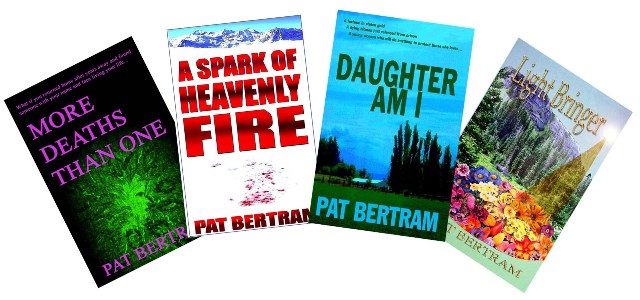
Pat Bertram is the author of the suspense novels Light Bringer, More Deaths Than One, A Spark of Heavenly Fire, and Daughter Am I. Bertram is also the author of Grief: The Great Yearning, “an exquisite book, wrenching to read, and at the same time full of profound truths.” Connect with Pat on Google+

Today I will be . . . seeing red

XI’ve been posting daily resolutions on my Facebook status as a way of focusing my attention on something positive rather than the truth. For example, if I have a hard time putting one foot in front of the other, I will write, “Today I will be . . . energetic.” Or if I know I’m going to have to rise to a challenge, such as coming to an agreement with someone who refuses to see my side of the situation, I will write, “Today I will be . . . flexible.” Or forgiving, or whatever the situation calls for.

Today I discovered a great new word: apolaustic, which means “seeking enjoyment,” and that seemed an appropriate resolution for the day since fun hasn’t been part of my life much lately.

The trouble is, I think the goblins out there got things confused, and they’ve been having a bit of enjoyment at my expense. When I opened the pantry this morning, I noticed there were two boxes of cherry Jello-O where yesterday there were three. Unless I walk in my sleep (or unless my father does, since he’s been spending most of his time sleeping lately), that box of red gelatin powder simply disappeared. (And since he doesn’t know how to make it and I don’t eat it, it couldn’t have been consumed by either of us in a wild bout of sleepeating.)

I wouldn’t have thought anything more of the missing red gelatin (well, that’s not true at all — I’ve spent hours searching for the ridiculous thing because something cannot disappear for no reason and the puzzle puzzles me) but an hour or so later, a red vehicle went missing. (No, not mine — whew! And anyway, I’m not exactly a red car sort of person, though that might be something to think about in the future as I’m trying to decide who I want to be.)

I was out walking in the desert when I saw, about a tenth of mile in front of me, a bright shiny new red pickup truck parked on a rise. I hesitated about going forward because vehicles parked in the middle of the desert take away from the enjoyment (ah! My apolaustic moment!) of my solitary walk, and besides, they make me nervous. Maybe I’ve spent too much time in my fictional community of Rubicon Ranch where my character has a penchant for finding dead bodies in the desert, or maybe I’m just careful. Either way, after the moment of hesitancy, I went forward.

I lost sight of the vehicle for a minute or two as I went around a bend, and when again I looked for the red pickup, it was gone. From where I was standing, I had a panoramic view of the desert, and no red truck was in sight though it wouldn’t have been able to drive out of sight in the brief time it was out of my view. About a quarter of a mile away, a white pickup, a much older model, was slowly making its way along a rutted desert road, but no red truck. I climbed to higher ground, and still couldn’t catch a glimpse of red, and in that stark beige world, even a touch of crimson would have been readily apparent.

So, who is stealing red from my life, and why? Are goblins or other tricksters playing games at my expense? Usually, when I get back from my walk, my cheeks are red from the cold, but today, they were barely pink. Had the goblins also taken the color from my blood? If I had pricked a finger, would I have bled blue or green?

Maybe a better status update on Facebook would have been, “Today I will be . . . seeing red.”

***

Pat Bertram is the author of the suspense novels Light Bringer, More Deaths Than One, A Spark of Heavenly Fire, and Daughter Am I. Bertram is also the author of Grief: The Great Yearning, “an exquisite book, wrenching to read, and at the same time full of profound truths.” Connect with Pat on Google+

The Dower House of Grief

floozyWhile doing a word puzzle, I came across the clue “widow,” which gave me pause since I couldn’t think of anything that means the same as widow, but then it came to me: dowager.  According to the dictionary, “Dowager” can apply to any elderly widow who behaves with dignity, though generally the word is used in historical, monarchical, and aristocratic contexts.

In previous eras, when an estate owner died and a married son took over the estates, the widow was often moved out of the principal family house and relegated to a dower house, a separate abode on the estate. If the heir wasn’t married, the dowager sometimes stayed in the main house until he got married, and then she was shunted off to the dower house, leaving the new bride as mistress of the family home.

Many of us today who have lost our mates have also been shunted off to a dower house of sorts. Without a husband or young children still living at home, we are often relegated to taking care of our elderly parents. Or, almost as frequently in these uncertain financial times, a daughter with a new baby moves in with us. This seems to be the “dower house” of grief, a way for us to still be part of the world, to still be useful, though we are no longer in our primary life of having our mates to care for and love.

Unlike the dowagers of old, the exile in our dower house of grief will come to an end, and then what? Most of us long for freedom and the resources to enjoy it. As one bereft friend says, “We need adventure and excitement and something different. A change of scenery, throwing caution to the wind or anything to get us “out of the parking lot” of our lives (which a friend claimed I’m stuck in).”

Maybe what we need is to embrace dowagerhood. Despite the definition of dowager as an elderly widow who behaves with dignity, I always had the impression of a dowager as a not-so-old, imperious and outspoken woman in outrageous hats, who sailed through life like an icebreaker, pushing ahead regardless of whatever obstacles floated in her path.

Sounds good to me. Meantime, I’ll go for a walk in the desert. That’s about the only adventure I get nowadays, and it’s better than sitting here coming up with (and mixing) metaphors for my life.

***

Pat Bertram is the author of the suspense novels Light Bringer, More Deaths Than One, A Spark of Heavenly Fire, and Daughter Am I. Bertram is also the author of Grief: The Great Yearning, “an exquisite book, wrenching to read, and at the same time full of profound truths.” Connect with Pat on Google+

What writer influenced you the most?

I’ve spent my life reading, so from a young age, “story” seeped into my conscious mind and steeped there until I began writing. In that way, all of the writers whose books I have ever read have influenced me, but if I had to pick a single author, it would be Taylor Caldwell. Caldwell told wonderful stories that showed history in the context of fiction, and I’ve tried to do the same. She also used a hundred words when a single sentence would have sufficed, and I’ve tried to do the opposite. And she overused words. In one novel, she used the word “inexorable” about a hundred times, and a couple of times I used the word in my own writings as an homage to her and a reminder to myself not to repeat unusual words. Such echoes resound in readers minds, as “inexorable” did in mine, and detract from the overall impression of the book.

Here are some responses from other authors about the writers who influenced them the most. The comments are taken from interviews posted at Pat Bertram Introduces . . .

From an interview with Rami Ungar, Author of “The Quiet Game: Five Tales To Chill Your Bones”

I’d have to say Anne Rice, Stephen King, and James Patterson. I discovered the first two when I was in junior high and high school, and they blew my mind. I knew after reading them, horror was what I wanted to focus on. I discovered James Patterson shortly before graduating high school, and I think he was the one who taught me how to write thrillers. To this day, I think of Alex Cross and James Patterson when I think about how I was able to write my thriller novel “Snake”.

From an interview with Juliet Waldron, Author of “Roan Rose”

At the moment, I’d say Cecelia Holland.

From an interview with Sherrie Hansen, Author of “Love Notes”

Maud Hart Lovelace, author of the Betsy Tacy books, set in fictional Deep Valley, Minnesota, my home state, greatly impacted my life as a young person. (Think Little House on the Prairie but set during the Victorian era.) Maud’s main character, Betsy Ray, longed to be a writer, and set the stage – really formed the expectation in my mind – that I would write a novel one day. The Betsy Tacy books are wonderful (and back in print thanks to Harper Collins). One of the guest rooms at my B&B is named “Heaven to Betsy” in honor of the tomes.

From an interview with Noah Baird, Author of Donations to Clarity

I picked up Still Life with Woodpecker by Tom Robbins when I was about 21. It was the book which really spoke to me. I’d always enjoyed reading, but it was the first book I felt like it was written to me. I loved Steinbeck, Twain, etc, but they were from another generation. Woodpecker was the literary equivalent of hearing Nirvana’s Smells Like Teen Spirit or Don McLean’s American Pie for the first time. I felt like someone else out there saw the world like I did. Christopher Moore, Tim Dorsey, and Carl Hiaasen are larger influences on me now, but Tom Robbins was the first to knock me down the rabbit hole.

What about you? What writer influenced you the most?

(If you’d like me to interview you, please check out my author questionnaire http://patbertram.wordpress.com/author-questionnaire/ and follow the instruction.)

Finding a New Life that Fits Properly and Looks Good

dancingIn a conversation with a friend about my father, who is still going strong at 96, I said, “I take after my mother, which is good because there is no way I want to live to such an advanced age, particularly since I won’t have a widowed daughter to come stay with me. It’s kind of spooky thinking of having to grow old alone.”

She said, “You never know what will happen. Maybe a new love will drop into your life. I can imagine you at some writer’s festival and a distinguished stud with salt and pepper hair and a sweet smile flirts with you. He asks for your number and the next thing the rest of us know, Pat’s out dancing and dining every Saturday night and she’s suddenly submitting romance novels for publication…”

I laughed. “I love the ‘sweet smile’ part. Who knows, with or without a stud, I might go out dancing every Saturday night. I desperately need a new life.”

She responded, “I think you need a new life too. I’m afraid you’re just wilting away. So — how do you get a new life? What do you want your new life to be?”

And that’s where the conversation stalled. How do you get a new life? It’s not as if you can go to the mall and search the aisles at Lifes ‘R’ Us until you find a new life that fits properly and looks good. (Though that does sound like an interesting concept.)

What-we-can-become is dependent on whether what-we-are is an integral part of our genetics, keeping us always “us,” or if we are infinitely mutable and can become whatever we wish to be despite our inborn proclivities. In other words, can we really get a new life or are we always “us”?

For me to go out dancing every Saturday night, I’d need a personality transplant. I’ve always been drawn to quiet activities, such as dinner and conversation that dances from one topic to another. If somehow I did overcome my natural inclination for such sedentary pursuits, where would I go dancing? I’m too old for nightclubs and too young for senior citizens groups.

Still, I will need a new life of some sort. My father will not live forever, and I will need to decide where to go and what to do. And the truth is, I haven’t a clue.

Current research by Harvard psychologist Daniel Gilbert shows that while we can see how much we have changed in the past, we never think we will change in future. (Hence that ill-advised tattoo you got when you were young and now wonder what you were thinking.) But this isn’t always true. I know how much I have changed in the past. I have a photo of me as a baby, and I can see the vast changes between me and that poor befuddled creature. I can also see how different I am today from what I was four years ago when I watched my life mate/soul mate’s slow descent into death, and I can see how different I am from what I was almost three years ago when grief catapulted me out of that shared life into a new one. I can extrapolate from those experiences of change that I will also drastically change in the future.

I always feel the same, of course. — just me. (There must be some sort of mechanism, like an internal gyroscope, that keeps us “us” no matter how we change.)

The point is that I cannot figure out now what I want my life to be when I am free to pursue that life because I don’t know who or what I will be at the time. Maybe by then, I’ll miraculously have developed grace and style, and will have become a dancing queen. Or not.

***

Pat Bertram is the author of the suspense novels Light Bringer, More Deaths Than One, A Spark of Heavenly Fire, and Daughter Am I. Bertram is also the author of Grief: The Great Yearning, “an exquisite book, wrenching to read, and at the same time full of profound truths.” Connect with Pat on Google+

Driving with “Big Brother”

grilleI just got a notice from my car insurance company telling me that if I have a 1996 or newer vehicle and have In-Drive, or a 2004 or newer vehicle equipped with OnStar, I can save big money on my insurance.

They, of all people, know that my car is much older than that, but insurance companies are not in the business of thinking, apparently, and just mindlessly stuffed the mailing envelope with whatever was within reach. Still, being one of those people who reads whatever falls into her hands, I examined the brochure. It said that if a vehicle is equipped with one of those devices, the information collected can be shared directly to the insurance company in return for a discount. That stunned me into verbosity. (Hence this bloggerie.) It seems unreal that people allow so much intrusion into their lives just to save a few dollars.

In-Drive is a device that records the number of miles a vehicle is driven, how the vehicle is driven, where the vehicle is driven. It also includes features such as automatically summoning assistance in case of emergency and receiving alerts about how a teenage dependent might be driving the vehicle.

OnStar is a service that offers emergency, security and hands-free calling services along with diagnostics reports and mileage records and other features.

Both these services seem as if they’d be helpful to drivers, but sending that information to an insurance company smacks of Big Brother. Sharing that information is optional now, but as such services become commonplace, chances are that insurances companies could compel drivers to have the information sent directly to them. (There must be a story in there somewhere. Maybe the murder of an insurance agent, and the villain needs to find a way to escape undetected? Maybe not. It sounds familiar, and anyway, Big Brother has been done to death — at least in fiction.)

If you are a safe driver (or rather, if the device decides you are a safe driver) you could potentially save 50%, but that’s only if you drive less than 500 miles a year, and even I, who drives but once or twice a week, puts on more miles than that. A more realistic mileage is about 8,500 miles per year. At that mileage, a safe driver could save 25%, while an average driver would save only 16%.

It makes me wonder how many people expect to get a “safe driver” rating only to find out they are an average or high-risk driver. (All drivers assume they are great drivers, but it only takes a few minutes on a busy road to see that most drivers overestimate their ability.)

Still, 16% could add up to a bit of a savings, but . . . (yep, there’s that “but” that always seems to show up in my blog posts) the OnStar service, for example, can cost almost $30.00 a month, which you’d have to take into consideration when figuring out your savings.

This wasn’t quite the humorous blog I intended, but truthfully, surveillance of any kind spooks me.

***

Pat Bertram is the author of the suspense novels Light Bringer, More Deaths Than One, A Spark of Heavenly Fire, and Daughter Am I. Bertram is also the author of Grief: The Great Yearning, “an exquisite book, wrenching to read, and at the same time full of profound truths.” Connect with Pat on Google+

Dreaming of a White . . . Everything

horseI hate dreaming. I hate that feeling of bizarre, unexplainable things happening, and I hate remembering my dreams because they are most often unpleasant. Even more than dreaming, I hate hearing about other people’s dreams, but . . . (you knew there’d be a “but,” didn’t you?) this blog doubles as a journal — one with a search function — and someday perhaps I might want to use last night’s dreamscape in a story, so I decided to recount it. Feel free not to continue reading. I won’t mind. Truly.

In my dream, I was walking in the desert under a clouded white sky. The sand was pure white and windswept. The desert wasn’t flat, but looked hilly like the desert I’m familiar with, and those knolls were also covered with white sand. No vegetation grew in that desert. No dark rocks relieved the expanse of white. The ground seemed hard, but still I left deep footprints in the sand as I walked. I hadn’t gone far, just about a quarter of a mile or so, and when I looked back, I could barely see my footprints, which were quickly being refilled by the white sand. With no vegetation or rocks standing out as landmarks to help me find my way, I feared getting lost, so I turned and followed my footprints back the way I came.

As I walked, three white horses sped across my path, then four white bunnies in a bunch, then one at a time, two small white squarish creatures I could not identify, and then finally, one immense white owl.

I thought, “I must be dreaming because such magical and mystical things don’t happen in real life,” but that world and my feelings of reality were so solid it didn’t feel like a dreamscape. Still, I tried to peel back the veneer of the dream and wake myself up, and when I didn’t wake, I figured it was no dream.

All the creatures passed into the whiteness of the desert except for the owl, who stood watching me. I stood, too, and looked at the work being done on a nearby fenced-in building — a small domed structure that apparently was a relic of conquistador days. Some boys had found a stash of lances and spears, and a woman was saying to the project manager, “We can let them have a couple. It won’t hurt anything.”

I laughed at that, which made my dreaming self think I really was awake since I had never heard myself laugh in dreams.

Eventually, I did awake from that dream, but into another dream where I told the man who’d been the project manager in the previous dream about the strangely solid and realistic-feeling dream I had. I woke from that dream into a third one that was muddled and nightmarish the way my dreams usually are, and then, at long last, I woke into the real world.

Or did I? Perhaps this is just another dream from which one day I will awaken.

***

Pat Bertram is the author of the suspense novels Light Bringer, More Deaths Than One, A Spark of Heavenly Fire, and Daughter Am I. Bertram is also the author of Grief: The Great Yearning, “an exquisite book, wrenching to read, and at the same time full of profound truths.” Connect with Pat on Google+

More Incendiary Photos

Yesterday I posted a couple of photos from my father’s ninety-sixth birthday party, and here are a couple more where he looks very wizardly. (The second one is actually the unretouched photo I posted for the benefit of Rami Ungar, whom I sure you know through his comments on this blog.)

In retrospect, perhaps lighting 96 candles wasn’t the smartest thing to do. One brother who didn’t make it to the party emailed me and asked if everyone behaved. I responded, “You mean except for the part where we lit 96 candles?” He replied, “No EMTs were called, so that doesn’t count.”

What does count, though is that it was an adventure. My life is too staid and going nowhere fast, so I decided to go in pursuit of 101 adventures. Until the candle incident, the number of adventures I’ve had so far this year is zilch. Zero. Nada. So, now I have only 100 more to go. (The resolve for 101 adventures wasn’t really a New Year’s resolution, though the resolution was made on New Year’s Day, because there is no way I can fit that many adventures into a single year and still look after my father.

***

Pat Bertram is the author of the suspense novels Light Bringer, More Deaths Than One, A Spark of Heavenly Fire, and Daughter Am I. Bertram is also the author of Grief: The Great Yearning, “an exquisite book, wrenching to read, and at the same time full of profound truths.” Connect with Pat on Google+

96 Candlepower — Don’t Try This Without a Fire Extinguisher Handy!

Yesterday was my father’s ninety-sixth birthday. I never had any intention of putting candles on the cake, but my brother brought four boxes of 24 birthday candles which added up to exactly 96, so it seemed a fitting sign. Besides, there didn’t seem to be very many of them when they were sitting side by side so innocuously in the boxes. Luckily (or maybe unluckily) we had fireplace matches, which are about eight inches long, otherwise those candles would never have been lit. Still, it took four people to light the candes before they burnt out.

Once the candles were lit, they became a single flame, so I never did get to see ninety-six tiny candle flames cheerfully paying homage to all those years.

As my brother said, “In retrospect, maybe this wasn’t such a good idea.” Next year, we’ll get the candles with numbers, but when my father hits 100, we’ll go for 100-candlepower, but maybe a bigger cake  . . .

***

Pat Bertram is the author of the suspense novels Light Bringer, More Deaths Than One, A Spark of Heavenly Fire, and Daughter Am I. Bertram is also the author of Grief: The Great Yearning, “an exquisite book, wrenching to read, and at the same time full of profound truths.” Connect with Pat on Google+

Who Wants to Live to Be Ninety-Six?

I don’t want to live to be ninety-six, and chances are you don’t either, so who wants to live to be ninety-six? Ninety-five year olds, that’s who!

Today is my father’s ninety-sixth birthday. He’s one of the lucky ones. He is still living in his own house with a daughter (me) helping keep him independent.

We get along well for the most part, but he doesn’t understand my sense of humor. He asked me the other day if it was normal for someone his age to sleep so much. I said, “I don’t know. Most people your age are dead.” In the long drawn-out explanation that followed (I meant only that most people don’t live to such an advanced age), any vestige of humor was lost.

A couple of my brothers will be stopping by for a small party. There will even be cake, but without the candles. Can you imagine the heat generated by 96 candles? Or how long it would take to light them? Besides, blowing them all out would probably kill my father and bring the festivities to an end. And anyway, that whole tradition of having someone blow on a cake before you eat it is unsanitary at best.

In case you’re wondering, 96 years is 35065 days.


***

Pat Bertram is the author of the suspense novels Light Bringer, More Deaths Than One, A Spark of Heavenly Fire, and Daughter Am I. Bertram is also the author of Grief: The Great Yearning, “an exquisite book, wrenching to read, and at the same time full of profound truths.” Connect with Pat on Google+