A Great Love Story

I’m working on my grief book, typing up my grief journal entries. I thought this would be a book about grief, but it seems more like a love story, which is so very ironic. Soon after I met my life mate — my soul mate — I quit my job to write. I wanted to tell the story of a great love that transcended time and physical bonds, told with wisdom and beauty. I sat down to write, and  . . . nothing. Back then, I thought all one had to do to write was to sit down, pen in hand, and let the words flow. Well the words didn’t flow. So I put off my dream of being a writer and went about the business of living. Years later, while going about the business of dying (his dying) I started writing again just to get out of my head, to get a respite from my life. I eventually learned how to write, but I always wrote slowly . . . until I started a grief journal and posthumous letters to my mate. Those flowed. And now it turns out that this grief book could be that love story I always wanted to tell. Life sure plays games with us!

Several people have told me they envied me my great love, but I’ve hesitated to tell the truth: it didn’t feel like love. We never had much of a romance. After a few brief years of hope and happiness, our love was sublimated by the constraints of his growing ill-health. It seemed that our cosmic love devolved into the prosaic things of life: cooking meals, doing errands, struggling to keep our retail business alive. And then it devolved further into simply surviving. Getting through the days as best as we could. We thought we’d stopped loving each other. We thought we were ready for the coming separation — he to death, me to life alone.

His hospice nurse, who got to know us both very well, told me she didn’t think he and I knew how much we loved each other. And apparently that was true. That mystifies me — how could we not  have known? We always knew we had a deep connection, though we never understood it and at times we both railed against it in our struggle to maintain our own identities, but we took that connection for granted. And what is that connection if not love?

In my foolish youth, I thought I’d still be able to feel his presence when he was dead, but I only feel his absence, and maybe that’s enough to remind me that love is not all hearts and flowers and passion. It is not what you feel. It is what you do. It is being there for each other. And, until the very end, we always were.


Driving My Grief

It might seem as if I am making zero progress or even backsliding with this upsurge in grief blogs, but writing my book on grief is bringing it back.

Do you want to know the sum total of all I have learned in the fourteen months and fourteen days since my life mate died? Here it is: you can get through grief. You can learn to live without him. You can find happiness again by living one day at a time. But the dead are still dead, and nothing you do can ever change that.

That is what drives my grief. Not the self-pity that sometimes breaks through my wall of courage, not the sustained note of sadness that keens beneath my consciousness, but the awareness that he is gone. He no longer cares that he suffered for years with an ailment the doctors couldn’t diagnose until it was too late. He no longer cares that he will never again watch any of his favorite movies or read a book. He no longer cares that he will never go on another road trip. He no longer cares that he will never again walk or talk or eat or smile. But I care.

Perhaps it is foolish of me still to care for and about someone who is beyond caring, but I cared immensely for him while he was alive, so why would I stop now that he is dead? He may no longer have feelings, but I do. Once he was alive and now he is not. Why shouldn’t I care about that?

There are many books on the market about how to get through grief quickly, how to get your life back on track, how to put the dead out of your head and take what you can from life. I know there is an element of self-pity when it comes to grief, and those books address that issue. But self-pity is not all there is to grief. Grief is a vast network of emotional, spiritual, and physical reactions, and part of that is sorrow on behalf of the one who died.

If grief is just about me (and perhaps someday I’ll get to the point where it is only about me), then it’s not my place to care about my life mate being gone from this earth. But if life is worth living, how can I not care that it is being denied him?

The corollary is, if he is the one who got the better end of the deal, if he truly is in a better place, then why am I still here? But I’d just as soon not dwell on that.

Surviving a New Stage of Grief

I’ve been working on my grief book, typing what I wrote immediately after the death of my soul mate. Suddenly it seems as if the past sixty-two weeks have melted into oblivion and I’m back there again, newly bereft, wandering in a fog of pain, wondering how to cope with the massive changes in my life. I know I have come a long way because the revisited pain seems bewildering to me. Did I really feel all that? Did I really survive such a terrible time? Apparently I did, because here I am, mostly back to normal. I’m still lonely, though, and the loneliness surges unbearably at times.

Loneliness is the newest stage of my grief, as it is for so many who are coming out of the first numbing months of grief. I don’t know how to cope with this vast loneliness, but I didn’t know how to cope with any of the other stages of grief, either. I just embraced the pain, the anger, the sorrow, and waited for a gentler time. So that’s what I will do with the loneliness. Embrace it and wait for it to subside. Waiting is not all I’ve been doing, though. I’ve been making an effort to be with people, which helps, and so does writing. I’d forgotten how quickly the hours go when one is immersed in words.

I still wonder if anyone will want to read this grief book when it is published. It is so intensely personal. And painful. Yet people who have read my blog posts about grief have found some comfort in them, so perhaps this book will serve the same function. Even if no one is interested in reading my daily struggles to come to terms with the death of my mate of thirty-four years, the book is important to me. It’s a way of binding my grief into a neat bundle so I can get on with my life, though I have been told one never truly gets over such a loss. But we do survive, and that is ultimately what my book is about — surviving grief.

R.U.E — Resist the Urge to Explain

There is a maxim in writing called R.U.E — Resist the Urge to Explain. Supposedly, if you show your readers the story rather than explaining it to them, it will allow readers to draw their own conclusions, thereby making readers a part of the story.

In some ways, my novel More Deaths Than One is a simple story. A man returns home after eighteen years in Southeast Asia to find the mother he buried before he left is dead again. Or rather, he finds her obituary in the morning newspaper, and when he goes to the cemetery, he sees a funeral party. He also sees someone who appears to be . . . himself. With the help of an unfulfilled and quirky waitress he meets in a coffee shop, he sets out to discover the truth.

Beneath that simple story lies the question of what makes us who we are. Is it our memories? Our experiences? Our natures?

And beneath that is the real story — a mythic tale of a man who reflects the people he meets back to themselves. This is the story I did not explain. I wanted readers to discover it for themselves, yet I’ve learned (by way of less-than-stellar reviews) that not everyone sees this story. One reviewer, who thought that the relationships were developed with too little explanation, couldn’t understand why the waitress would run off with someone she barely knew. I thought as readers got deeper into the story and noticed more of the characters seeing themselves in the hero (good guys saw good, evil guys saw evil, victims saw a fellow victim, the artistic saw the artist, the soulless saw a drone) that it would be apparent the waitress’s adventure-starved soul saw in him the fulfillment of her dreams. I guess not.

It’s too late to rewrite the story, and even if I could, I wouldn’t. But . . . here’s the question: should I have explained more? Should I have resisted the urge to resist the urge to explain?

I Am a Fourteen-Month Grief Survivor

Fourteen months sounds like a long time, doesn’t it? Plenty of time to get over the death of one’s lifemate/soulmate/best friend. And yet, those who have been where I am today know you don’t ever truly get over it. You deal with it, you get on with your life, but there is always that niggling feeling of something being not quite right.

I still feel bad for him that he’s gone, that he suffered so much, that he died too young, that he is no longer here to enjoy something as simple as eating a bowl of his chili. (Though the batch I made today in his honor wasn’t worth coming back from the dead for. The kidney beans were overcooked, the onions undercooked.)

I still feel sad for me, that I’ll never get to see him again in this lifetime, that we’ll never get to do all the things we planned, that his smile exists only in my memory, that I’m alone. I’m glad we had all those years together, but that doesn’t ease the loneliness he left behind. It is odd, but for some reason I never expected to be lonely. I’m used to spending time alone, I know how to entertain myself, and I’m quite capable of taking care of myself (though the thought of growing old alone makes me panic at times). I also have more friends now than I’ve had in many years. But still, I’m lonely — lonely for him specifically, and lonely in general. Perhaps my loneliness is another stage of grief rather than a character flaw. Perhaps someday it, too, will pass, as have other manifestations of my grief.

One stage of grief I am clinging to is anger. Not rage, just a quiet pilot light of anger. I accept that he is dead in the sense that I know he will never be coming back (though I still long desperately to go home to him, still yearn to see him one more time). But I cannot accept the rightness of his death. It seems so terribly wrong that death was the only resolution of his illness, the only solution to his pain. And that does anger me. Anger is generally considered to be a negative emotion, but during the past few months I’ve found that in small doses, anger is a positive thing. Anger can give us the strength to survive. Anger can give us the energy to do things we couldn’t do under normal circumstances. Anger can give us a feeling of control in uncertain times. Anger can keep us going when we want to give up. Anger can give us the courage to live with the injustice of death. Anger can motivate us to find solutions to problems, can motivate us to undertake dreaded tasks, can motivate us to change our lives. So, yes, I’m clinging to whatever vestige of anger I can. It’s the only way I can get through these lonely days.

I am now more aware of the years looming in front of me than the years behind me, those years we shared. I’ve been saying that I don’t know who I am now that he’s gone, but I do — I’m still me. Still the person I’ve always been, just older and sadder. I’ve mostly untwinned our lives, no longer see me as half of a couple. And yet, something is missing. I don’t cry much any more, but sometimes I find myself crying for . . . I don’t know what.

It’s a relief to be telling the truth. I’ve been keeping upbeat the past few weeks — preparing for my presentation at the writers’ conference, traveling, being around people who only know me as an author, posting photos of my adventures. It was wonderful, but it’s only half my story. The adventure ended, and now here I here I am. Fourteen months of missing him, and still counting.

Stellar Review for Light Bringer

I got an email from Aaron Lazar this morning. If you don’t know Aaron, you should. He is a fine writer and a contributor to the Murder by Four Blog. He was one of the first to buy one of my books, one of the first people I kept awake at night finishing my book, one of the first (if not the first) who dreamed of my characters!! And now he has joined the club of those who have read (and loved) all of my books. I’m sure he won’t mind if I share his email with you:

Pat, Here’s the mini-review for Light Bringer. Dang, that was one FINE read!

***

I’m already a fan of Pat Bertram’s books. I’ve read them all and loved them deeply. But LIGHT BRINGER was something completely new and surprising… surprising in its freshness, originality, its genre bending brilliance. Part thriller, part fantasy, part sci fi, part mystery…its plots were large and complex, encompassing themes that plague us every day; offering social and world commentary blended with weather trend observations (where ARE all those tornadoes and tsunamis coming from??) I do believe Bertram has defined a new genre, and it is a pure delight. Fresh. Original. Riveting. The characters are real and engaging. I particularly enjoyed the bit of romance between Luke and Jane – yes, another subplot. I couldn’t put it down and extend my highest compliments to Ms. Bertram for her supremely smooth writing – there are no hiccups in this book.

Very highly recommended. — Aaron Paul Lazar, author of the LeGarde Mysteries, The Moore Mysteries, and the Tall Pines Mysteries

***

Immersing Myself in Southern/Island Culture

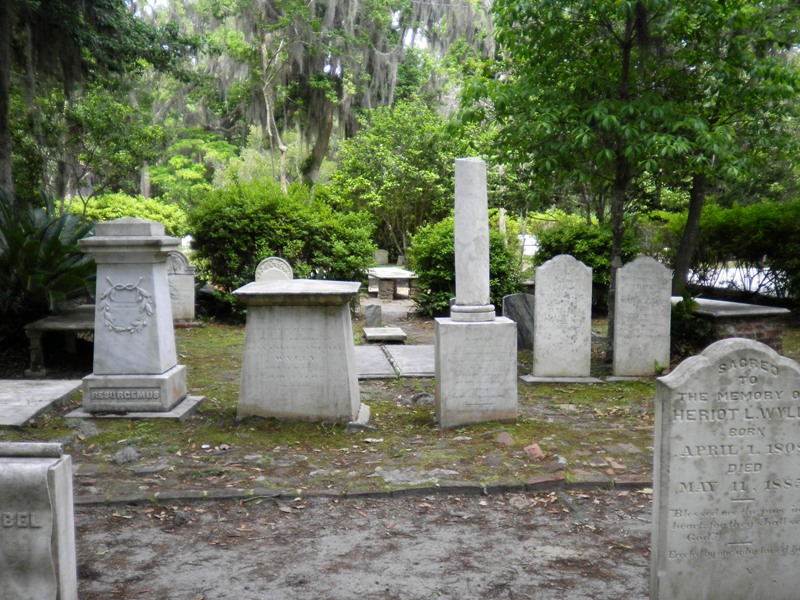
My visit to St. Simons Island, GA to speak at the Scribbler’s Retreat Writers’ Conference was my first trip to the south, and I made sure that I immersed myself in the culture (at least as much as one can in a few days). I walked on the beach, climbed the lighthouse, toured a Civil War era cemetery, strolled among live oaks dripping with Spanish moss (which is neither Spanish nor moss but a member of the pineapple family). And ate. She-crap soup. Crab cakes. Shrimp and grits. Red beans and rice. Key lime pie. Fried oysters. Fried green tomatoes. Fried dill pickles. Vidalia onion pie. I was disappointed in the fried green tomatoes and the beans and rice. Both dishes were seasoned heavily with rosemary, which is my least favorite herb. And I was disappointed not to find such haute cousine as fried Twinkies, but I’m sure my stomach thanks me for the oversight.

I also met a woman I considered to be a quintessential fading southern belle. She was still beautiful despite being past her first youth, and hospitable (she took me on a tour of the island on Sunday in the hours between hotel check-out and my flight home). She was also charming, sweet,  and  . . .  from Maine. Just shows one should not assume anything.

Several of my meals were eaten in the company of fellow speakers Phillip Margolin, Chuck Barrett, and Jane Wood, (and Chuck’s delightful wife who taught me that “the store is always open,” meaning that authors always need to be ready to promote themselves. Maybe I’ll even heed her words and carry my bookmarks with me!)

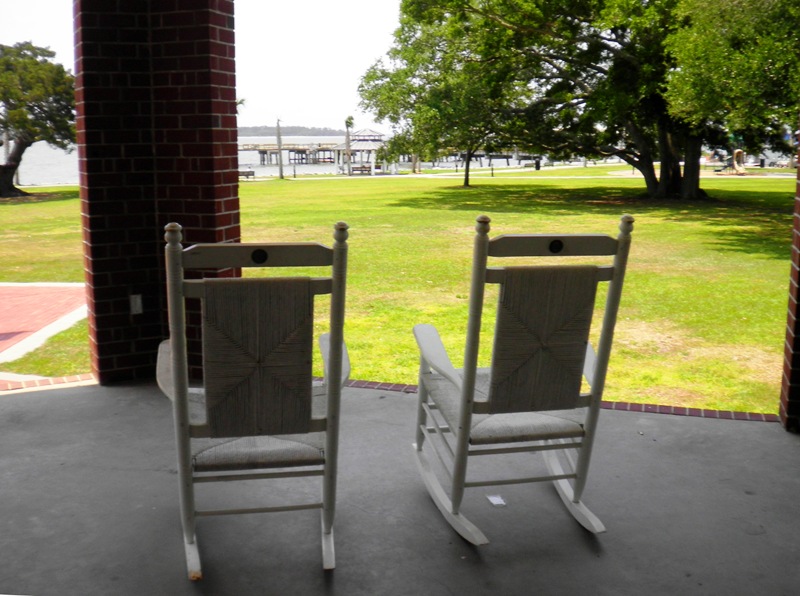
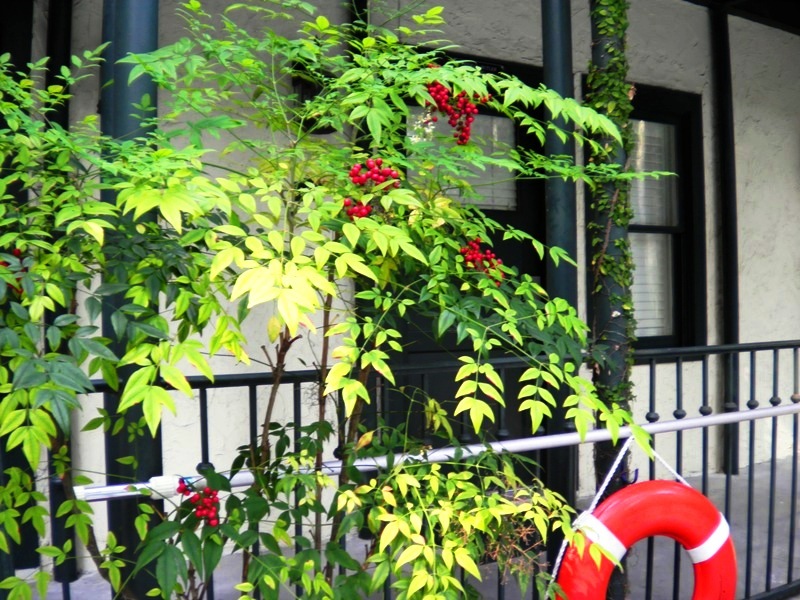
I’m still trying to collect the photos that people took of me, but until then, you’ll have to be satisfied with photos I took.

The Hotel where I spent Wednesday and Thursday night

My room at the Village Inn

Atlantic Ocean

Pier at St. Simons Island

Civil War Cemetery

Southern Gothic

Fried Green Tomatoes, Fried Oysters, Vidalia Onion Pie, Fried Dill Pickles

St. Simons Island Lighthouse

I mentioned in my previous post that I went visited the lighthouse on St. Simons Island instead of working on my presentation for the Scribblers Retreat Writers’ Conference, and it was time well spent. How often does one get to roam around a lighthouse unsupervised? Luckily there was a handrail, because 129 narrow steps is a long climb!

Lighthouse at St. Simons Island, GA

Lighthouse tower entrance

View from the top of the lighthouse -- Jekyll Island and the Atlantic Ocean

One foot forward -- Beginning the dizzying descent.

Dazzling the Audience

When I was invited to speak at the Scribbler’s Retreat Writers’ Conference in St.Simons Island, I accepted, though I hadn’t a clue how to give a speech. The last time I stood in front of a group to give a formal talk was during a speech class freshman year in high school. We were supposed to give a demonstration speech, I remember, and I decided to be clever. So, when my scheduled day came, I stood in front of the class and announced I was the representative of the Emperor’s New Clothes Manufacturing Company. I held up one invisible garment after another and proceeded to describe every style, every fabric, every frill. When I finished, the teacher frowned at me and said, “Your speech was very good, but it would have been better if you had used real clothes.”

Just goes to show you, one shouldn’t try to be too clever. And I took that to heart when I wrote my speech on “Creating Incredible, but Credible, Characters” for Scribbler’s Retreat. It was simple, more of an introduction to the art of creating characters than a full-blown exposition. I wanted to spend most of my hour showing them how to create great characters, not telling them, so I prepared a character questionnaire to help them delve deeper into the social, physical, and psychological aspects of their character. My plan was to have them create a character as a group so they could see how conflicts, plot, and subplots grow along with a character.

I didn’t have time to practice my speech before I left, so I figured I’d do it on the plane. Yeah, right. It had been so many years since I’d flown that I didn’t realize how impossible it was to do anything on a flight except get through the hours. When my idea of studying my speech on the plane didn’t work out, I figured I could do it once I got to St. Simons. That would have been a good idea except for . . . Did I mention this was a resort area? Right on the ocean? In the south? I went for a walk on the beach, and happened upon a trolley leaving for a tour of the island. I hopped aboard and was entertained with tales (and some tall tales) of the island’s history. When we returned, I was still in tourist mode, so I went to the lighthouse, and walked up all 129 steps to the top. And so the time went.

Despite not studying my speech, I wasn’t nervous. Until . . .

I’d met fellow speaker Chuck Barrett, author of The Savannah Project, so I particularly wanted to hear his speech, which came right before mine. He talked about point of view, a difficult topic that he handled well, and at the end, everyone applauded. All of a sudden, it occurred to me that people would applaud at the end of my speech, and that thought panicked me. So I went to the front of the group, thanked the woman who introduced me, and froze. Just for a second. Then I remembered that this was my party, and I could do what I wanted, so I smiled, told the story about my Emperor’s New Clothes Speech, and sailed right through the rest of my talk. I think I might have stammered a few times, but people were kind. Then, when we got to the questionnaire, I dazzled!!

Well, it was more that the audience dazzled me. When they caught on to what we were doing, their eyes lit up, and I knew I had them. Many people contributed to our character — a beautiful 27-year-old woman of French descent and a shady past. A certain fellow in her life wanted her to make them a fortune as a stripper, but she was resisting him. She wanted a simpler life, the life of a writer. She had a best friend, who loved her, and a sister who hated her. And she had a daughter she’d given up for adoption when she was sixteen.

We could all see this woman, as if she were a part of the group. Afterward, several people told me that I helped them see how to overcome problems they were having with their own characters, which is exactly what I’d hoped for. Oddly, I can’t remember the applause. I only remember looking at each of the participants and thanking them for making the experience so wonderful.

Leaving on a Jet Plane

My bags are packed, I’m ready to go, but I have a few minutes before I have to start donning my traveling togs, so I thought I’d say good-bye. Unlike Mary Travers, I do know when I’ll be back again — late Sunday night. I’m going to take notes and photos to show you, but most of all, despite 100% humidity (yikes!!), I’m going to have fun. It’s been so long since I’ve had fun, I’m not even sure what the word means any more, but I intend to find out.

I had an interesting revelation today, and oddly, it wasn’t even my revelation. I showed the preparations for my Scribbler’s Retreat Writer’s Conference presentation to a couple of people at different times the past two days. One said, “You have enough here for a book.” The other said, “This would make a good book.” And it would. I’m surprised I didn’t think of it, but sometimes we’re too close to things to see the truth. So, I haven’t even left for my conference, and I already have what I hoped to gain from it — a new direction and the confidence to go where it takes me.

Knowing I have something to do after my grief book is published will give me the impetus to type and edit the writings from my year of grief. My first year of grief. I’m still not over it, though I am healing every day. And perhaps I’ve outlived my stay at my grief support group. One woman brought a poem to read today, purportedly from our loved ones on the other side. At the end, everyone was wiping away tears but me. I was horrified by one of the lines: “everyday is the same here.” When I mentioned my horror, it sort of broke the mood. Ah, well. I’m mostly there for the hugs and to help the newly bereft however I can. They (whoever “they” is) say that grief brings strange blessings, and mine appears to be the ability to put into words what others are thinking.

The past few days have been so busy, I’m looking forward to doing nothing but sitting back and letting the plane take me where it wills. And even the five hour layover in Atlanta is even looking good. I was on top of the situation the whole time until Facebook decided to archive my old groups unless I acted immediately, so I couldn’t wait till I get back.

I have a favor to ask. If you belong to one of my facebook groups, and if you have time, will you go to the group, scroll down the wall (and click “older posts” when you get to the botttom of the page), look for discussion threads and make a comment? That brings the discussions to the top of the group page, and is a way of keeping them from getting lost. I’ll do it when I get back, of course, but any help will be appreciated.

My facebook groups: Suspense/Thriller Writers, Genre Book Club, and Second Wind Publishing.

I already did Help Support Independent Publishers,, but feel free to stop by and comment in a discussion anyway, especially the one where we are posting the first sentences of our books.

My ride is here. Gotta go!