Is Hate a Stage of Grief?

Is hate a stage of grief? If not, it should be. I don’t see how one can avoid it.

I’ve proved, to myself at least, that I can live without my life mate. It’s been twenty-eight weeks since he died, and in that time I’ve managed to get rid of his clothes and his car, clean out the accumulation of decades, move 1000 miles from our home, walk at least that many miles, eat, drink a lot of water, sleep (after a fashion), make new friends (mostly people who have also lost their mates, which gives us an instant bond of understanding). I smile now, and laugh. I can even look forward to the immediate future: I’ve planned an excursion (going to an art museum to see Mesoamerican antiquities, including an Olmec head) and I’m thinking about doing NaNoWriMo (something I said I would never do, but I need to kick start my writing after all the kicks life has given me lately). The point is, despite my grief, despite the oceans of tears I’ve shed and continue to shed, I have done these things. I can live without him. But I hate that I have to.

I’m coming to an acceptance of his death, though I’m not sure I understand it. (Don’t much understand life, either, but that’s a topic for another day.) I know I will never see him again in this life, and I hate it. I hate that I will never go back home to him. I hate that I will never talk to him again. I hate that I will never see his slow sweet smile again.

I hate that he will never watch another movie. I hate that he will never plant another tree and watch it grow. I hate that he will never have another cat. I hate that he will never read another book. I hate that he will never listen to his music tapes again. I hate that he will never start another business. I hate that he will never play another game of baseball, or smell another flower, or swim in another lake. I hate that so many of his dreams are going unfilfulled.

Most of all, I hate that he is dead.

I am thankful that I had him in my life for as long as I did, but I hate that his years were cut short. I know I should be glad that he isn’t suffering any more, and I am. But I hate that he had to suffer in the first place.

This stage will pass as have all the other stages of grief I’ve lived through. I might even find happiness again, but he will still be gone. And I hate that.


Introvert or Extravert?

I don’t like the words introvert and extrovert. The common definition of an introvert is a painfully shy person or someone who thinks only of him/herself, while an extrovert is an outgoing, sociable person with interests outside him/herself. In our society, which rewards the gregarious, being an introvert seems to put one at a disadvantage. Introverts, however, are not always shy, and apparent extroverts can be uncomfortable in crowds. And introverts are no more self-centered than extroverts.

According to Laurie Helgoe, author of Revenge of the Introverts published in Psychology Today, “It’s often possible to spot introverts by their conversational style. They’re the ones doing the listening. Extraverts are more likely to pepper people with questions. Introverts like to think before responding—many prefer to think out what they want to say in advance—and seek facts before expressing opinions. Extraverts are comfortable thinking as they speak. Introverts prefer slow-paced interactions that allow room for thought. Brainstorming does not work for them. Email does.”

Colin DeYoung, assistant professor of psychology at the University of Minnesota, says that introverts do best in quiet conditions and extraverts do better with more noise.

So being an introvert is neither a disadvantage nor an advantage, simply a different way of processing information. Which could provide an answer to a conundrum I’ve been considering for some time now: why some authors can effortlessly flood a page with words, and others struggle to find a few words.

All the books about how to write say not to edit as you go, but to let the words gush out of you, to write the first draft as quickly as possible. As much as I like the idea of letting the words flow and seeing what transpires, nothing shows up on the page unless I sit and ponder. So, even though few writing coaches admit it (and why would they? They are probably all extroverts) there are different approaches to writing: extrovert and introvert.

A writing extrovert would be someone who can write anywhere — on a bus, in a crowded room, in a coffee shop. Even when alone, they like to write accompanied by sound, either music or the television. And no matter what, the words gush forth as fast or faster than fingers can type.

A writing introvert would be someone who can only write when alone and in absolute silence. The words come slowly to these authors. Once involved in a scene, however, these writers get into the flow of writing, and the words can come more quickly, though still slowly in comparison to the writing extroverts. And, though they are gradually shifting to computers, their preferred method of writing is by hand so they can get the best mind/hand connection.

Of course, few people inhabit the extremes of this writing spectrum — most authors find themselves somewhere in the middle.

It’s apparent what kind of writer I am — an extreme introvert. I need the quiet so I can find the few words that bobble to the tip of my mind. What kind of writer are you?

I Am a Six-Month Grief Survivor

Six months ago my life mate — my soul mate — died of kidney cancer, and my life changed forever. I survived the first excruciating weeks, and now I am learning to live with his absence and finding ways of going on by myself, but it’s lonely. So few people know how to act around the bereft, and they end up offering us maxims that bring no comfort because the adages are simply not true.

People tell us that time heals. Time does not heal. We heal. Grief helps us heal. Time does nothing. Time doesn’t even pass — we pass through time like persons passing through an endless desert.

People tell us that we’ll get over our loss, but when you have suffered a soul-quaking loss, you never totally get over it. Nor do you want to. Getting over it seems like a betrayal, a negation of the life you shared. The best you can do is eventually accept the person’s absence as a part of your life.

People tell us to on with life. They don’t understand that this is our life. Grief is how we get on with it.

Grief is not the problem. The problem is that our loved one died. Grief is the way we deal with that loss, the way we process it, the way we heal the wound of amputation. By experiencing the pain, by allowing ourselves to feel the loss, we honor our loved one and our relationship, and gradually we move through the pain to . . . to what? I’m not sure what lies on the other side of grief. I’ve passed the worst of the pain but not yet arrived at a new way of living.

During these past six months, I’ve been inundated with information about how to deal with grief. I purposely refrained from reading the material, which is strange for me — I’ve always been one who researches everything — but I didn’t want to know the accepted way to grieve. I wanted to experience my own grief without the current fad getting in the way. It used to be that grief was a regimented experience — one wore black and mourned for a year. More recently, the “stages of grief’ became the accepted way of grieving, though now there are various new ways of thinking about grief. The truth is, grief is personal, and except for the extremes of not allowing oneself to feel anything and trying to find ways of dying so you can join your loved one, however you grieve, that is the right way to grieve.

Grief makes even friends and family uncomfortable, so eventually the bereft learn to hide what they feel. They stop talking about their loved one, but they never forget.

I will never forget.

He will always live in my memory.

Is Twenty-Five Weeks a Long Time or a Little Time?

Is twenty-five weeks a long time or a little time? I haven’t a clue. All I know is that twenty-five weeks ago my life mate — my soul mate — died of inoperable kidney cancer, and I am still learning to deal with his absence. Sometimes it seems as if he’s been gone forever, and other times it feels as if he just left, as if I should be able to reach out, hold him in my arms, and keep him safe. Strange, that — I couldn’t stop his dying when he was living it. I certainly can’t stop it now that he is gone.

When I was a child, twenty-five weeks seemed a lifetime, especially if I was counting down to Christmas or summer vacation. When the weight of age began settling on my shoulders, twenty-five weeks went by in a flash. Or at least they used to. Now weeks stop and go, dam and flow, and I no longer have a concept of time, perhaps because the passing weeks are not relative to anything but his death and my loss.

Even the future seems long and short by turns. I think of growing old by myself, of learning to live with the limitations aging will bring, and ultimately of dying alone, and the coming years seem long. Yet those same years will still be full of life, maybe even happiness, which will make them feel short.

I do know that twenty-five weeks is a long time when it comes to feeling lost, alone, and confused by this major change — both his and mine. (I am very confused by his death. I worry about him still, feel sad for what he is missing, glad he is beyond pain.) At the same time, twenty-five weeks is way too short to even begin to process all that this experience means and will mean.

So, is twenty-five weeks a long time or a little time? I haven’t a clue.

Recording Your Character’s Voice by Aaron Paul Lazar

Please welcome my guest, Aaron Paul Lazar, author of the LeGarde mysteries and  Healey’s Cave, the first book in the Moore paranormal mysteries. Lazar says:

I’m wondering if every author needs to take voice-over training. Especially if they want to record their works in audio formats. 

Readers like hearing the author read. Right? They know that only the author really understands the nuances of each sentence, the way it was supposed to be said aloud. I do believe this, and wish I could download books read by Dean Koontz himself, or that John D. MacDonald could come down from Heaven for a while to record his Travis MacGee series for us. Wouldn’t that be cool? 

When you’re reading from your own character’s point of view, you really have to get inside his head. You have to feel his pain, suffer his humiliations, and share in his joy. 

Could you do that? If so, it’s a good sign that you really know your characters.

And what do you do if your character is of the opposite sex? I guess unless you’re a woman with a very deep voice, or a man who does a reasonable falsetto, you’ve got to find someone who fits that mold, a friend who can sound like your character and really get inside his or her brain. 

Would you like to get to know a character, even before you read his book?

Well, I never took acting lessons, but I sat in the back of the auditorium while my daughter performed in fifteen musicals and plays. Maybe a little of the training rubbed off on me. I don’t know. 

Regardless, I figured it was a good idea to help create a little buzz for my debut book in my new green marble series by writing a letter from Sam Moore to his future readers. Would you like to hear it? See what you think and please let me know, below. 

Sam Moore’s most intimate and tortured thoughts are in this video. It’s not really a normal video, but the only way to get audio on YouTube or other sites is to put a jpeg image behind it and save it as a movie file. ;o) Took me all day to figure that out – shows you how bright I am. And I didn’t want to make it into a book trailer, for Heaven’s sake. I already have one of those!

Sam Moore is a retired country doctor in the new paranormal mystery series, Moore Mysteries. The first book just came out via Twilight Times Books, and you can read the first few chapters here: Healey’s Cave .

***

Aaron Paul Lazar writes to soothe his soul. The author of LeGarde Mysteries and Moore Mysteries enjoys the Genesee Valley countryside in upstate New York, where his characters embrace life, play with their dogs and grandkids, grow sumptuous gardens, and chase bad guys. Visit his websites at www.legardemysteries.com and www.mooremysteries.com and watch for his upcoming release, FIRESONG, coming Winter, 2010.


The Healing Power of Stories

I attend a bereavement group every week, which surprises me, considering that I’ve always been a do-it-yourself sort. I only started going to the meetings because I wanted to know how to survive the terrible agony of grief I experienced after the loss of my mate. I didn’t learn how — it’s something no one can teach another — but I learned that one could survive those first unbelievably painful weeks when I met people who had survived them. I keep going to the group because of those same people. We have something in common, a shared understanding, a survivor’s respect. And now, after five months, I am one of those who, just by being there, show the newly shell-shocked bereaved that one can learn to live with the devastation of a major loss.

Each meeting begins with a lesson, and today’s lesson was about the importance of stories and how they help us heal. The people who attended the meeting today all happened to be women who had lost their mates after decades of being together, and the counselor asked each of us to tell the story not of our mates’ deaths, but of how we met. We all knew the end of each of our love stories — over the months we have told the story of our grief many times. But this is the first time we talked about the beginning of our love stories, and in those stories we found hope, comfort, smiles, a reconnection to our past.

According to the handout we were given, the benefits of telling stories are:

  • Searching for wholeness among our fractured parts
  • Coming to know who we are in new and unexpected ways
  • We can explore our past and come to a more profound understanding of our future direction
  • We can seek forgiveness and be humbled by our own mortality
  • We can discover the route to healing lies not only in the physical realm, but also in the emotional and spiritual realms.

An unexpected result of today’s lesson was a new understanding of the importance of writing. For me, anyway.

These past months, I’ve spent a lot of time reading. I have always tried to lose myself — and find myself — in fictional worlds during periods of trauma, but this time it’s not working the way I hoped. I’m not finding healing in current books. The authors seem to be going for the shock effect of not-so-good versus unbelievably-outrageous-evil, for story people who have identifiable characteristics but no character, for fast-paced stories with little substance or truth. How does one find wholeness in such stories? How do we come to know each other or come to a more profound understanding of our future in trite mysteries and unrealistic thrillers?

Perhaps it’s not important. Maybe entertainment is all that counts when it comes to fiction, but I want something more. And I especially want something more when it comes to my own writing. I don’t know where grief is taking me — it is changing me in ways I cannot yet fathom — but I hope I will end up writing stories of truth, of understanding, of healing. I hope I will make people smile. I hope my words will matter.

Snake in the Grass

I bet you thought the title was a reference to a metaphor, didn’t you? Well  . . .

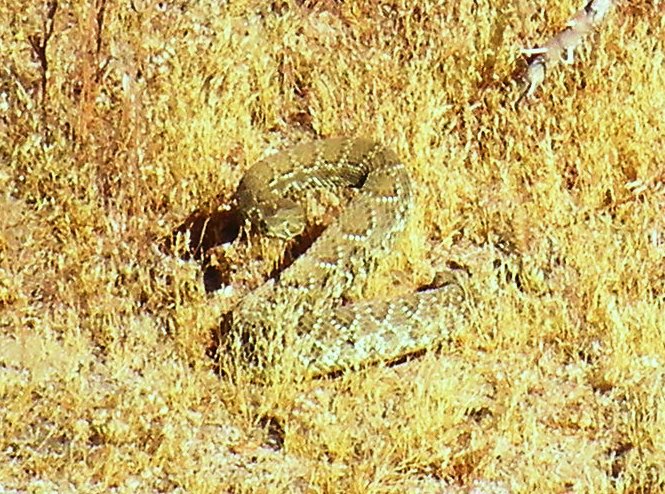
I encountered my first Mojave green rattler while I was out walking in the desert today. I didn’t even notice it — I was walking down the middle of a sandy path, minding my own business, when a hiss and a rattle startled me.  I looked around and there was this beauty lying in the grass beneath a creosote bush. I moved ten feet away, then stopped and took a couple of photos. Apparently it didn’t like having its picture taken, because as I was aiming for the third, it raised it’s head and rattled at me again. I took the hint and left. Every time I think about this encounter, I smile. I don’t know why it makes me feel good, perhaps because I finally encountered the real desert. I also got to find out what I always suspected: I am not afraid of snakes, just healthily wary. 

The Mojave green rattlesnake will not attack, but if disturbed or cornered, they will defend themselves. Apparently, bites occur if people accidentally step on a snake or purposely harass it, so if people are careful, they can keep from being bit. Generally, if bit, a person has time to walk out of the desert, since the effects don’t always take place immediately, and only 5% of the bites are fatal.  Supposedly, the only cure for the bite is antivenin at a cost of $18,000 per treatment. Now that’s scary! (But it can’t be right, can it? Seems excessive.)

Sucker Punched by Grief

After the first excruciating months, dealing with a major loss is like being in the ring with an ever-weakening opponent. The feeble jabs inflict little pain, and you start feeling as if you can go the distance. Gradually, as the blows come further and further apart, you let down your guard. You even welcome the blows that do land, because they remind you why you are fighting. Then . . .

Wham!

Out of nowhere comes the knockout punch.

My knockout punch came after a restless night. I finally fell asleep in the early morning hours, and I dreamt.

I dreamed that my life mate was dead, but I woke to find him alive and getting well. It was wonderful seeing him doing so much better, and a quiet joy seeped over me.

I started to wake. In the seconds before full consciousness hit, I continued to feel the joy of knowing he still lived. Then . . .

Wham!

The truth hit me. I couldn’t breathe, couldn’t move. Then, like an aftershock, came the raw pain, the heartbreak of losing him . . . again.

I’d only dreamt about him once before, and that was at the beginning when my defenses were still in place. In that first dream, I told him I thought he’d died, but deep down I knew the truth, and there was no shock when I awoke, just a feeling of gladness that I got to see him once more. But this time, I had let down my guard. I even felt a bit smug that I was getting a grip on my grief so early in the process, and so the dream caught me unaware. In the depths of my being, I believed that he hadn’t died.

I cried on and off for two or three days (I lost count; grief tends to override time) but now I’ve regained my equilibrium — at least until the next time.

A friend who counsels the bereft told me, “In my experience with grief, a healthy person, such as yourself, is going to grieve in a gradually diminishing way for two years.”

Two years??!!

If so, I have a very long way to go. I’d planned to stop blogging about grief. I don’t want people to think I am eliciting sympathy, nor do I want to seem pathetic, grieving long after the non-bereft think I should be done with it. But if I’m going to have bouts of pain for many months to come, I might as well share them and let others take whatever comfort they can from my learning experiences.

This episode with the dream taught me to be patient with myself. I’ve been thinking that I’m mostly healed, and I’ve been feeling like a slacker, just taking life a moment at a time, not doing anything to prepare for the rest of my life, not doing much of anything but reading, walking, writing a little (a very little), taking photographs, and going through my mate’s collection of movies. Now that I know the power of the sucker punch, and how easily it can gain the upper hand, I understand this simple life is all I can expect of me right now. And perhaps that’s the way it’s supposed to be.

I Am a Five-Month Grief Survivor

Five months ago, my life mate died . . . and I am surviving. I had not expected to grieve much — he had suffered a long time, and his death was hard-won — but still, those first endless weeks were difficult. The delineation between “us together” and “me alone” was so abrupt, so stark, so uncompromising that I had a hard time fathoming it. I finally went to a grief support group to find out how one survives such pain. I never did find out, but I discovered that one can survive the trauma, which helped, as did talking about my experience and listening to what others had to say. Grief is so isolating that it’s nice not to feel alone.

What helped most of all, though, was simply living. During the past five months, I have read dozens of books, walked hundreds of miles, written thousands of words, taken I-don’t-know-how-many photos, met many people both online and offline. All of those experiences have helped create memories, memories of a life without him, and those memories have softened the threshold between “us together” and “me alone.” I still have times of great sadness, still have that falling-elevator feeling when I remember I will never see him again, still miss him (probably always will), but for the most part I am doing okay.

I’ve abandoned my mental crutches — I no longer write a letter to him every day, don’t talk to him very often, don’t feel a need to scream. I am thinking more of the future, which signifies hope and getting on with my life, but such thoughts also bring moments of panic when I think of having to grow old alone. Mostly, I try to live in the moment and take each day as it comes.

One big trauma this past month was when I finally accepted in my depths that I will never see him again in this life. I knew that from the beginning, of course, but knowing it, feeling it, and accepting it are completely different things. People talk about acceptance as if it’s a peaceful thing, yet it at the time it felt as if I were losing him all over again. But that passed as everything does.

One big advancement this past month happened just this morning — for the first time since his death, I smiled when I thought of him. He would be glad — he’d have hated being the cause of so much pain.

He was a good man. I’m glad he shared his life with me.

In Grief, There Will Not Be Closure

In our society, for whatever reason — perhaps because of the manic need to be positive, because of a short attention span, because of ignorance of what grief entails — after four to six months, most people seem to lose patience with outward shows of grief from the bereft. No wonder depression peaks six months after the death of a loved one — grievers are left alone to suffer in silence when they most need comfort.

I am still a long way from that six-month period, but already I sense impatience from others whenever my grief bleeds over into my real life, though my grief doesn’t often show. I can carry on a conversation, smile and laugh at appropriate times, concede that yes, I am finding closure.

I don’t know who wrote this, but it reinforces what we grievers have come to understand:

At some point we begin to find the road to life again and begin to retain a productive life. This is not closure. Closure is a term that was invented to make other people feel better. We will not experience closure and shouldn’t. We will miss our loved one and will never forget. As time goes by it gets easier and we learn to cope with the necessary changes, but there will not be closure.

Sometimes there is closure, especially if the deceased did not play a major role in our lives, but after any significant loss, we muddle along as best as we can with a big hole in our heart. It might scab over. We might learn to love again. But there will not be closure.

Very few people manage to live their entire life without a major loss, but still grief makes people uncomfortable. Almost no one knows what to say to the bereft, which adds an interesting bit of irony to grief. It is the bereft who must be sensitive to the needs of would-be comforters, to be understanding when confronted with insensitivity, to bring comfort to the uncomfortable. We’ve all encountered insensitive remarks (like “how could he have allowed himself to get cancer?”) yet we take the comments in the spirit we hope they were given.

Even though I have to let others feel better by thinking I’m finding closure, it’s nice to be able to tell the truth here in this blog: I am still grieving. And there will not be closure.

add to del.icio.us : Add to Blinkslist : add to furl : Digg it : Stumble It! : add to simpy : seed the vine : : : TailRank : post to facebook