


The summer before my epic cross-country trip, I lived in a friend’s camper in Northern California where I could tramp along the coast and hike the redwood forests. Although most people call this camping, to me I was simply living in a tiny house and enjoying the environment that was so different from anything I’d experienced before. (And enjoying the friendship, of course.)
The other end of the camping spectrum is “cowboy camping” — out in the wilderness with no roof over your head except the Milky Way and so many stars you wouldn’t believe. Although the romanticism of that appealed to me, the physical sensation of being out alone and vulnerable in that vastness seemed too intimidating, so I never did it.
I did camp in a tent, though, which seemed, Goldilocks-like, to be perfect, falling as it does somewhere between a tiny house on wheels and an infinite roof overhead.
I loved tent camping. Like most of my adventures, people kept telling me I couldn’t do it — I was too old, it was too dangerous, too many things could go wrong — but that didn’t deter me.
The first night I camped out was the first night of my cross-country trip. I’d practiced setting up the tent, so that wasn’t a problem, though it was a bit awkward since the tent was a six-footer. (I got a big one because I wanted to be able to stand up. And it was on sale.) I had a folding lounge chair big enough to sleep in since I wasn’t sure I could sleep on the ground, and all sorts of other comforts, including the main one — a restroom within walking distance.
I woke in the middle of the night to use that rest room. By the time I got back I was wide awake, so I lay on the top of the picnic table and drank in the stars. Eventually, I went back into the tent and finished the night in my cozy pallet on the ground.
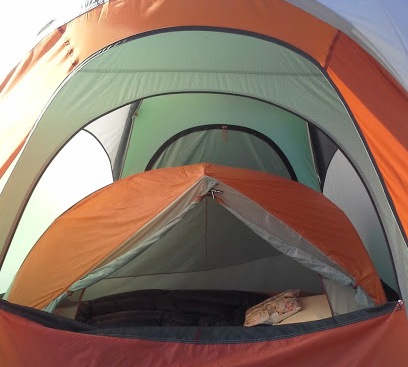
I learned a lot about how to be comfortable in that tiny space. I spent most of my time outside, of course, so it was only at night and in the heat of the day that I sought shelter. A few nights were frigid, and I couldn’t get warm, so I opened my backpacking tent inside the larger tent, and soon became warm enough to sleep comfortably.
During that trip, I camped in deserts, mountains, forests, near swamps and lakes and on a beach. Each campsite was special. Each experience was exquisite. Each person I met was an instant friend. One slightly older woman had gone to the same high school I did, which made us even instanter friends. She was a retired teacher whose retirement funds didn’t stretch enough for a conventional life, so she spent most of her time on the road, living in her tent. Although campers were only allowed a two-week stay, she’d been there almost a month. There were few campers during that February, and so they let her stay.
I considered doing what she was doing, and if I hadn’t lucked out on buying a house, I might have lived the camping life, though to be honest, as much as I loved camping, I’m so much more comfortable living in a stationary house with a roof and heat and running water and my own bathroom.
I didn’t camp every night during that trip. Most often I was with friends, who treated me royally. Occasionally I spent nights in motels, especially if the weather was bad or I was tired or there weren’t any nearby national parks. (I did stay in a couple of state parks, but so many were almost as expensive as a motel that it didn’t seem worth it.)
I still have that oversize lounger. Maybe this summer I’ll drag it out and sleep under the stars. Or not. Although it’s a nice thought, second thoughts remind me that mosquitos, skunks, and other denizens of the night aren’t so nice.
It’s funny — sitting here writing this, I know I had all those adventures, but they seem as if they happened to someone else, as if I’d just read myself into some fictional character’s life — a character who is spontaneous and adventuresome and courageous, all things I’m not.
Except, apparently, I am those things. Or at least I was.
***
Pat Bertram is the author of Grief: The Inside Story – A Guide to Surviving the Loss of a Loved One









