


When I saw this blog prompt, my first thought was to let it pass as I’ve been doing with most of the prompts, such as “If you could relive one year of your life, what would it be?” and “What are your five favorite apps on your phone?” Those subjects just don’t seem worth wasting any words on, and neither does this one. After all, if I ever kept thinking about a book I’d never finished, I’d just finish it and get it out of my mind.
My second thought was to write a tongue-in-cheek post, even though most of my whimsies seem to pass people by, but I couldn’t think of anything even dubiously fanciful to say.
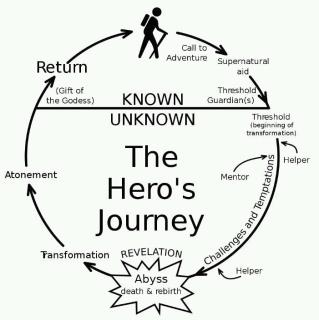
Then it dawned on me that there is one book, or rather a series of books that I never finished and that I do think about. The Lord of the Rings. I’ve started those books multiple times because I wanted to like them, but I simply could not get immersed into the story even though the series is considered a seminal work. For most people, I think, the books were a revelation, but as one who had been studying myths, legends, quests, and fairy tales my whole life, the books seemed . . . flat. The framework of the story isn’t new — it’s the quintessential hero’s journey story, where a naïve person (or hobbit, apparently), leaves the ordinary world, sets out on a quest, meets allies and mentors, encounters obstacles, fulfills the quest, faces one last transformative ordeal, then returns home with an elixir or boon to transform the ordinary world.
This framework of the hero’s journey is written in our psyches — it’s as old as humankind and goes all the way back to the very beginnings of literature: The Epic of Gilgamesh. Other ancient examples are Beowulf, The Odyssey, and most of mythology; also, King Arthur, The Fisher King legend, fairy tales, The Wizard of Oz, and the tarot (the major arcana seems to be an outline of the hero’s journey). The examples of pre-Tolkien heroic epics are endless, and yet he’s the one everyone holds up as the epitome of the genre.
A lot of authors who have been called derivative either had never heard of The Lord of the Rings or had been writing before the series was even published, and the similarity comes about because they used the same source material. The truth is, writers have always drawn on those ancient tales for their stories, and so did Tolkien. (In fact, his ending, where Frodo sails away, is part of the King Arthur story.) Still, I keep thinking I should have managed to read his books. After all, I’ve read tens of thousands of books, including one heck of a lot that were boring, uninspiring, and downright awful, so I should have managed to read The Lord of the Ring trilogy. But nope. Each time I tried, I got a little further — into the second book the last time — but never quite got caught up in the story. Finally, to give me some idea of what the books were about, I watched the movies that were supposed to be the closest to the books, so I basically know the story. Which, basically, is a basic story. Admittedly, he did do things like create his own language, develop his own mythology, and use the etymology of words to build depth to his world, but none of that interested me. And still doesn’t.
I do not like fantasy (though oddly, the two book series I find myself rereading are both considered fantasy, which goes to show . . . something, I’m sure), so it makes sense that I wouldn’t like the most foundational book of all modern fantasy.
Still, I do think of the books — not the story — just the books and wonder if someday I’ll finally be bored enough that those books would seem exciting by contrast. But I don’t think so.
***
Pat Bertram is the author of Grief: The Inside Story – A Guide to Surviving the Loss of a Loved One









