Basically, a Basic Story

Daily writing prompt
What’s a book you never finished but still think about?

When I saw this blog prompt, my first thought was to let it pass as I’ve been doing with most of the prompts, such as “If you could relive one year of your life, what would it be?” and “What are your five favorite apps on your phone?” Those subjects just don’t seem worth wasting any words on, and neither does this one. After all, if I ever kept thinking about a book I’d never finished, I’d just finish it and get it out of my mind.

My second thought was to write a tongue-in-cheek post, even though most of my whimsies seem to pass people by, but I couldn’t think of anything even dubiously fanciful to say.

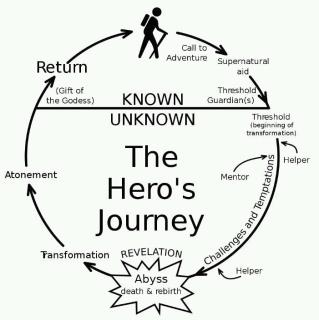
Then it dawned on me that there is one book, or rather a series of books that I never finished and that I do think about. The Lord of the Rings. I’ve started those books multiple times because I wanted to like them, but I simply could not get immersed into the story even though the series is considered a seminal work. For most people, I think, the books were a revelation, but as one who had been studying myths, legends, quests, and fairy tales my whole life, the books seemed . . . flat. The framework of the story isn’t new — it’s the quintessential hero’s journey story, where a naïve person (or hobbit, apparently), leaves the ordinary world, sets out on a quest, meets allies and mentors, encounters obstacles, fulfills the quest, faces one last transformative ordeal, then returns home with an elixir or boon to transform the ordinary world.

This framework of the hero’s journey is written in our psyches — it’s as old as humankind and goes all the way back to the very beginnings of literature: The Epic of Gilgamesh. Other ancient examples are Beowulf, The Odyssey, and most of mythology; also, King Arthur, The Fisher King legend, fairy tales, The Wizard of Oz, and the tarot (the major arcana seems to be an outline of the hero’s journey). The examples of pre-Tolkien heroic epics are endless, and yet he’s the one everyone holds up as the epitome of the genre.

A lot of authors who have been called derivative either had never heard of The Lord of the Rings or had been writing before the series was even published, and the similarity comes about because they used the same source material. The truth is, writers have always drawn on those ancient tales for their stories, and so did Tolkien. (In fact, his ending, where Frodo sails away, is part of the King Arthur story.) Still, I keep thinking I should have managed to read his books. After all, I’ve read tens of thousands of books, including one heck of a lot that were boring, uninspiring, and downright awful, so I should have managed to read The Lord of the Ring trilogy. But nope. Each time I tried, I got a little further — into the second book the last time — but never quite got caught up in the story. Finally, to give me some idea of what the books were about, I watched the movies that were supposed to be the closest to the books, so I basically know the story. Which, basically, is a basic story. Admittedly, he did do things like create his own language, develop his own mythology, and use the etymology of words to build depth to his world, but none of that interested me. And still doesn’t.

I do not like fantasy (though oddly, the two book series I find myself rereading are both considered fantasy, which goes to show . . . something, I’m sure), so it makes sense that I wouldn’t like the most foundational book of all modern fantasy.

Still, I do think of the books — not the story — just the books and wonder if someday I’ll finally be bored enough that those books would seem exciting by contrast. But I don’t think so.
***

Pat Bertram is the author of Grief: The Inside Story – A Guide to Surviving the Loss of a Loved One

Maybe Rereading “Dune”

I’m rereading Dune. At least, I think I’m rereading it. I’m beginning to wonder if I ever read it at all until now.

I remember thinking I liking the book when I was young, and several times over the intervening years I’d end up with a copy and try to reread it, but I could never get into the story again. Admittedly, when I was young, I had a lot more patience for books that were mostly descriptions of day-to-day living, whether on this planet or another (the first 150 pages of Dune seem more like setting the scene than the beginning of a book) and I lost that patience in later years. It’s also harder to keep whole books in my head now, so that adds to my impatience with dragginess.

It’s possible the book gets better (I’m not even halfway through), and it’s possible it has a great ending that would make me feel good about the book. And it’s possible that something in the latter half will strike a chord of memory, but so far, there isn’t so much as a ding. Even if I can’t remember books I read decades ago, if they impressed me in some way, I have some sort of lingering impression of them. Most books, of course, leave no impression — there is simply no “there” there. I’m not sure where Dune would fit in the book spectrum because it is different enough that I should remember something or hear a faint echo of recognition in the back of my mind. But nope. Nothing. I can’t even figure out why I would have read it. I have never liked authors who have to create incomprehensible names for people, things, and places. The strange spellings seem to take up space in my brain that would normally be used for following the story.

Even more confusing, I see the cover in my mind’s eye — a reddish cover with a fellow trudging across a wide expanse of dunes. I spent some time looking at Dune covers today, and there is not a single one of them that looks familiar. (Except for the one I bought at a library book sale a while back and redonated unread.)

It makes me wonder what book I did read. It’s possible I read some other book and misremembered it as Dune. It’s possible I misremembered the cover. (If there even was a cover image. It could have been a rebound book from the library.) And I could have found the book completely unmemorable.

Too bad there’s no way to rewind a memory to see the truth of it.

What I am seeing is a lot of similarity to The Wheel of Time series, at least in small things — the witches, the truthsayers, the uncanny powers, the manipulation of people and events. Of course, these are all fairly common archetypes and scenarios for the hero/savior story, but people often compare The Wheel of Time world to The Lord of the Rings, and I don’t see it at all. (But then, that’s another iconic series I haven’t been able to slog through, so I could have missed any similarity.)

One thing that amused me — in a book that uses so many strange-sounding names and words, at one point, Frank Herbert describes someone as having olive skin. Couldn’t he have come up with a more interesting word? I have always hated “olive” applied to skin because it takes me out of the story and makes me wonder what color the character is. I still remember the first time I came across that descriptive word. I couldn’t figure out if the character had green skin or black. It took years before I realized the word referred to the color of the inside of a black olive.

So, I can remember being puzzled by olive skin, but I can’t remember anything about a book I thought I read and thought I liked.

The life of a reader does get bizarre at times.

***

Pat Bertram is the author of Grief: The Inside Story – A Guide to Surviving the Loss of a Loved One. “Grief: The Inside Story is perfect and that is not hyperbole! It is exactly what folk who are grieving need to read.” –Leesa Healy, RN, GDAS GDAT, Emotional/Mental Health Therapist & Educator

Seeking Stories that Live Within Us by Malcolm R. Campbell

I am delighted to welcome my guest, Malcolm R. Campbell and his newest novel “Sarabande.” Malcolm is so very generous to other authors, it’s great to be able to return the favor. Besides, he’s a fine writer who pens powerful tales, and he has better insights into storytelling than anyone I know. Malcolm says:

A living myth is told and retold as the centuries pass. Poets, painters, musicians are nourished by its imagery, and in each retelling something is added from the collective attitudes, conscious and unconscious, of the time and from the individual vision of the artist.” – Helen M. Luke in “The Laughter at the Heart of things.”

As I read Helen M. Luke’s analysis of the myth of the ring as viewed by Richard Wagner in The Ring of the Nibelungen (known as the four-part “Ring Series”) and J. R. R. Tolkien’s The Lord of the Rings, I was struck by the fact this story is now part of our world view. Whether we learned of the myth through the original source materials, Wagner’s musical dramas, Tolkien’s books, or the feature film trilogy directed by Peter Jackson, the story lives inside us as though it actually happened. Tolkien expressed contempt for Wagner’s version of the old Norse myth drawn from the 13th century Icelandic Volsung Saga. Yet most critics believe Wagner’s The Ring of the Nibelungen (consisting of “Das Rheingold,” “Die Walküre” Siegfried, and Götterdämmerung”), composed between 1848 and 1874, and Tolkien’s Lord of the Rings, written between 1937 and 1949, are different interpretations of the same myth, and that Tolkien was also influenced by Wagner. Myths often have as many interpretations as history as though they refer to actual events.

Listen to the discussions about J. K. Rowling’s Harry Potter books, and you will hear people talking about Harry, Snape, Dumbledore and Voldemort in the same way they speak of celebrities, world leaders and newsmakers who come into their lives television, concerts and the Internet. All of these people, fictional or actual, are larger than life. While novel readers and film audiences know there is a difference between Tolkien’s characters and Rowling’s characters on one hand and well-known people within our culture, all of them are part of our shared story.

Earlier generations were impacted by Star Trek and Star Wars events and characters just as strongly. We know the difference between fictional characters aren’t read and that real people aren’t fictional, but it doesn’t matter. They’re all the same. While even the most fanatical fans don’t expect to see Captain Kirk, Spock, Frodo or Hagrid searching for salad greens in the produce department at Kroger or addressing Congress about the state of the galaxy, the worlds of those characters is part of our lives as though it’s a living and breathing reality.

Most authors don’t write with the expectation that their stories will impact readers with such force that the characters will suddenly take on independent lives of their own. At best, authors hope their stories and characters will seem real while their books are being read. For a reader, there’s nothing better than plunging into a good story, becoming enchanted by it, and following it with the fervor they follow family dramas and the biggest news stories of the day.

Yet some stories catch our fancy and stay with us long after we put the book down or leave the theater. Those are the stories we seek because they take us on flights of fancy, display new worlds before our mind’s eye, and take us on physical and emotional journeys that expand our lives and enrich our imaginations. Ask any reader what his or her favorite books are, and s/he will tell you about good guys and bad guys and things that go bump in the night and awesome landscapes that are just as much a part of his or her life as co-workers, neighbors and family.

As readers, finding such novels is part of a never-ending quest for a real page turner of a story we will never forget because it lives inside us and evolves every time we read it, talk about it and think about it. As readers, we love our living fiction.

Malcolm R. Campbell is the author of three contemporary fantasies, Sarabande (2011), Garden of Heaven: an Odyssey (2010) and The Sun Singer (2004).

Click here to read an interview with: Malcolm R. Campbell

Click here to read an excerpt of: Sarabande




