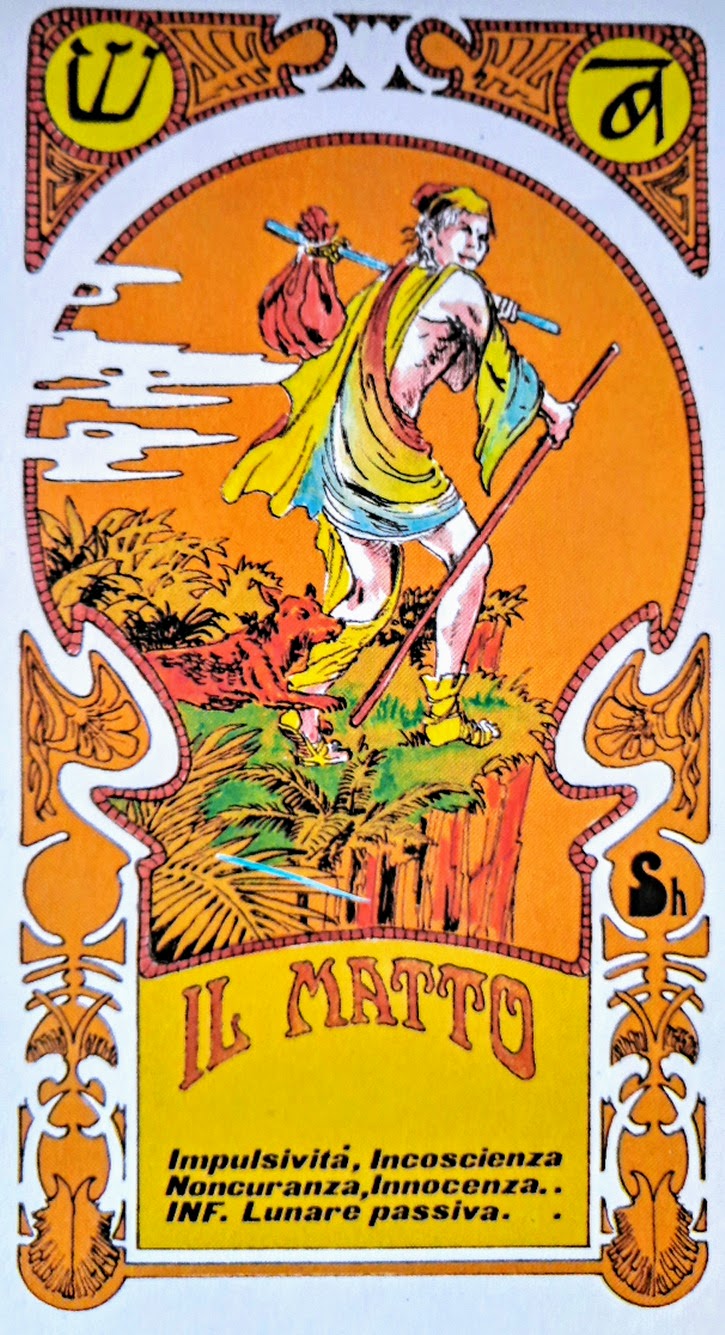
The Fool, one of the major arcana cards in the tarot, symbolizes wanderings, unawareness, naivete, spontaneity, transition, vitality, the beginning of an adventure, the ability to embrace new opportunities. At times, it can also mean recklessness in the face of danger.
The Fool is often depicted as a young man with a stick, a dog at his heels. (In some tarots, this dog is replaced by a fox, which fits because the fool is often “crazy like a fox.”) He is walking blithely toward a precipice, apparently caring nothing for the possible dangers that lie in his path. He’s almost childish in his approach, believing that there are many opportunities in the world just waiting for him to explore and develop.
In Italian versions of the tarot, the fool card goes by “Il Matto.” In French versions, the card goes by the name of “Le Mat” or simply “Mat.” These versions give the name the connotation of “madman,” though in Arabic it means “a dead person.”
In The Wheel of Time, one of the major characters is named “Mat.” Everyone who meets him thinks he is a fool, and in fact, all through the books, that is the word most used to describe him. I thought he was simply an archetype, but when I studied the tarot, I realized he is definitely based on the Fool card. (And if not, it’s too much of a coincidence to ignore. Since the major characters in The Wheel of Time have tarot equivalents, either Jordan succeeded in writing the “all stories” epic he intended — a reimagining all our myths, legends, cultures — or the tarot itself is representative of “all stories.”) Not only is his name “Mat,” not only is his character based on all that the card symbolizes, not only does his character arc follow that which is outlined above, but he represents the Arabic definition of his name. As he once said, “I’m usually pretty good at staying alive. I only failed one time that I remember.”
The Fool supposedly goes in stages from a naïve country boy to a mentally ill outcast (and because of a cursed dagger, Mat truly did become insane for a while), to becoming one who has greatness riding on his shoulder, which Mat does. And through it all, even while Mat is helping save existence from evil cosmic forces, the other characters continue to see him as a fool.
And perhaps he is a fool. He’s the sort of person who will rush into a burning building to save people, cursing himself the whole time, while others just stand and watch. Most often, he rescues women, but as he has come to learn, “even if a woman needed help, if she did not want it, she made you pay for giving it.”
He’s also a character who has no sense of what he really is. Even as he’s breaking into a dungeon to rescue women who can’t rescue themselves, he insists he’s no kind of hero. He thinks he is selfish, though he is not. He’s a bit of a womanizer, but he only goes after women who want him. Though many women are charmed by him, he sometimes overestimates his charm. In one case, a woman was affronted at a slight given by one of Mat’s companions. “Mat offered her a smile. He knew he could smile most women into feeling soothed.” The woman sniffed at him and turned away, not soothed at all. “Most women, he thought sourly.”
Mat is a special character in the Wheel of Time. He only wants to drink, gamble, and cuddle with women, but instead almost always does what is right even if it lands him in more trouble. That trouble, in certain cases, means becoming a battle commander who garners immense loyalty from his men. He almost never loses a fight though he hates killing; he hates even more getting his men killed.
The humor of this character is subtly created by the disparity between who he thinks he is and what he actually does. This is utterly engaging, making Mat one of the few characters who’s fun to read.
Until . . .
Yep, until the substitute author. That writer has no idea what subtlety is. Has no idea what Mat’s appeal is. Has no idea where the character was headed. By the end of the last book Jordan wrote, poor Mat has grown up, accepts the responsibility he has fought against through all the first eleven volumes, and is truly poised to be the hero he was always meant to be. In fact, we begin to see beneath the “fool” to the tragic figure he is hiding behind that lighthearted mask. As he mused: “Taking responsibility drained all the joy out of life and dried a man to dust. What he wanted right then was a great deal of mulled wine in a snug common room full of music, and a plump, pretty serving maid on his knee, somewhere far from Ebou Dar. Very far. What he had were obligations he could not walk away from and a future he did not fancy.”
But the substitute erased Mat’s entire character arc, turned him back into that naïve fool, dressed him like a county bumpkin rather than the sophisticate he had become. Even worse, the author turned him into a clown without the underlying sadness that made him more than one dimensional. Apparently, the author knew Mat was supposed to be a bit of comic relief but had no idea why. And so poor Mat was set up in situations where he tried to be witty but made puerile jokes, got involved in clownish behavior where he played for laughs, was flippant for the sake of flippancy rather than to hide his true feelings, and often acted boorishly silly.
The interesting thing is, Mat himself as Jordan wrote him was never funny, not even at the beginning when he was known as the town prankster. He took himself seriously, took life seriously, took his responsibilities seriously (even if he complained all the while), but never cracked a single joke, at least none that appeared on the page. Yet, for all that, he brought some lightheartedness to a series of books that could otherwise be rather dismal.
This is one of the reasons I keep up with my studies of the books even though (as you might have guessed) there is a lot I don’t like and cannot bring myself to reread. Not only is this series a masterclass in creating characters and archetypes with a few bold slashes of words, it’s also a study of the contrast between two authors. Though they are developing the same universe, they have two different writing styles, two different ways of presenting material (one is subtle in the storytelling, one hits you over the head with explanations), two different ways of looking at that world, two different senses of what humor is, two different real-world views that color their writing. (One was a soldier who understood the traumas of war and how soldiers dealt with the horror. The other was simply a writer.)
But the main difference? One, at his best, is brilliant. The other . . . never. Though oddly, (oddly to me, that is), most readers seem to prefer the substitute author.
P.S. Influences Jordan admitted he used to create Mat’s character are the Norse war deity Odin; the trickster gods — Loki, Coyote, and the Monkey king; Math fab Mathonwy, a Welsh figure of good fortune; Rommel, the desert fox; Francis Marion, the swamp fox. These last two reflect the “fox” part of the tarot card.
***
Pat Bertram is the author of Grief: The Inside Story – A Guide to Surviving the Loss of a Loved One.









 Bertram's Blog