Subverting Stereotypes in The Wheel of Time

Last night, I spent a considerable amount of what should have been sleeping time looking for bad reviews of the last three books of The Wheel of Time series. After the death of the real author, the series was finished by a stand-in author, who did an execrable job, and I wondered why none of those books rated less than a three-star review on Amazon.

One reason, I discovered, is that a lot of people give him kudos for doing a thankless job, but it wasn’t thankless. He got paid for his work, and those books helped catapult him into the fantasy-writer stratosphere.

Another reason is that he writes in a simplistic style that appeals to today’s readers — short sentences; quick scene changes; lots of action; little real character development; not a lot of depth, emotional or otherwise. All of which is antithetical to Robert Jordan’s writing.

I also tend to think a lot of the acclaim he gets for his Wheel of Time books is because they are in direct contrast to Jordan’s books. There is no doubt that Jordan’s last few books could have used some heavy editing (though oddly, one of the substitute author’s acclaimed books is more or less a replay of the Jordan book that people tend to hate) but much of what people seem to object to in Jordan’s writing are things that shouldn’t be an issue.

For example, when Jordan started writing The Wheel of Time books, there were few female protagonists in that genre. This lack makes sense in a way because the writers of high fantasy tended to be male. Also, the genre seemed to attract more males than females in the beginning (or at least it was assumed to be so). Writing a male protagonist was safe — females will read books written by and for males more often than the reverse.

Jordan tried to turn this assumption on its head, writing both male and female protagonists. He tried to balance the power between males and females, and he tried to subvert stereotypes. It surprised me to discover that so many people think his writing is sexist, though in a world of his own making, with sexual dynamics of his own making in that world , how can he possibly be considered sexist?

One of the problems is that his readers are so young. (I have yet to discover a group of readers my age, online or off, who have any interest in reading the books let alone discussing them in any depth.) These younger generations don’t realize there was a time not that long ago when women were considered gossipy, flighty, unable to handle finances, and needed to be looked after as if they were children. In fact, it wasn’t until 1974 that women could obtain credit cards in their own name without a male co-signer. At the same time, it became illegal for mortgage companies to refuse loans to unmarried women as had been common.

It was only a handful of years after these major real-world changes that Jordan started thinking about his series. In his attempt to subvert stereotypes, he reversed things — women in his series consider men to be gossipy children who don’t have any sense, so the women think nothing of bullying the men to get them to do what the women think is right. Making things more complicated, in Jordan’s world, men are raised to be chivalrous, putting women’s safety first, and protecting them even if they don’t want the protection. This leads to an underlying theme of the story — men don’t understand women, though they try to. Women don’t understand men, though they think they do.

Adding further to this complicated dynamic, the “magic” system had become one-sided. It used to be that both men and women could tap into the power that drove the universe, so they were equals. But during the time of the story, only women were able to use the power, so it threw the balance off.

And yet readers try to fit today’s mores into Jordan’s world.

What really made me stop and think during my research last night is that most of the people in the United States today became adults after those life-changing laws governing women’s financial autonomy came into play. If only 20% of people were born before 1964, then that means 80% never had to deal with (and probably never had to learn about) a fairly recent time when things were so terribly unbalanced in the real world. No wonder so many Wheel of Time readers haven’t a clue what that particular theme of Jordan’s was all about.

In the end, I suppose it doesn’t really matter why the substitute author gets lauded for his awful writing. In my world, those books no longer exist, so unless I can come up with my own ending, the series ends with the real author’s death.

***

Pat Bertram is the author of Grief: The Inside Story – A Guide to Surviving the Loss of a Loved One.

Saving the World

I finished rereading The Wheel of Time, and since the library isn’t open yet, I’ve begun re-rereading the series. It’s not that it’s such great writing — with over four million words spread out over fifteen books, there really should have been a huge amount of culling to make it less of a sprawl. Some of the meanderings off the main track are unimportant and inane and downright aggravating — a reader does not need to see every savage side of the lesser antagonists to get the point that they have sold their souls to The Dark One. Nor does a reader need to see certain characters doing the same thing over and over and over again. Nor does a reader need to see author mistakes, such as his forgetting what his characters are like and have them acting brainless for no reason whatsoever.

The series was originally proposed as a trilogy, though the scope of the story demands more than that. TOR Books, knowing how wordy Robert Jordan was, turned it into a six-book deal, which they should have enforced. The Wheel of Time is a perfect example of an author falling in love with his creation. He spent ten years planning the work, doing research, and taking copious notes before he started writing, and apparently, he couldn’t bear to give up any bit of his creation even if it would have made a much stronger story to do so. As to why his publisher didn’t rein him in — there is a whole lot more money to be made by fifteen bestselling books (fourteen plus a prequel) than six. Since the fantasy market is predominately younger folk, I guess they figured they had a non-critical readership, and every time a new book came out, a new crop of readers came of age, which prompted sales of the earlier books in the series.

Luckily, it’s easy enough to skip over the many sidetracks and dead ends to keep to the essence of the work, though that doesn’t help dealing with the parts of the story that aren’t there. Jordan delighted in writing ad nauseum about trivial matters but mentioned important points almost as an aside and brought in mysterious characters for cameo spots without any elucidation of who they were or why they were important. Despite myriad interviews, he refused to explain some of his seemingly pointless points, saying he wanted people to think about them. A bit of a god complex, there, but then, I guess that’s understandable when one has created such a massive world to play with.

There is also too much war for my taste, but after all, Jordan is a military historian, and ultimately, this series is about the battle between the forces of light and dark, so all the military hoopla has a place.

Despite the many drawbacks of the series, it’s compelling because of the eternal themes of honor and duty, loyalty and integrity, steadfastness and kindness and friendship, doing what’s right no matter the cost, standing by one’s word, rising above the baseness of one’s life to grasp nobility, accepting one’s fate and becoming a hero. Those are the nuggets of purity that drive the (sometimes appalling) story. And it’s those same nuggets that perhaps make the work worth reading and even rereading.

It’s funny — each time I reread the series, I tell myself that this time I will read every word, and each time I get bored by the trivial chapters and inane characters and become aghast (re-aghast?) at the sadism, and end up skipping vast sections to get to better parts. Some of the horror is necessary, of course, to help forge the rather ordinary characters into the heroes (reluctant or not) they will become. I mean, you don’t simply wake up one morning with the power and resolve and ability to fight the overwhelming darkness that might be threatening to consume us all.

Jordon has created an incredibly complex kaleidoscope of a world, taking all the bits and pieces of our cultures, customs, costumes, mythologies, legends, religions, histories, and shaken them up and spread them out in a new and vibrant pattern. One of the fun things about rereading the book is picking up elements that one missed the first time through. (Despite that, there are whole storylines that add nothing to the whole — the Seanchans, Slayer, Perrin and Faile to name just a few.)

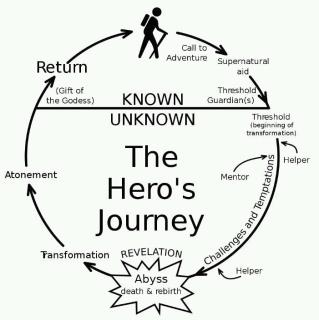
Since this is the quintessential hero’s journey, with each character on his or her own path to greatness, there is homage to the legend of King Arthur as well as to lesser known legends.

There are the archetypal characters, such as shapeshifters and tricksters, mentors and allies. And underlying it all is the savior tale, both the Christian story and the pre-Christian ones.

What would you do if you’re going about your ordinary life, doing what you’ve always done, and then discover you’ve been chosen to save mankind, chosen to give up your life to save the world?

I wonder — as I sit in safe isolation while many folks around the world are dying of a novel virus — if I would have the courage, the stamina, the will, to undertake such a task. In my heart of hearts, though I would wish I did have such a heroic character, I know I would not be able to do it. Could not do it — I’m too old, too tired, too powerless. But when I immerse myself in this legendary world, I think . . . maybe.

Just maybe . . .

***

Pat Bertram is the author of Grief: The Inside Story – A Guide to Surviving the Loss of a Loved One. “Grief: The Inside Story is perfect and that is not hyperbole! It is exactly what folk who are grieving need to read.” –Leesa Healy, RN, GDAS GDAT, Emotional/Mental Health Therapist & Educator.
The Wheel of Time

Since I finished reading all my emergency books, I’m reduced to reading the books in my Nook, books I’ve already read. Although I don’t generally like rereading books, Robert Jordan’s massive Wheel of Time series seems to be the perfect place to go to hide from The Bob.

The books in the series are not stand alone books — you cannot understand one book without the previous books — which means that in effect the WOT series is single novel of over four million words broken up into fifteen parts. In fact, the series itself is not stand alone — there are all sorts of books, blogs, discussion forums comprising billions of words where readers try to figure out the truth of the story.

Not only is the scope of WOT almost impossible to fathom, but Jordan had a bad habit of putting in bits of deus ex machina that he refused to elucidate in the work itself, companion books, or even interviews. Perhaps he himself did not know what those bits meant or maybe he simply wanted to be mysterious for mysterious’s sake, to create a legacy of people debating worthless points. Which they do. Ad infinitum. Jordan also refused to explain what to him were obvious story points, such as who killed a certain bad-guy-turned-maybe-good-guy, but again, dozens of forums present various theories because that obvious point was obvious only to he who created it. At least in this particular case, the murderer was revealed in an appendix several books after the fact. Jordan also spent thousands upon thousands of words on red herrings and subplots that go nowhere, but sometimes used a single sentence buried in huge blocks of description to bring out a major point. Yikes.

And wow, is there description. Tons of description. Whenever food is mentioned, I find myself skipping a paragraph or two. When clothes are mentioned, I skip a couple of pages. And sometimes, when there is zero action or character development, such as in a few very clean bathing scenes, I skip the whole dang chapter.

I also tend to skip over some of the women’s parts. Although Jordan mostly develops his three main male characters into individual heroes, each with his own mythic journey, he turns his three main women characters into insufferable caricatures, indistinguishable from one another except for a few annoying character tics. At first I thought he had a problem with women, but his secondary and tertiary female characters are often well-defined or at least not brats and prigs who believe, without giving a single shred of thought to the forces the other characters face, that they know the best for everyone.

Even after investing so much time in reading and rereading the books, I’m still not sure I like the series — although the theme seems to be about the importance of having choices, most of the characters, both good and evil, go out of their way to force others to their will. Too much torture and punishment for my taste. It seems to me that in a world where everyone is free to choose (or at least what the pattern created by the wheel of time allows them to choose), it’s just as easy to find someone to willingly do your bidding as to waste the effort forcing someone to do it. (Oddly, the three main males do turn others to their will, but without wanting to or without even trying.)

But despite my ambivalence, I keep rereading. The scope of the story is utterly astounding. In the story, during the so-called age of legends, people wielding the power that turns the wheel of time, broke the world. Mountains grew where no mountains had been, waters flooded lands, green spaces became deserts. And humans started over. Again.

Interestingly, breaking the world is exactly what Robert Jordon did when he wrote his series — he smashed our world into bits, mixed it all up — legends and traditions; countries and races, clothes and customs; myths and mysteries, religions and philosophies — and put it all back together into his own creation.

I wonder what it would be like to create such a massive fiction world, a world that reflects our world but not. A world that reflects our values but not. A world that exists only in our minds but not. Or, rather, maybe not. If it exists in our minds, it’s possible Jordan’s world exists for real, sort of dream world we all created together, just as philosophers and physicists say we do with the real world.

Assuming there is a real world.

Maybe we’re all writing the story of our world as we live it, creating with our hive mind the very fact of our existence. If we all stopped believing in it, would it disappear as if we were closing the cover of a novel? Would we disappear if we stopped believing all the things we see and hear except with our own eyes or ears? Would we be different if we simply refused to accept the role that has been forced on us?

Maybe, as I study Jordan’s world, I’ll learn how to help build a better version of our own — how to write it or right it, either one.

Meanwhile, the wheels of time keeps turning . . .

***

Pat Bertram is the author of Grief: The Inside Story – A Guide to Surviving the Loss of a Loved One. “Grief: The Inside Story is perfect and that is not hyperbole! It is exactly what folk who are grieving need to read.” –Leesa Healy, RN, GDAS GDAT, Emotional/Mental Health Therapist & Educator.

Author Dynasties

I don’t particularly like Sue Grafton’s books, but I do admire her — she left her legacy as is, her series unfinished, and would not allow anyone to step up after her death and keep her characters alive.

Too many authors didn’t make that decision before they died, so their heirs made it afterward. For example, some classics are being brought back to life when authors today write unsanctioned sequels to beloved favorites, such as those who pretend to channel Jane Austen or Daphne Du Maurier. 

One of the few times posthumous writing was warranted was when Robert Jordan died before he could finish his modern classic, the fourteen volume Wheel of Time series. Another writer was hired to work with Jordan’s wife and Jordan’s copious notes to finish the series. Can you imagine going through decades with all those thousands of characters and millions of words only to be left hanging on the wheel without a resolution? So yes, it had to be finished. But once it was, it was done. There will be no more Robert Jordan books.

But some stories and authors’ names that do not need to be kept alive are still going for no other reason than to milk the money machine. 

Some fellow is now writing Michael Crichton’s books. And another fellow is keeping Robert Parker’s Spenser alive. Who needs these books? They are not the author’s words, not the author’s vision — just some pale vision of the vision.

A new thing now is for the literary name is passed to the next generation. Michael Palmer’s son is now writing Michael Palmer books. Lee Child’s son will be taking over is father’s series.

And what the heck is going on with James Patterson? The way he’s spawning co-authors, his name will be one of the last words uttered when the earth falls into the sun.

This is what happens when an author’s name becomes a brand. I never used to pay attention to authors’ names except as a way of finding more books to read, and neither did anyone else, at least not to the extent that holds true today. The title was the main thing; the author’s name almost an afterthought. But branding and modern publishing changed all that. Now it’s the author who’s paramount, and no one cares what drivel is passed along to the reading public under the famous brand. (I got caught with a Michael Palmer book written by his son because the famous name was in huge letters, the title in a smaller type, and the writer’s name all but swallowed up in the graphic on the very bottom. So not nice!)

It used to be as one author’s star waned, another’s would rise, but what’s happened to all those non-rising stars? What will happen to readers when the brands finally are laid to rest? Not that it matters. There are plenty of books for me to read, and when there aren’t any more books that I like, I’ll write more of my own.

***

Pat Bertram is the author of Grief: The Inside Story – A Guide to Surviving the Loss of a Loved One. “Grief: The Inside Story is perfect and that is not hyperbole! It is exactly what folk who are grieving need to read.” –Leesa Healy, RN, GDAS GDAT, Emotional/Mental Health Therapist & Educator

 

The Wheel of Time

Over the past several months, I’ve been reading (and rereading) Robert Jordan’s massive Wheel of Time series. The books in the series are not stand alone books — you cannot understand one book without the previous books — which means that in effect the WOT series is single novel of over four million words broken up into fifteen parts. In fact, the series itself is not stand alone — there are all sorts of books, blogs, discussion forums comprising billions of words where readers try to figure out the truth of the story.

Not only is the scope of WOT almost impossible to fathom, but Jordan had a bad habit of putting in bits of deus ex machina that he refused to elucidate in the work itself, companion books, or even interviews. Perhaps he himself did not know what those bits meant or maybe he simply wanted to be mysterious for mysterious’s sake, to create a legacy of people debating worthless points. Which they do. Ad infinitum. Jordan also refused to explain what to him are obvious story points, such as who killed a certain bad-guy-turned-maybe-good-guy, but again, dozens of forums present various theories because that obvious point was obvious only to he who created it. At least in this particular case, the murderer was revealed in an appendix several books after the fact. Jordan also spent thousands upon thousands of words on red herrings and subplots that go nowhere, but sometimes used a single sentence buried in huge blocks of description to bring out a major point. Yikes.

And wow, is there description. Tons of description. Whenever food was mentioned, I found myself skipping a paragraph or two. When clothes were mentioned, I’d skip a couple of pages. And sometimes, when there was zero action or character development, such as in a few very clean bathing scenes, I’d skip the whole dang chapter.

I also tended to skip over some of the women’s parts. Although Jordan mostly develops his three main male characters into individual heroes, he turns his three main women characters into insufferable caricatures, indistinguishable from one another except for a few annoying character tics. At first I thought he had a problem with women, but his secondary and tertiary female characters are often well-defined or at least not brats and prigs who believe, without giving a single shred of thought to the forces the other characters face, that they know the best for everyone.

I am not a fan of fantasy fiction, especially not one man vs. the powers of darkness stories, but when I was house bound for all those months, I needed something to do, and a massive read seemed to fill that need. Though I’d tried to get immersed into other such series, books that start with a war in a bizarre place with an incomprehensible name fought by characters with equally tongue-twisting names for a goal that seemed completely alien hold no interest for me. Luckily, the first Wheel of Time book began in an earthly place with understandable actions by understandable people with simple names.

Even after investing all this time in reading the books, I’m still not sure I like the series — although the theme seems to be about the importance of having choices, most of the characters, both good and evil, go out of their way to force others to their will. Too much torture and punishment for my taste. It seems to me that in a world where everyone is free to choose, it’s just as easy to find someone to willingly do your bidding as to waste the effort forcing someone to do it. (Oddly, the three main males do turn others to their will, but without wanting to or without even trying.)

But despite my ambivalence, I keep rereading. The scope to the story is utterly astounding. In the story, during the so-called age of legends, people wielding the power that turns the wheel of time, broke the world. Mountains grew where no mountains had been, waters flooded lands, green spaces became deserts. And humans started over. Again.

Interestingly, breaking the world is exactly what Robert Jordon did — he mashed our world into bits, mixed it all up — legends and traditions; countries and races, clothes and customs; myths and mysteries, religions and philosophies — and put it all back together into his own creation.

I wonder what it would be like to create such a massive fiction world, a world that reflects our world but not. A world that reflects our values but not. A world that exists only in our minds but not. Or, rather, maybe not. If it exists in our minds, it’s possible Jordan’s world exists for real, sort of dream world we all created together, just as philosophers and physicists say we do with the real world.

Assuming there is a real world.

Maybe we’re all writing the story of our world as we live it, creating with our hive mind the very fact of our existence. If we all stopped believing in it, would it disappear as if we were closing the cover of a novel? Would we disappear if we stopped believing all the things we see and hear except with our own eyes or ears? Would we be different if we simply refused to accept the role that has been forced on us?

Maybe, as I study Jordan’s world, I’ll learn how to help build a better version of our own — how to write it or right it, either one.

Meanwhile, the wheels of time keeps turning . . .

***

Pat Bertram is the author of the suspense novels UnfinishedMadame ZeeZee’s Nightmare, Light BringerMore Deaths Than OneA Spark of Heavenly Fireand Daughter Am IBertram is also the author of Grief: The Great Yearning, “an exquisite book, wrenching to read, and at the same time full of profound truths.” Connect with Pat on Google+. Like Pat on Facebook.