No Regrets

Daily writing prompt
Describe a risk you took that you do not regret.

I don’t like taking risks. Too often I’ve seen people taking risks, such as with their investments, because as “everyone” knows, the bigger the risk, the greater the rewards. Except, of course, when those risks don’t deliver the sure thing people are expecting. Quite frankly, I’m not sure “everyone” knows what a risk is — if they don’t get the outcome their bravery at taking the risk seems to call for, then they’re shocked and they get upset. But that’s what a risk is — you take a chance, and it might work out or it might not.

In my case, I never take a risk if I can’t handle the negative outcome. Which means, I don’t take risks.

And yet . . .

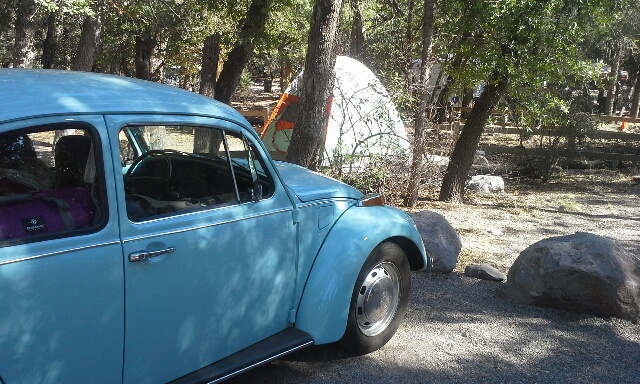
I’ve done a few things that other people considered extremely risky, though I didn’t. Ten years ago, when I planned a cross-country trip in my vintage VW bug, people were horrified and kept telling me I couldn’t do it, that it was too dangerous for me to go alone. Of course, none of those people offered to go with me to mitigate the danger, but it wouldn’t have mattered. The point was for me to do it by myself.

I wasn’t foolish about the trip. I had my car restored, a new engine put in, bought reliable camping equipment, and stocked up on emergency supplies for when unexpected and perhaps dangerous things might happen. And dangerous things did happen, but I handled whatever came along. To me, it was all part of the adventure, that willingness to go wherever the road took me and to live with the uncertainty (and consequences) of each day. Even more than that, it was a way of reclaiming my life after the death of both Jeff and my father. (After Jeff died, I was left homeless, so I went to take care of my father, and after he died, I was left homeless again.)

Perhaps the trip was a risk, but I didn’t see it as such. I wouldn’t do a long trip again, though just writing this I think maybe . . . someday . . . Still, the car is ten years older, as am I, and I’m not willing to put myself in the danger a trip could bring, not just the driving danger, but the uncertainty of the situations I might encounter — the USA isn’t the same as it was ten years ago, and even back then there were times I wasn’t sure what country I was in.

Besides, I’m homeful now, not homeless, so there is a lot more at risk than there was a decade ago.

Another risk I took was when I bought this house sight unseen. I’d seen photos, of course, and had an inspector check out the house, but I never saw it as a risk. The way I figured, it was my house, and I’d do whatever needed to be done. Other people were appalled at what they thought was my lackadaisical outlook, and the realtor made me sign a document absolving her of any responsibility if things didn’t work out.

I don’t regret either of these risks. Both worked out, but however they would have worked out, they would have worked out. I’m just glad, and so very thankful, to have had both these experiences.

Nope, no regrets at all!
***

Pat Bertram is the author of Grief: The Inside Story – A Guide to Surviving the Loss of a Loved One.

The Courage to Start Over

Two characters in the book I am reading are talking about why they moved to that particular small town. One was born there, moved away, then returned for as yet undisclosed reasons. The other said she just wanted to start over. The first woman said, “I think it’s admirable. A lot of people don’t have the courage to do something like that.”

Is it true? Does it take courage to move to a new place to start over? Or is it that sometimes we’ve lost so much there’s nothing to lose by doing so?

I know several widows who moved out of their homes, and then took off, looking for a place to settle. A couple of them bought RVs, traveled across country, and eventually found a place they liked well enough to stay. Others just . . . wandered. It might have taken courage, but I have a hunch it was simply easier than staying and living with the memories and the ghosts of things past. Some people who are left behind do stay in their once-shared home and that, perhaps, takes more courage than heading out to look for a new place.

In my case, after Jeff died, I moved to a different state to take care of my father, and when he too died, I wandered. In between road trips, I’d rent rooms in people’s houses. Then three years ago, I bought a house sight unseen (though I had seen photos), in an area I’d only driven through once. At the time, I knew no one in town, though I promptly rectified that little matter. Did any of this take courage? Not particularly. Does it take courage for a stone that was catapulted into the air to land somewhere? No. It’s just the way things are. It’s the same thing when you are catapulted out of your life — you eventually have to land somewhere. It’s just the way things are.

Come to think of it, that’s not the only time I went looking for a new place to live, though the other times were with Jeff. We were fed up with the growth of Denver and the attendant problems like crime and pollution. We were also without work. So we just took off with no destination in mind. I don’t think that took courage; it was an adventure, and to be honest, once we left everything behind, it was the freest I ever felt in my entire life. The problem with such an irrevocable act is that eventually you have to find a place to live, and that search destroys the feeling of freedom.

It’s a good thing this place is working out for me because I don’t have another move left in me.

But I am getting off the theme of “courage.” Although I have done many things people say take courage — such as dealing with grief, my solo road trips, buying my first house so late in life — I didn’t particularly feel courageous. I did endure, however, and I did persevere despite having lost so much, and I tend to think that counts more than mere courage.

***

Pat Bertram is the author of Grief: The Inside Story – A Guide to Surviving the Loss of a Loved One. “Grief: The Inside Story is perfect and that is not hyperbole! It is exactly what folk who are grieving need to read.” –Leesa Healy, RN, GDAS GDAT, Emotional/Mental Health Therapist & Educator.




