In an effort to see life in a new light, I’m going try to believe impossible things. I’ve always wanted to know the truth, but grief has thrown so many of my perceptions out of whack that I don’t know the truth of anything any more, so I’ve decided to believe things that are untrue. For example, I’m going to believe I am at the perfect weight. And maybe that’s the truth. Who’s to say? Only me, and I’m not talking.
And hey. Why stop at weight? Maybe I’ll believe that I myself am perfect. Now that I think about it, that is the truth. Since I am the only me in the world, whatever I am is perfectly me.
I’ve always been very self-aware — knowing both my good points and my bad points, my successes and failures — but if the universe is unfolding as it should be and I am where I am supposed to be, then there can be no good points and bad points. There can be no successes and failures. There is just me, a creature born of stardust, the culmination of billions of years of creativity and change. Odd to think that I (well, all of us) are a part of this process.
Maybe we are the process.
This thing called grief has given me an interesting perspective on life. A day or two after my life mate died, I couldn’t visualize him, so I looked at the only photo I have of us, and I wept because I did not recognize him. When that photo was taken, it was an exact likeness of him, but during the subsequent years of illness, he lost the fullness in his face, first becoming distinguished looking, then gaunt. When he died, I an idea/image of him in my mind, perhaps a composite of him through the years, perhaps what he actually looked like near the end, and that single photo I have of him does not resemble the person I knew. Now, however, the photo is how I remember him since it’s the only image of him I have. (Occasionally I can remember his smile or the way he looked when he died, but mostly he has faded from memory.) The way he looked in the photo and the way he looked at the end are both parts of his process, so I’m content remembering him when he was still relatively young and healthy.
It’s not just our internal images of a person that changes to accommodate the vagaries of age; our internal image of the relationship itself changes to accommodate the vagaries of life. Most of the transformation of a relationship from youthful and passionate to aged and (perhaps) wise and companionable goes unnoticed. We are always who we are. We are always in the present.
In other words, we are a process. Do we have an existence beyond the process? Someone told me recently that we can’t prove we exist. Maybe this is why we can’t prove it — whatever we try to pin down is already gone, lost in the past.
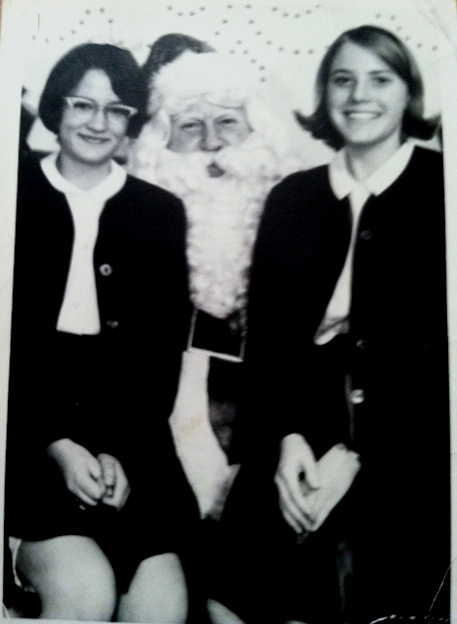
I never had much use for photographs of myself, but after my mother died, I inherited a bunch of photos taken of me when I was young. I put them in an album and I leaf through it occasionally, seeing the progression of myself from a baby to a young woman, trying to figure out what those girls have to do with the me of today. I’ve always felt like just me, and yet, (for example) I cannot remember this little girl in the photo, cannot remember being her. She has receded far into my past. Or perhaps she’s become subsumed into my current persona. Either way, she no longer exists even in memory.
But she is part of the process of me.
(Hmmm. Maybe there is something to this idea of believing impossible things. I’ve already found one new way of looking at life.)
***
Pat Bertram is the author of the suspense novels Light Bringer, More Deaths Than One, A Spark of Heavenly Fire, and Daughter Am I. Bertram is also the author of Grief: The Great Yearning, “an exquisite book, wrenching to read, and at the same time full of profound truths.” Connect with Pat on Google+
In A Spark of Heavenly Fire, I had a character meeting up with a coyote as a way of showing that the character was becoming “untamed,” that she was finding her inner savage. She went from searching for self-affirmation from the men in her life to finding affirmation in herself. But more than that, she overcame her squeamish nature to do whatever she needed to do to survive.
When people fall in love, when they are giddy with hormones, when they get caught up in the emotion of their love and the dream of a wonderful new life together, their friends and family never tell them, “Okay. Enough. It’s time to get over your love and move on.” The whole world celebrates their love (or so it seems to the new couple), and everything they say and do for the rest of their lives is shaded by this focus on each other.
Although yesterday’s post
1000 days have passed since the death of my life mate/soul mate.
Once a long time ago, I crashed a Halloween party. It sounds as if I am very bold, doesn’t it? But truly, it was out of character for me, and besides, I was in costume. I remember that the party was given by a friend of a friend, but I have no idea how or why I decided to go — perhaps as a joke to see how long it would take for people to realize they didn’t know me.
Yesterday I wrote about 


What Do You Do If Someone Posts an Insulting Comment on Your Blog?
November 28, 2012 — Pat BertramFor one thing, my posts tend not to be controversial — they’re more of a way of chronicling my journey through life and the writing life. It’s hard for someone to argue that I’m getting it wrong when I can’t get it wrong. I’m being me, and who can argue with that?
For another thing, my readers tend to be intelligent and kind, and they give thoughtful responses that add to the conversation instead of posting negative comments that bring the discussion to an abrupt end.
The other day, however, someone left an insulting comment on my article How Many Books Are Going to be Published in 2012? (Prepare for a Shock) that I didn’t know how to handle. That is not my favorite post by any means, in fact, it’s one of the few I wish I had never written. I’d only written the article as a way of trying to make sense of the current book climate and to show the meteoric increase in the number of books available, not to establish myself as any authority on the subject. And yet it’s become my most quoted article, and the one most frequently linked to.
It’s no wonder that an insulting remark landed on the post. Someone commented: “why would anyone bother to pay attention to a blog which starts off with uninteresting stuff about the author, and then gives data without a source? takes all types, I guess.”
I guess it does take all types. When I see an article that doesn’t lead up to the hype, I merely pass on by without stopping to leave a comment. But, for whatever reason, that person left a comment. I didn’t know whether to delete it or approve it. And if I posted it, I didn’t know whether to respond to it or ignore it. Admittedly, it’s not much of an insult, but it still put me in a quandary.
I asked my blogger friends on Facebook what they do in such a circumstance, and got a whole range of answers from “delete it” to “find where the person lives and go beat them up.” Some people thought that if it had merit or if it said more about the commenter than me, that I should post it but not respond. Some said that if it was a business blog, to delete the comment, that it wasn’t good to have snipers in your store.
The comment now seems innocuous, and the commenter has a point, why would anyone bother to pay attention to that particular blog post? (Though I did give a source, just not a link to the source.) Still, I left his remark in comment limbo until just a few minutes ago. I found the deciding factor in You and Your Blog Suck: 7 Steps to Responding to Negative Comments, a blog post by Marc Ensign. He said, “By deleting it you are telling your readers that they are welcome to say whatever they want as long as they agree with you. The only time I would consider deleting a post is if it was obscene or offensive to your readers.”
Since the comment under consideration is not obscene, not offensive to my readers, not even much of an insult, I took a deep breath and approved the comment.
So, what do you do if someone posts an insulting remark on your blog? Do you delete it or do you approve it so posts where everyone can see it? If you post it, do you answer it or ignore it?
***
Pat Bertram is the author of the conspiracy novels Light Bringer, More Deaths Than One, A Spark of Heavenly Fire, and Daughter Am I. Bertram is also the author of Grief: The Great Yearning, “an exquisite book, wrenching to read, and at the same time full of profound truths.” Connect with Pat on Google+