Learning to be Open and Unafraid

A friend wrote me yesterday and told me how much she appreciated my openness in talking about my grief and other traumas and added that it was a learning experience for her. To tell the truth, it’s been a learning experience for me, as well. For decades, I’ve kept my private life private (secretive, some people say, though why they would think they have a right to my privacy, I don’t know), but things change. I changed.

I was more open when I was young. I remember writing long angst-ridden letters to friends when I was in my late teens and early twenties, but stopped abruptly when a friend found one of the letters I’d written to her years previously and read it to me on the phone, laughing the whole while. She thought I’d find it funny, but I didn’t see the humor, only the betrayal. I never wrote another such letter to anyone. Although I talked about my feelings and situations, I didn’t want anyone to have written proof of my follies. And yet, here I am.

computerWhen I first signed up for the internet seven years ago, I didn’t quite know what to do. I figured I’d pay for a year and then if I still hadn’t found a way to make use of the resource, I would disconnect. Within a mere four months, though, I’d entered a contest, made online friends, and discovered blogging. Blogging was my way of getting people interested in me as an author, so I wrote posts about writing, reading, trying to get published, and anything else loosely pertaining to my writing life.

Even though I was living through the trauma of a dying life mate/soul mate, I couldn’t write about my life or his illness. He was afraid people would think less of me if I mentioned his being sick, but even if I wanted to mention our situation, I wouldn’t have. His illness didn’t belong to me. I am intensely loyal and my loyalties were with him. Besides, I mostly took his ill health and our strange half-life for granted and didn’t have much to say about either. I can see now how numbed I was by his dying and the trauma of my life, but back then, I accepted the situation as simply the way things were. Since I was online only to try to promote myself as an author, I tried to be professional — I was disheartened that many people used online forums to whine, and I didn’t want to be another whiner.

After he died, well, none of that mattered. I no longer needed to be loyal to him (the way I figured it, if he didn’t want me talking about our life, he shouln’t have died) and I was so stunned by the way I felt that my feelings just burst out of me. I couldn’t believe the exorbitant pain of grief could be so unknown (unknown to me, anyway), and it seemed important to chronicle what I was feeling. Now talking about my emotional traumas has become a way of life. I am comfortable with writing about my feelings, though I am amazed (and so very grateful) that people don’t tell me to shut up and quit my bellyaching.

And if they did? Well, I’ve accepted that possibility as the price of learning to be open and unafraid online.

***

Pat Bertram is the author of the suspense novels Light Bringer, More Deaths Than One, A Spark of Heavenly Fire, and Daughter Am I. Bertram is also the author of Grief: The Great Yearning, “an exquisite book, wrenching to read, and at the same time full of profound truths.” Connect with Pat on Google+. Like Pat on Facebook.
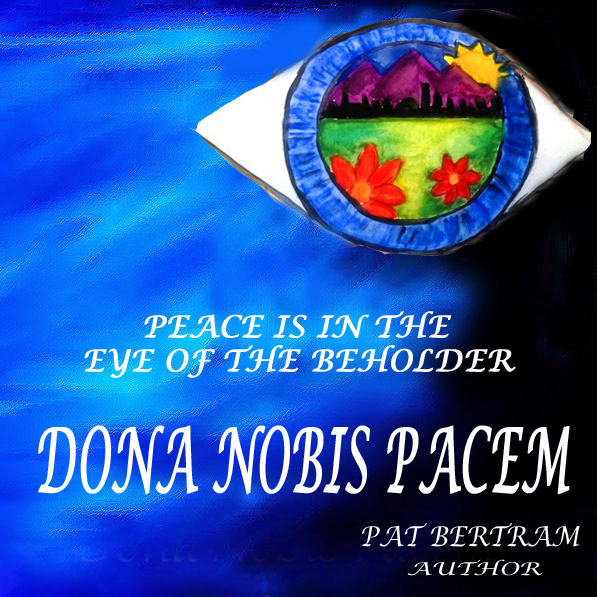
Dona Nobis Pacem

Thousands of bloggers from all over the globe are Blogging for Peace today.

One subject. One voice. One day.

Words are powerful . . . this matters.

peace-blog-hand copy

***

Pat Bertram is the author of the suspense novels Light Bringer, More Deaths Than One, A Spark of Heavenly Fire, and Daughter Am I. Bertram is also the author of Grief: The Great Yearning, “an exquisite book, wrenching to read, and at the same time full of profound truths.” Connect with Pat on Google+. Like Pat on Facebook.

Blogging For Peace

Blog 4 PeaceOn Tuesday, November 4, people all over the planet blog for peace. This year, I’m going to join the the Blog Blast for Peace, and you can join the movement, too. You make your own peace globe/statement or simply choose one pre-made at http://blogblastforpeace.com, and become a peace blogger. The theme this year is “Words in the hands of love,” meaning that what we say or write should be offered with love.

Peace bloggers believe that words, especially words written with love, are powerful, and that this event matters. If you’re not a blogger, you can still join the movement by posting an appropriate status or photo on Facebook or Twitter.

So, check out the above website or check out the Facebook page: https://www.facebook.com/BlogBlastForPeace.

How To Blog For Peace The short version:

1. Choose a graphic from the peace globe gallery http://peaceglobegallery.blogspot.com/p/get-your-own-peace-globe.html or from the photos on Facebook https://www.facebook.com/BlogBlastForPeace#!/BlogBlastForPeace/app_153284594738391 Right click and Save. Decorate it and sign it, or leave as is.

2. Send the finished globe to blogblast4peace@yahoo.com

3. Post it anywhere online November 4 and title your post Dona Nobis Pacem (Latin for Grant us Peace)

Sounds cool, doesn’t it? See you on November 4!

***

Pat Bertram is the author of the suspense novels Light Bringer, More Deaths Than One, A Spark of Heavenly Fire, and Daughter Am I. Bertram is also the author of Grief: The Great Yearning, “an exquisite book, wrenching to read, and at the same time full of profound truths.” Connect with Pat on Google+. Like Pat on Facebook.

Going Ad Free on WordPress?

When I first started my blog with WordPress, their policy was that they would try to be as ad-free as possible, but that to keep the site a free service for bloggers, they would occasionally and unobtrusively add ads. At the beginning, I never noticed the ads, but as the number of blogs and the cost of doing business has increased, so has the number of ads. (At least it seems that way.)

I can go ad-frimagesee for $30 a year, but I don’t know if this is a necessary expense. The ads, including videos, generally appear at the bottom of individual blog posts. Sometimes the ads seem disruptive and not at all in keeping with my posts, but I don’t know if this makes a difference to readers. Many readers are also WordPress users, so they understand about the ads, and I’m not sure it matters about people who stop by accidentally, hoping for . . . whatever it is they were hoping for.

So, is it important to go ad-free, or do people simply take the ads as a matter of course?

***

Pat Bertram is the author of the suspense novels Light Bringer, More Deaths Than One, A Spark of Heavenly Fire, and Daughter Am I. Bertram is also the author of Grief: The Great Yearning, “an exquisite book, wrenching to read, and at the same time full of profound truths.” Connect with Pat on Google+. Like Pat on Facebook.

Fair Use, Copyright, and Images

I have a friend who freely uses images she finds on the internet to pretty up her blog posts, and at the bottom of each post, she always adds the caveat, “No copyright infringement intended.” That cracks me up because of course she intended to infringe upon the copyright — she blatantly and purposely used the image without permission. That is an infringement. Saying that no infringement was intended does not negate the perhaps illegal use of the image. Even giving credit or providing a link to the original photo doesn’t make the infringement legal.

Yesterday I spoke of “Fair Use” and copyright as pertains to song lyrics and told you how many words of a song written after 1923 you can legally use in your work. (None. That’s right, none. You can use the title, paraphrase the words, write your own songs, or purchase the rights to use the lyrics. Those are your only options. You cannot use a single word of the lyrics without permission.)

Fair use also applies to images, not just written works. Fair use laws allow using bits of copyrighted materials without having to obtain permission, though what constitutes “fair use” is murky and subject to interpretation by the courts. (And oh, just so you know, all original works are protected from the moment of creation, so if the work was never filed with the copyright office, if the work lacks a copyright symbol, the work is still protected.)

According to the US Copyright Office, there are four factors to determine what is fair use:

copyright1       The purpose and character of the use, including whether such use is of commercial nature or is for nonprofit educational purposes

2       The nature of the copyrighted work

3       The amount and substantiality of the portion used in relation to the copyrighted work as a whole

4       The effect of the use upon the potential market for, or value of, the copyrighted work.

You can use of some images, such as images public domain images created before 1923 (unless they have subsequently been copyrighted). And you can generally use images in product reviews. Using a product image, such as a book cover, an image of a vehicle, or cold cereal, is necessary for a helpful review. Since the image is not the product and the owner’s rights are only minimally infringed upon, your use of the image falls under fair use.

Some people who post images on the internet do allow you to use their images with only attribution as payment (and they will state as much on the site where the images are posted, generally under a Creative Commons License). Also, many royalty free photos are available from various sites, such as Free Stock Photos, but you need to read the small print carefully to find what each photo requires of you before you use it.

If you use an image of an original photograph or work of art, even if you attribute it to the author and even if you link back to the original, you are in violation of copyright laws unless you have the artist’s permission to use the image. If you don’t have permission, you can be sued. And yes, bloggers have been sued over the use of images. One blogger I know used a photo she found on the internet, thinking it was okay to do so because it is general practice among internet users to adorn one’s blog with such images. When the owner’s lawyer contacted her about the matter, she removed the photo and thought that would be the end of it. But she was wrong. They sued her — and won. She is still paying them off. (And she still owes hefty attorney’s fees.) She was lucky. Others have had their sites removed from the internet in addition to all the other legal hassles.

So, if you do not know for certain if you can legally use an image (and the only way to know for sure is if the image is posted with such information), then don’t. It’s not worth the risk.

***

Pat Bertram is the author of the suspense novels Light Bringer, More Deaths Than One, A Spark of Heavenly Fire, and Daughter Am I. Bertram is also the author of Grief: The Great Yearning, “an exquisite book, wrenching to read, and at the same time full of profound truths.” Connect with Pat on Google+. Like Pat on Facebook.

How to Become a Bestselling (Romance) Author

I don’t know how to become a bestselling non-genre writer, which is what I am — a non-genre writer. (Recently a reviewer took exception to my non-genre status, giving A Spark of Heavenly Fire only two stars because she expected the novel to be romantic/suspense, an action/adventure or a good mystery. She admitted the book contained all of these elements but not enough to tag the story as such. I wanted to leave a “duh” response, but I’ve been around long enough to know that arguing with a reviewer is never a good idea.) But I do know a bit about how to beome a bestselling romance writer since I’ve studied so much of their techniques in my quest to become a bestseller myself.

First, write good story, create or have a cover designer create a compelling cover that says “buy me,” and give your book a thorough edit or get someone to do it for you. A good editing is paramount. With so many romance novels on the market, you need to be a bit better than average to stand out. (Unless, of course, you are the first person to write erotic vampire bondage books or any such novelty, then of course, you can write however you wish.)

Second, finish book two and three in the series, and give them a good editing, also. Then give away the first book in the series to as many people as possible using a Smashwords coupon. Give the book away on blogs, on FB, as a mass mailing, maybe even on Smashwords itself for a short time. Sign up for a giveaway on Goodreads, LibraryThing, and wherever else you can. But this only works after the three books are published because otherwise it doesn’t gain you much of a marketing advantage. If all the books are published and readers like the first book in a series, they will buy the others. There are too many books published now for readers to want to wait for additional books in a series, which is why more than one book in a series needs to be published if you really want the marketing push to count. If the book is professional, one of a published series, is romance and especially regency romance, and has a touch of eroticism (more than a touch is even better), that’s all you have to do. Amazon’s algorithms will do the rest. Theoretically, at least.

Although social networking is often touted as the best way of promoting books, it is slow and doesn’t really help a lot in making you a bestselling author, but it can increase awareness of your books once you become known. Also, a bit of social networking can help you find other romance writers who might promote your books if you promote theirs (such reciprocal promotions have catapulted many romance authors and thriller writers into stardom). You might even find fans who will be delighted to help spread the word about your book for a bit of swag. It’s good to have a blog or be part of a multi-author blog so your readers can keep up with you, though you don’t have to blog regularly, just once a week on a personal blog or once a month on a multi-author blog since for the most part blogging doesn’t sell books.  A Facebook presence or a Twitter account is also nice, but none of these will make you a bestselling author by themselves. Oh, sure, there are people who have made a killing using Facebook, but they are generally those who sell books about how to make a killing on Facebook. And some people play the link (spam) game, posting their book links to thousands of groups on Facebook, but since most of the people in those groups are also playing the link game, the results are variable.

In today’s book world, as much as I hate to admit it, Amazon is the key.

If you don’t have a romance series or if you do have such a series and wish to give your book an extra push, do KDP select but list the book for $.99 on free days. You don’t get as many downloads as you would if the book were free, but the book stats are figured with the regular books not the free books, and so it has a longer lasting effect.

In addition, try giveaway sites like http://readcheaply.com/, 99 cent sites like http://www.pixelofink.com/sskb/ and paid sites like http://digitalbooktoday.com/join-our-team/

This is such good advice, I wish I were interested in writing romance series!

As for A Spark of Heavenly Fire: if you’re interested in seeing if the above mentioned reviewer is correct, until November 23, 2014, A Spark of Heavenly Fire will be available at 50% off from Smashwords, where you can download the novel in the ebook format of your choice. To get your discount, go here: A Spark of Heavenly Fire and use coupon code ST33W when purchasing the book. (After you read the book, posting a review on Smashwords would be nice, but not obligatory

***

Pat Bertram is the author of the suspense novels Light Bringer, More Deaths Than One, A Spark of Heavenly Fire, and Daughter Am I. Bertram is also the author of Grief: The Great Yearning, “an exquisite book, wrenching to read, and at the same time full of profound truths.” Connect with Pat on Google+. Like Pat on Facebook.

Happy (Belated) Bloggiversary to Me

I seem to be losing track of dates lately. Not days of the week, of course — I am always aware of what day it is to make sure I don’t miss a dance class — but the days of the month seem to be escaping me.

I’d planned to do a grief update at four and a half years, and although yesterday’s post was coincidentally about grief, the fact that it was my four and a half year anniversary didn’t even register. Nor did it register that it was the 27th. The day that my life mate/soul mate died — the 27th of the month — has always brought with it a special awareness, and yesterday that awareness went missing. It’s possible, of course, that subliminally I did remember, hence the mention of grief, but it could also be that I was simply reaching for a blog topic and seeing a friend reading Grief: The Great Yearning spurred me to write what I did.

Another blog post I’d planned to do was my blog anniversary post. On September 24, 2007, I posted my very first bloggerie, and September 24, 2014 came and went without any sort of awareness of the 7th anniversary of this blog.

Still aballoonsnother post I’d planned to do was a concurrent celebration — the anniversary of three years of daily blogging. During the first four years of blogging, I posted only three or four times a week, but on September 24, 2011, I made a 100-day commitment to post a daily blog, and I continued to post every day once that initial commitment was fulfilled. I was particularly interested in this anniversary because I’d planned to rethink the daily blogging — it’s not always easy to post every day, especially now that the traumas of my life are settling down a bit so that I have less to write about. (And, of course, I’m dancing more, so I have less time to write.) Yet, subliminally, I must have made the decision to continue, because here I am, still blogging each day.

When I started this blog, it was a way of getting a head start on promotion for when/if I got published. After I got published, it was supposed to be a way of promoting my books. But, as I’ve learned, blogging, like all social networking efforts, has minimal effect on book sales.

[Social networking only helps create a web presence. What makes a huge difference in sales is playing Amazon’s algorithmic games, trying to get on one of their seemingly endless bestseller lists and letting the algorithms catapult you to stardom. But, silly me, I am carrying on my own private war with Amazon (I think they exert too much control over the book business) and so, to use a very trite and quite disgusting metaphor, I’ve cut off my nose to spite my face. Facebook works to a certain extent if you join a zillion groups and frequently post links to your books in those groups, but that isn’t networking — it’s spamming.]

Although promotion is no longer a factor (well, not much) in keeping up with this blog I do like writing and publishing my articles. I feel safe here, and that feeling of safety gives me the freedom to say what I want, no matter how personal. Four and a half years ago when my life mate/soul mate died, his death catapulted me into such a world of such pain that it bled over into my posts. This blog became a place where I could try to make sense of what I was going through, to offer comfort and be comforted, to find my way to renewed life. And even though grief is mostly leaving me alone now, I’ve continued the policy of writing about the various traumas and conflicts of my life.

It’s nice to know that whatever life throws at me, whatever problems I encounter, whatever challenges come my way, this blog will be here for me, even if I do forget my bloggiversary.

***

Pat Bertram is the author of the suspense novels Light Bringer, More Deaths Than One, A Spark of Heavenly Fire, andDaughter Am I. Bertram is also the author of Grief: The Great Yearning, “an exquisite book, wrenching to read, and at the same time full of profound truths.” Connect with Pat on Google+. Like Pat on Facebook.

Finding the Wildness

Look what the goddess does when she is sad:
she takes up a tambourine, made of taut skin
and rimmed with castanets of brass,
and she begins to dance. The sound of flutes
blares out wildly, reaching even to the depths
of the underworld, so loud, so clamorous is it.
Look what the goddess does when she is sad:
she finds the wildness in herself, and as she does
she finds that there is joy there too.
~ Greek dramatist Euripides

A reader left this lovely poem as a response to my post In the Presence of Death…, and Euripides’s words are so very apropos. Although I am far from being a goddess, I am hoping to find the wildness within. And I am dancing.

I don’t dance wildly — the classes I take are all classical dances with practiced steps and choreographed movements, but dance does speak to something wild deep inside of me. For someone who’s life has always been about words — both reading and writing — dance is a way of reaching the wordless depths, of finding the woman beneath the trappings of civilization and expectations and other people’s stories. I sense it’s also a way of awakening more of the wildness within, bringing with it the strength and courage to live fully and gracefully.

I once read an article that talked about stream-of-consciousness being the brain’s default mode. The journalist reported that in depression, the default mode network appears to be overactive, that a depressive brain shows a pattern of balky transitions from introspective thought to work that requires conscious effort, and it frequently slips into the default mode during cognitive tasks. A depressive brain also shows especially weak links between the default mode network and a region of the brain involved in motivation and reward-seeking behavior.

This could be the reason why blogging is so easy for me and writing fiction so hard. Blogging for me is stream-of-consciousness writing and brings immediate rewards, while writing fiction is more cognitive and takes more conscious effort than I am sometimes willing to spent. (A fellow writer once described writing as a mental prison, and while most authors seem to find freedom in fiction, I find it restrictive, especially since the rewards of a finished project are delayed for sometimes years.)

But dance . . . ah, that transcends both stream-of-consciousness and cognitive thinking. It’s a matter of concentration and memory, of training the body to do your will (or rather, your teacher’s will). And where there is neither stream-of-consciousness nor cognition, there is no depression, no sadness. Or so it seems.

Although I still have upsurges of sadness when I am alone, I am seldom sad in class and never depressed. I don’t always find dancing joyful. It’s often hard for me and frustrating at times when my body simply will not do what I will it to do, or when I cannot get what seems to be a simple step. But dancing is always compelling, even when it is difficult — especially when it is difficult. The discipline of stretching just a bit further or reaching a new understanding of a movement, helps dig beneath what I know of myself, helps find the wildness in me. There is joy in that, and joy is its own reward.

There is also joy, of course, in dancing in unison with other not-so-young women who are also dedicated to the art, and there is vast joy in having learned a new dance, particularly for someone such as I who never in her life conceived of such a possibility.

During class, after we warm up, before we work on the current dance, we practice the dances we already know. And each time we dance one of those numbers, there comes a point in the dance where I can feel a huge smile on my face as I realize that oh! I am dancing! And for that moment, I feel like a goddess.

***

Pat Bertram is the author of the suspense novels Light Bringer, More Deaths Than One, A Spark of Heavenly Fire, andDaughter Am I. Bertram is also the author of Grief: The Great Yearning, “an exquisite book, wrenching to read, and at the same time full of profound truths.” Connect with Pat on Google+. Like Pat on Facebook.

Blogging and Disloyalty

Sometimes I feel disloyal blogging about all the problems I have with my family’s various infirmities, whether physical or mental, as if I am betraying them, my father and brother especially. And yet, these problems are the same ones other people are struggling with — aged parents and dysfunctional siblings or offspring. It’s in talking of these matters that we discover how un-unusual the problems are — we all have seem to have the care of someone thrust on us, disrupting our lives.

Some people have to deal with various other problems, of course, such as caring for a spouse’s infirmities, but I don’t have much to say about such matters since my coupled days are behind me.

While my life mate/soul mate was dying, I seldom talked privately and never publicly about his decline or the problems it caused me — that truly would have felt like a betrayal, as if I were exposing him or as if I were talking about matters that did not belong to me. To cope, I simply drew within and continued to live as best as I could. His death catapulted me out of that state, enatugofwarbling me to launch my angst-ridden cry into cyberspace. I’m not sure he would have approved of my being so open about my feelings, but by then, he no longer had a say in my life. Besides, my grief belonged to me alone.

I doubt I will ever feel that intense loyalty again, which is good. I no longer want or am able to live in the empty spaces in my soul.

Last night I blogged out my frustration with my father’s panic attack and the mindlessly mean way he acted. It enabled me to sleep peacefully (well, sort of) last night and wake up encouraged enough to go on.

The time is coming, perhaps soon, when my father can no longer be allowed to have his way about staying alone when I am out of the house, but despite the minor emergency last night, I’m inclined to let things remain as they are awhile longer. He is terrified of losing control, and he is someone who has always had to have steely control — of himself, his family, his surroundings. (You’d think I’d take delight in this gradual erosion of his control, considering how domineering he was in my youth, but I find no joy in watching his decline.)

Still, disloyal or not, I will need to continue blogging about my problems as life and death persist with their game of tug of war. It’s a matter of my survival.

***

Pat Bertram is the author of the suspense novels Light Bringer, More Deaths Than One, A Spark of Heavenly Fire, andDaughter Am I. Bertram is also the author of Grief: The Great Yearning, “an exquisite book, wrenching to read, and at the same time full of profound truths.” Connect with Pat on Google+. Like Pat on Facebook.

A Fowl Day

Today was clear, dry, and hot. The outside temperature reached 100 degrees, which could be why we didn’t have fowl weather on such a fowl day. (Fowl weather, I imagine, is weather that gets the geese flying south for the winter.)

I’m no spring chicken, which is especially apparent on fowl days such as this. I’ve been running around like a . . .

chickenNope, I can’t say it. I’ve never seen a chicken running around with its head cut off, though I suppose the bodies of chickens can last a few seconds without their brain — after all, the expression “hen-brained” must have come from somewhere. Still, whether I use the chicken metaphor or stick to the unfeathered truth, I have been rather busy today, running seemingly unending errands, dealing with visitors and various hospice workers, fighting an invasion of ants.

When I was out, I stopped to see a small camper for rent, a refinished 1955 Field and Stream 14-foot trailer. I’m not actually looking for something like that. I’m not sure my car could tow it, don’t particularly want the problem of parking it somewhere, and I’m afraid I’d feel cooped up. (Aha! Another fowl metaphor!) Still, it’s fun thinking about perhaps crisscrossing the roads in a portable roost to see what is on the other side of the country.

As much fun as it has been to use so many fowl metaphors, one I will never use is “henpecked.” I once saw a poor hen-pecked rooster, and oh, what a sad and bloody sight that was.

I hope you have a ducky day today!

***

Pat Bertram is the author of the suspense novels Light BringerMore Deaths Than OneA Spark of Heavenly FireandDaughter Am IBertram is also the author of Grief: The Great Yearning, “an exquisite book, wrenching to read, and at the same time full of profound truths.” Connect with Pat on Google+. Like Pat on Facebook.