The Reveries of a Solitary Walker

I’m reading The Reveries of a Solitary Walker, written by Jean-Jacques Rousseau between the years 1776 and 1778 when he was in exile. He had been considered a great thinker in his time, and had won a prize and much acclaim for his writing, but after the publication of what he considered to be his greatest work, Èmile, a novelized philosophy about education, he was condemned and his book burned because it was proclaimed to be destructive of the Christian religion and all government everywhere. He slipped out of Paris before he could be arrested, was ousted from Switzerland and other countries where he found asylum for a time, denounced from pulpits (which turned the common folk against him), and scorned by even his friends.

He was understandably bewildered by all this because he could see no great difference in his ideas that raised him to literary heights and those that buried him in contempt. And so he became a solitary walker as well as a solitary thinker, saving his “charming periods of contemplation” for himself alone. The essays in this book were written for himself, not for publication, and seem like the sort of thing one would write when one was trying to account for the vicissitudes of one’s life.

Although he came to accept his shunning, and perhaps even welcome the solitude, he never understood the forces that shaped his life. Or perhaps he did, and I have not yet gotten that far in the book. I’m still trying to come to terms with the horror of warrants being issued for his arrest because people didn’t like his book.

Sheesh, I get upset when people leave even mildly bad reviews or somewhat condemning remarks online. I can’t imagine having to deal with true condemnation, and not just from a few people, but from one’s whole world. I can’t even imagine writing anything that would garner a fraction of that reaction.

It’s strange to think that here I am, almost 250 years later, reading Rousseau’s anguished words. Who of us today will still be read 250 years from now? None of us, I would imagine. Words come too cheaply now. More than that, though, I doubt many people today would recognize a deep and abiding thought. We live in a world of opinion — untried opinion, often garnered not from considered thought and research but from an emotional response to the news and issues of the day. When everyone has an opinion, opinions have no value for anyone else except to affirm what one thinks one knows. True, people are being hushed if they don’t conform to the “right” opinions, so maybe things aren’t that much different today than they were in Rousseau’s time. The difference being, the “wrong” opinions (even if they are really right) don’t often get published, at least not in any epochal way.

It’s also strange to think that, divided by the centuries, Rousseau and I share a proclivity for solitary walking, as well as thinking and writing. For all the customs and costumes that have changed, some things abide.

***

Pat Bertram is the author of Grief: The Inside Story – A Guide to Surviving the Loss of a Loved One. “Grief: The Inside Story is perfect and that is not hyperbole! It is exactly what folk who are grieving need to read.” –Leesa Healy, RN, GDAS GDAT, Emotional/Mental Health Therapist & Educator

Puzzling out the Tarot

Although I see myself as a bit of a mystic, I’ve never been into tarot, or any sort of divination for that matter. I always figured if we can change the future, then it doesn’t matter what the predicted future is, and if we can’t change it, then the prediction especially doesn’t matter.

If ever a thought of the tarot crossed my mind, it would have been in the same mental classification as astrology, Ouija boards, and fortune cookies. I used a Ouija board once when I was kid, know my astrology sign and will read my horoscope when it’s in front of me (though the horoscope never seemed to have any relation to anything going on in my life), and enjoy fortune cookies, but that was the extent of my interest. Oh, I did read up on the occult since I have always been one to try to get a peek into the secrets of the universe, but charlatans so often dominated the field, that I stuck with more scientific gateways, like particle physics and quantum mechanics. (Yep, I was one of those who read such books for fun.)

I’m still not sure there is anything for me in the tarot, but considering that it is supposed to be a way to get insights into one’s inner being, it’s worth studying for now. And besides, it seems a message from my brother. Admittedly, this collection of tarot cards hadn’t been specifically earmarked for me, but that mass of decks sure struck a chord with me, so it felt as if he meant me to have them.

So here I am, trying to make sense of a massive amount of contradictory information. For example, the card I picked this morning to answer my question of what I needed to know today, was the nine of swords. Swords are supposed to be a bad luck sort of card, without a lot of happiness attached, and the nine of swords especially so. One interpretation talks about fears, vulnerability and inner turmoil and suggests that I learn what the source of those fears are. Another interpretation talks of depression and suffering, scandal and loss.

But swords relate to consciousness at a mental level, and reflect an individual’s thoughts, beliefs, and overall attitude. They also point to fears and worries, but don’t necessarily put a whole lot of weight on those fears, because the sword is two-edged, which connotes a balancing act to stay positive.

And nines are about nearing completion, maybe about reaching a plateau, because what looked like the end hasn’t quite arrived.

All that seems positive to me, so instead of the nine of swords telling me I’m depressed and fearful and need to figure out what my trouble is so I can get into a more benign state, my own take on the matter is I’m already there. Or almost. That I’m doing well balancing my fears and staying positive, even though I can do better.

See what I mean about contradictory information?

And this isn’t even taking into consideration the whole ancient elements matter — water, fire, air, earth. According to the most common tarot tradition, swords mean air, but some decks and some scholars indicate that swords are fire. (As you can see, in my own interpretation, I left off any mention of air or fire because the element question muddles an already muddled situation.)

On a different note completely, as I was reading about the elements, I happened to open the book to another page that was defining the “fool” card, and I had to laugh. Apparently, in Italy and Austria, The Fool goes by the name “Mat,” which is an Arabic word meaning “a dead person.” In The Wheel of Time, one of the major characters is a fellow everyone thinks is a fool. I thought he was simply an archetype, but he is definitely one of the major arcana characters from the tarot. Not only is his name “Mat,” but as he says, “I’m usually pretty good at staying alive. I only failed one time that I remember.”

Now I’m going to have to re-reread The Wheel of Time again to look for additional tarot references. As well as to continue puzzling out the tarot itself.

***

Pat Bertram is the author of Grief: The Inside Story – A Guide to Surviving the Loss of a Loved One. “Grief: The Inside Story is perfect and that is not hyperbole! It is exactly what folk who are grieving need to read.” –Leesa Healy, RN, GDAS GDAT, Emotional/Mental Health Therapist & Educator.


The Tarot and The Wheel of Time

A hot lazy day, today. With nothing better to do, I unpacked my tarot cards and sorted out my tarot books. Some of the books match a specific deck, and I like to keep the matched sets together. Other books seem more generic, or it could be I simply don’t have the decks the books mention. I also set aside the duplicates, the unopened packs, and those that might be collector’s items, such as the Dali tarot. I’ve never opened either the Salvador Dali tarot (supposedly a deck he was creating for the James Bond movie Live or Let Die), or the Tarocco di Sissi (from artist Amerigo Folchi and based on the life of Austrian Empress Elisabeth) thinking these might have more value still in their factory seal, but things only have monetary worth according to what people will pay, and I don’t know how to find people who want such things. I could keep them as part of my collection, of course, but when one has more than three dozen decks (and doesn’t use any of them), another one or two, especially one by an artist you don’t admire or one about a person you don’t know, doesn’t seem that important.

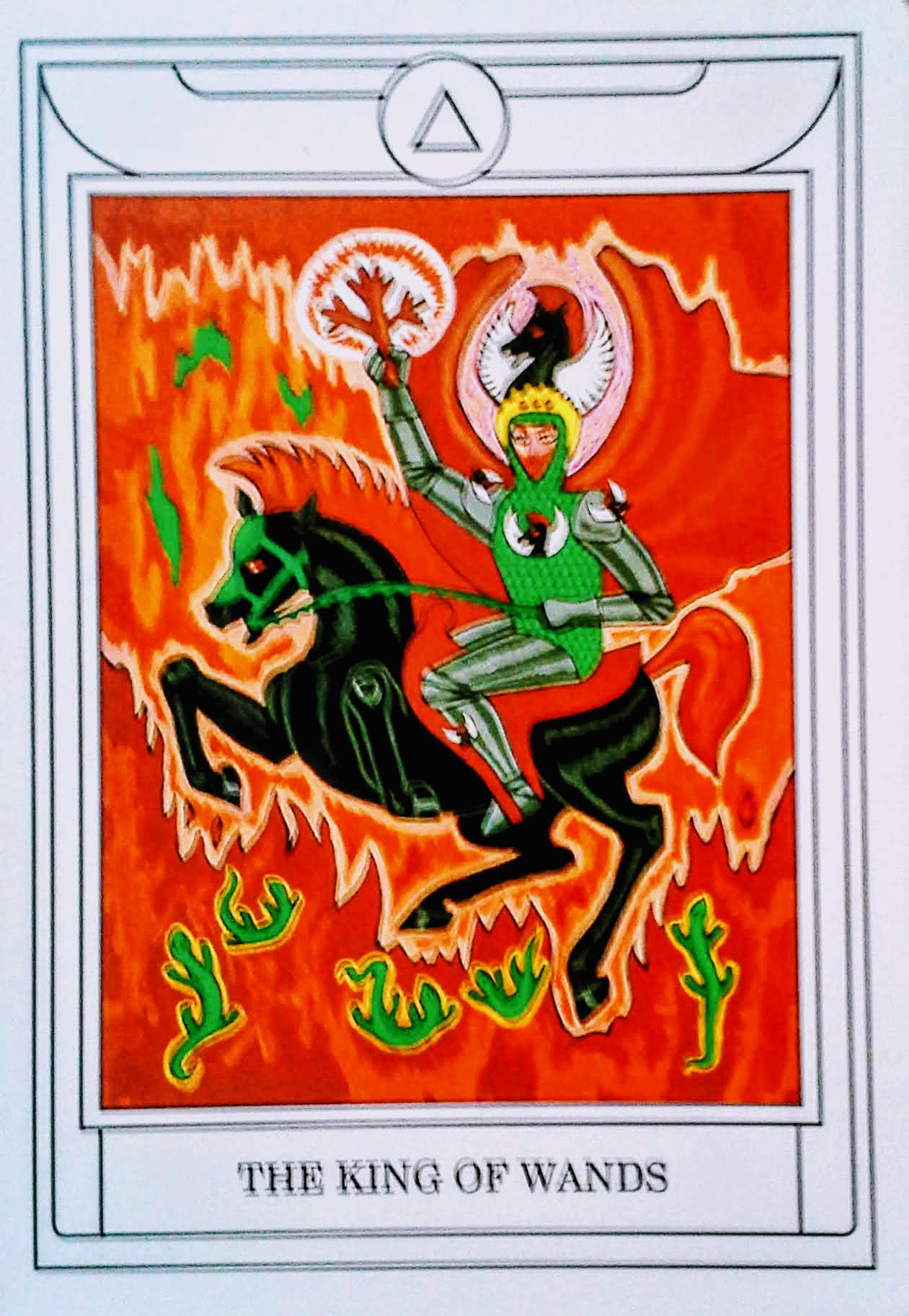
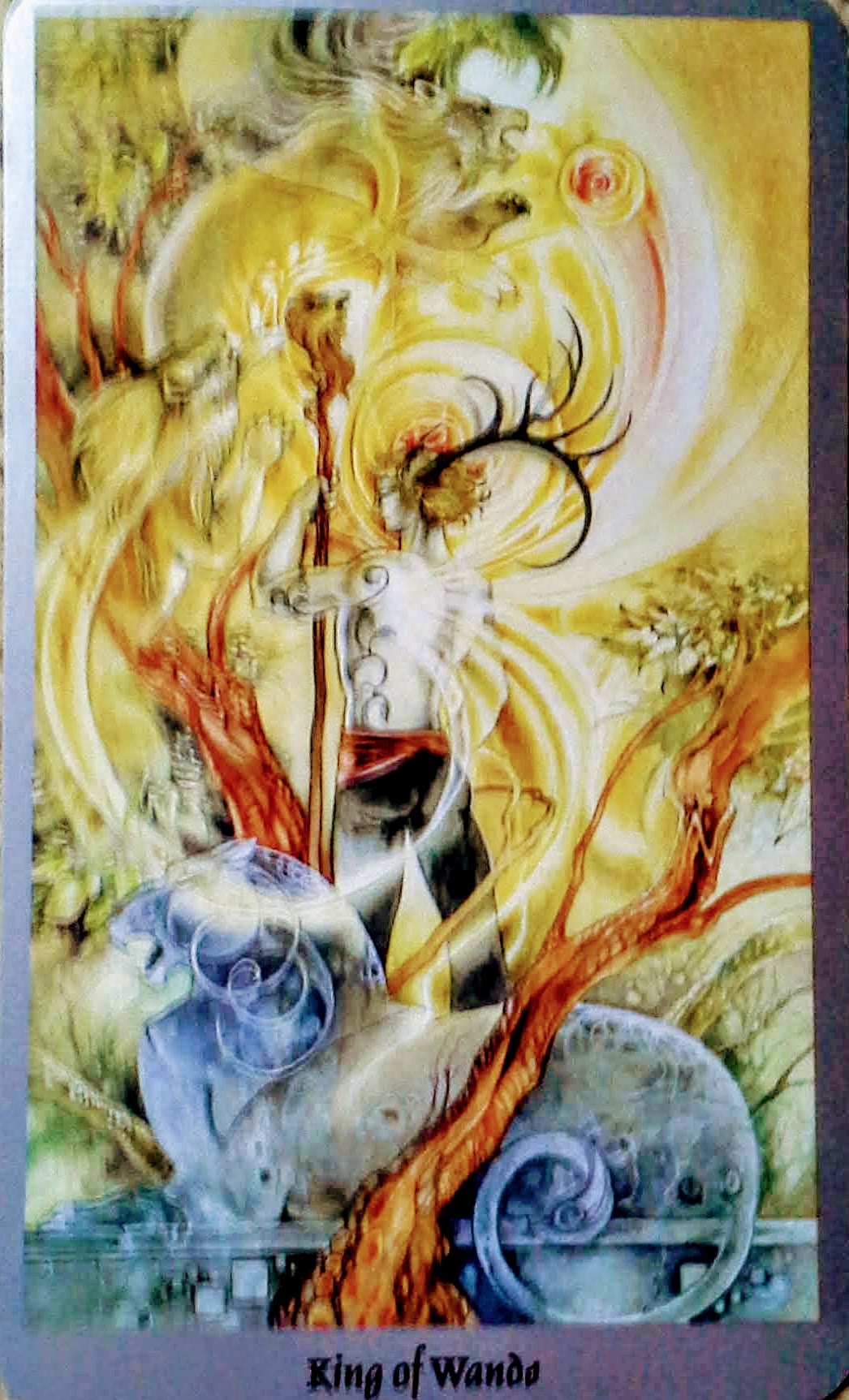
Just for an experiment, I attempted a one-card tarot reading for a friend who is trying to figure out whether to move or not, and I drew the King of Wands. To be honest, I have no idea how this card answers the question (apparently, it’s best to do a spread and see how the cards relate to one another, but maybe he can figure out if the card means anything to him), but I was struck by a coincidence having to do with The Wheel of Time. Coincidence? Considering the ten years that Robert Jordon put into researching, constructing his world, and developing the story before he started writing, I would have to say that it’s a good bet there’s no coincidence here.

In the book The New Golden Dawn Ritual Tarot, the King of Wands is described as “a red-haired man with blue eyes riding upon a fiery black stallion. The horse and rider both seem wild and warlike, but this is due to raw, unleashed power. The overall feeling that the card gives is one of great uncontrollable energy which erupts with volcanic force.” Another passage says “He is extremely dynamic. He is the Fire of Fire, the volatile igniting spark of the Father Force.”

In the Sadowscapes Companion, the King of Wands strides forward and “The trees part before him, lifting their branches to make way for his passage. The environment shifts to his will and obeys his unspoken desires and commands.” Also, he is charismatic, and is “a source of inspiration and bears his mantle of authority with ease as if he were born to it.”

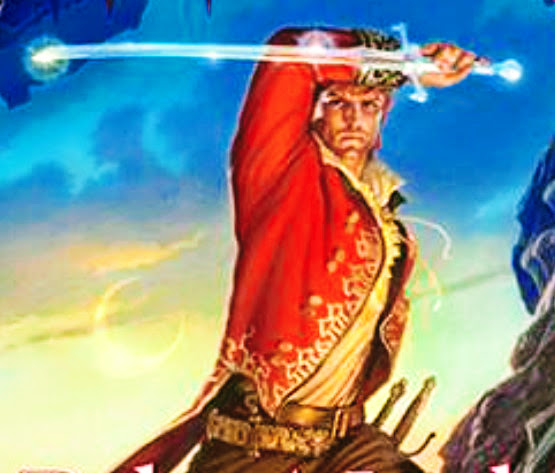
If you know anything about The Wheel of Time, you will recognize The Dragon Reborn. Although sometimes his eyes are described as gray rather than blue, this is the savior character in the series, a clueless country boy who attempts to control the raw power of the universe at his command. Eventually he controls the power and develops into a fire-wielding king who rides a black horse. He becomes a charismatic leader who changes the very lives of those he meets, who molds the world around him however he wills. Also, the salamanders in the red tarot card are more like the dragons in the book than what we consider to be dragons.

At one time I thought it would be interesting to use the tarot to create a story, basing the story on cards chosen at random, as well as by a spread, but apparently, Robert Jordan has already done it.

Many of characters in The Wheel of Time are typical archetypes, such as the trickster, nurse, queen, shapeshifter, but now I suspect there’s a completely different element to the book, a tarot element, for me to deconstruct.

***

Pat Bertram is the author of Grief: The Inside Story – A Guide to Surviving the Loss of a Loved One. “Grief: The Inside Story is perfect and that is not hyperbole! It is exactly what folk who are grieving need to read.” –Leesa Healy, RN, GDAS GDAT, Emotional/Mental Health Therapist & Educator.

Saving the World

I finished rereading The Wheel of Time, and since the library isn’t open yet, I’ve begun re-rereading the series. It’s not that it’s such great writing — with over four million words spread out over fifteen books, there really should have been a huge amount of culling to make it less of a sprawl. Some of the meanderings off the main track are unimportant and inane and downright aggravating — a reader does not need to see every savage side of the lesser antagonists to get the point that they have sold their souls to The Dark One. Nor does a reader need to see certain characters doing the same thing over and over and over again. Nor does a reader need to see author mistakes, such as his forgetting what his characters are like and have them acting brainless for no reason whatsoever.

The series was originally proposed as a trilogy, though the scope of the story demands more than that. TOR Books, knowing how wordy Robert Jordan was, turned it into a six-book deal, which they should have enforced. The Wheel of Time is a perfect example of an author falling in love with his creation. He spent ten years planning the work, doing research, and taking copious notes before he started writing, and apparently, he couldn’t bear to give up any bit of his creation even if it would have made a much stronger story to do so. As to why his publisher didn’t rein him in — there is a whole lot more money to be made by fifteen bestselling books (fourteen plus a prequel) than six. Since the fantasy market is predominately younger folk, I guess they figured they had a non-critical readership, and every time a new book came out, a new crop of readers came of age, which prompted sales of the earlier books in the series.

Luckily, it’s easy enough to skip over the many sidetracks and dead ends to keep to the essence of the work, though that doesn’t help dealing with the parts of the story that aren’t there. Jordan delighted in writing ad nauseum about trivial matters but mentioned important points almost as an aside and brought in mysterious characters for cameo spots without any elucidation of who they were or why they were important. Despite myriad interviews, he refused to explain some of his seemingly pointless points, saying he wanted people to think about them. A bit of a god complex, there, but then, I guess that’s understandable when one has created such a massive world to play with.

There is also too much war for my taste, but after all, Jordan is a military historian, and ultimately, this series is about the battle between the forces of light and dark, so all the military hoopla has a place.

Despite the many drawbacks of the series, it’s compelling because of the eternal themes of honor and duty, loyalty and integrity, steadfastness and kindness and friendship, doing what’s right no matter the cost, standing by one’s word, rising above the baseness of one’s life to grasp nobility, accepting one’s fate and becoming a hero. Those are the nuggets of purity that drive the (sometimes appalling) story. And it’s those same nuggets that perhaps make the work worth reading and even rereading.

It’s funny — each time I reread the series, I tell myself that this time I will read every word, and each time I get bored by the trivial chapters and inane characters and become aghast (re-aghast?) at the sadism, and end up skipping vast sections to get to better parts. Some of the horror is necessary, of course, to help forge the rather ordinary characters into the heroes (reluctant or not) they will become. I mean, you don’t simply wake up one morning with the power and resolve and ability to fight the overwhelming darkness that might be threatening to consume us all.

Jordon has created an incredibly complex kaleidoscope of a world, taking all the bits and pieces of our cultures, customs, costumes, mythologies, legends, religions, histories, and shaken them up and spread them out in a new and vibrant pattern. One of the fun things about rereading the book is picking up elements that one missed the first time through. (Despite that, there are whole storylines that add nothing to the whole — the Seanchans, Slayer, Perrin and Faile to name just a few.)

Since this is the quintessential hero’s journey, with each character on his or her own path to greatness, there is homage to the legend of King Arthur as well as to lesser known legends.

There are the archetypal characters, such as shapeshifters and tricksters, mentors and allies. And underlying it all is the savior tale, both the Christian story and the pre-Christian ones.

What would you do if you’re going about your ordinary life, doing what you’ve always done, and then discover you’ve been chosen to save mankind, chosen to give up your life to save the world?

I wonder — as I sit in safe isolation while many folks around the world are dying of a novel virus — if I would have the courage, the stamina, the will, to undertake such a task. In my heart of hearts, though I would wish I did have such a heroic character, I know I would not be able to do it. Could not do it — I’m too old, too tired, too powerless. But when I immerse myself in this legendary world, I think . . . maybe.

Just maybe . . .

***

Pat Bertram is the author of Grief: The Inside Story – A Guide to Surviving the Loss of a Loved One. “Grief: The Inside Story is perfect and that is not hyperbole! It is exactly what folk who are grieving need to read.” –Leesa Healy, RN, GDAS GDAT, Emotional/Mental Health Therapist & Educator.

Not Cowering, Not Courageous

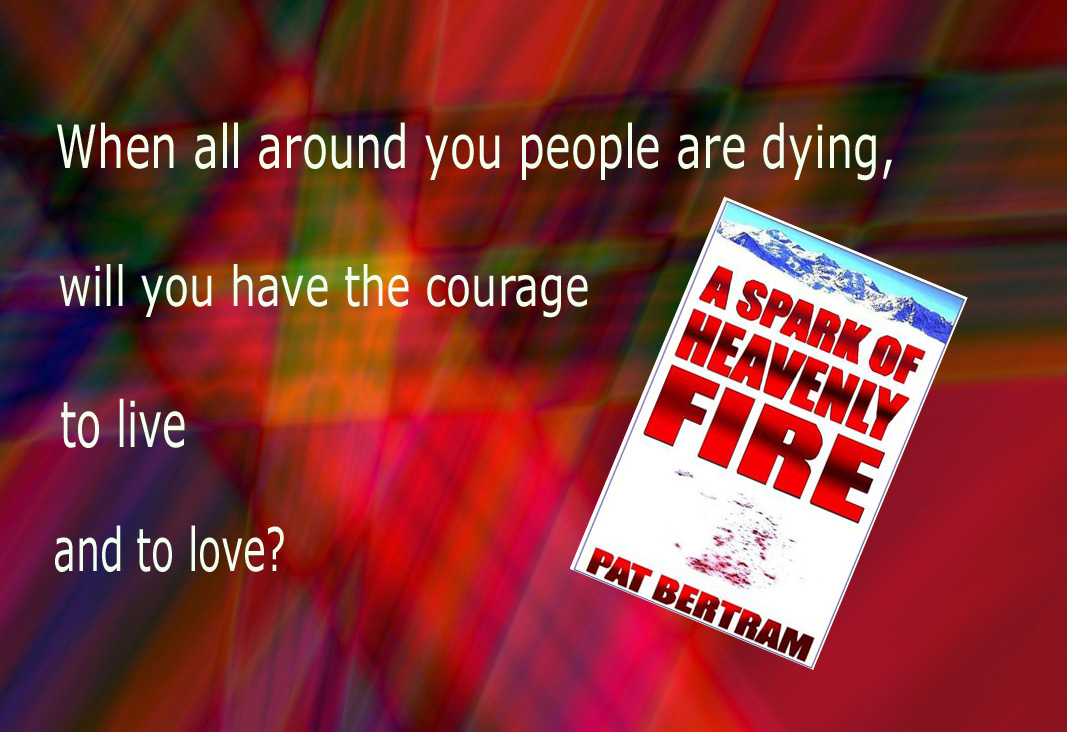
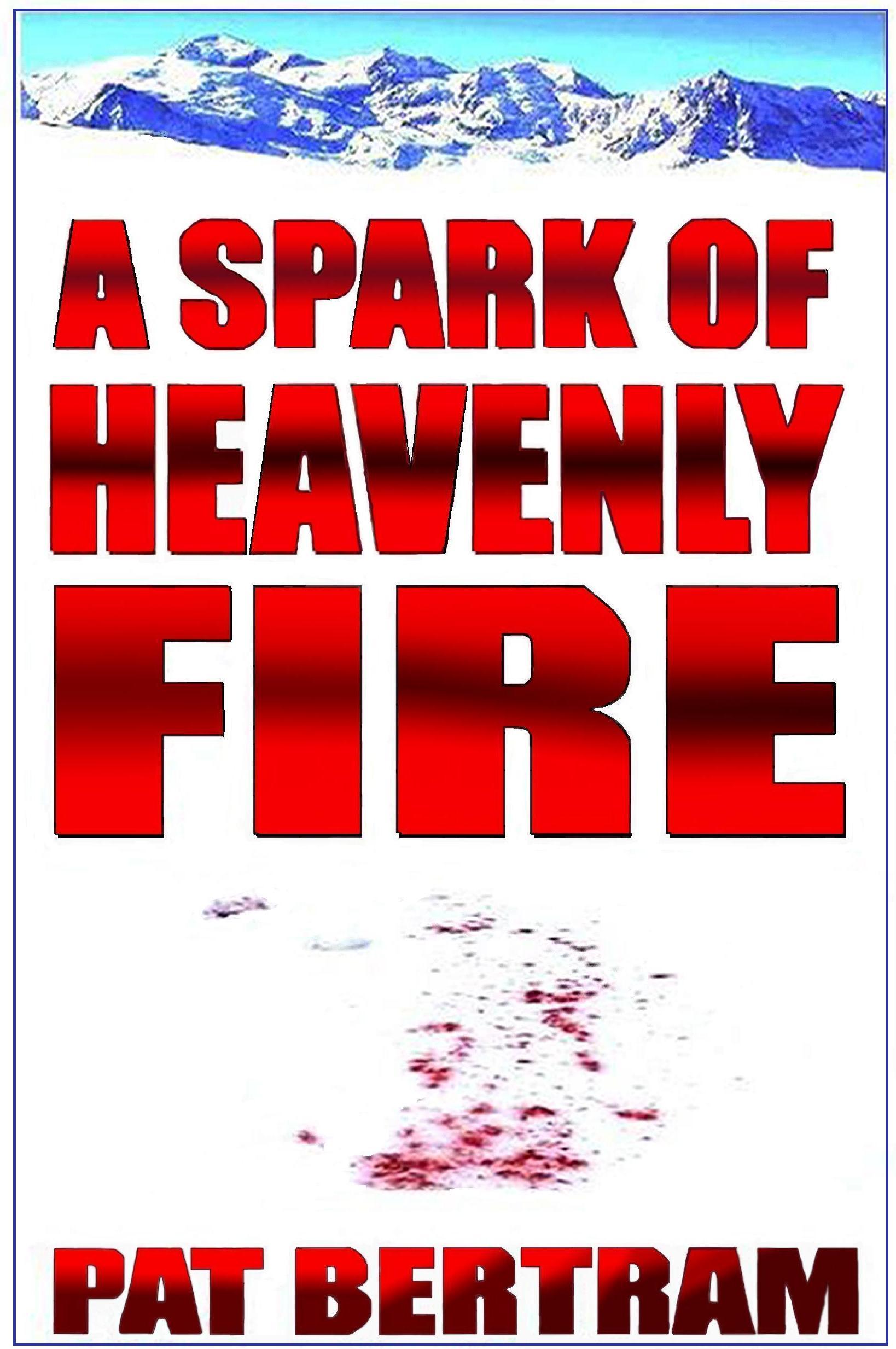
What if there were hundreds of thousands of people dying in Colorado alone, not just the 987 who have died so far? Would you have the courage to live, to fall in love, to open your home to those less fortunate, to try to find out who unleashed the microscopic beast as my characters in A Spark of Heavenly Fire did?

Apparently, I wouldn’t. I’m following orders and staying home. Alone. Not much courage in that. No spark of heavenly fire, either, that’s beaming up and blazing in this dark hour of adversity.

I’m not exactly cowering, but I am paying attention to the stay-at-home order even though most people in my age group aren’t. Little by little they are claiming their lives, going out and doing non-essential things, getting together in small groups. If my knee were healed, I might join some of them, especially those who meet outside, but my knee makes me feel vulnerable. I’ve also spent so much time alone that I fear my immune system isn’t exactly in tip-top shape, so I’d be especially susceptible to any small illness that comes along.

So, not cowering, not courageous. Just pragmatic.

I do worry, though. I have spent so much time in the years since Jeff died trying to be sociable despite my inclination to not go out, that I fear this time of being forced into staying home will make it all but impossible for me to gain the energy to overcome my natural hermit tendencies. I used to say “yes” to all invitations because that forced me out of my nest, but now I find myself saying “no.” Eventually, people will stop asking.

Although I do believe that The Bob was never severe enough to merit the measures that were taken to keep us home and to “flatten the curve” to keep the ill from overwhelming hospitals (the projection of deaths was built on a flawed model that was discredited months ago), I would probably have stayed home anyway. I tend to catch things easily and be sick longer than most people — and did so even when I was younger — that I have learned to take extra precautions, though I admit, those precautions probably would not have been as strict as the stay-at-home orders.

Luckily, I have the choice. Luckily, I have a lovely house in which to stay home.

And luckily for you, for the next month, A Spark of Heavenly Fire will be available as a free download from Smashwords in all ebook formats. You can find the book here: https://www.smashwords.com/books/view/1842. Be sure to use the coupon code WN85X when purchasing.

I figure that by the time the world gets back to normal — or as normal as it will ever get — people will be sick of the very word “quarantine,” and won’t want to have anything to do with novel diseases or diseases in a novel, which is why I giving it away now. I hope I’m wrong about people not wanting to read about devastating diseases after this is all through because A Spark of Heavenly Fire is more than a story about a pandemic — it’s the story of survival in the face of brutality, government cover-up, and public hysteria. It is also a story of love: lost, found and fulfilled.

It certainly is not about a woman who stayed home. Where’s the story in that?

***

Pat Bertram is the author of Grief: The Inside Story – A Guide to Surviving the Loss of a Loved One. “Grief: The Inside Story is perfect and that is not hyperbole! It is exactly what folk who are grieving need to read.” –Leesa Healy, RN, GDAS GDAT, Emotional/Mental Health Therapist & Educator.

The Wheel of Time

Since I finished reading all my emergency books, I’m reduced to reading the books in my Nook, books I’ve already read. Although I don’t generally like rereading books, Robert Jordan’s massive Wheel of Time series seems to be the perfect place to go to hide from The Bob.

The books in the series are not stand alone books — you cannot understand one book without the previous books — which means that in effect the WOT series is single novel of over four million words broken up into fifteen parts. In fact, the series itself is not stand alone — there are all sorts of books, blogs, discussion forums comprising billions of words where readers try to figure out the truth of the story.

Not only is the scope of WOT almost impossible to fathom, but Jordan had a bad habit of putting in bits of deus ex machina that he refused to elucidate in the work itself, companion books, or even interviews. Perhaps he himself did not know what those bits meant or maybe he simply wanted to be mysterious for mysterious’s sake, to create a legacy of people debating worthless points. Which they do. Ad infinitum. Jordan also refused to explain what to him were obvious story points, such as who killed a certain bad-guy-turned-maybe-good-guy, but again, dozens of forums present various theories because that obvious point was obvious only to he who created it. At least in this particular case, the murderer was revealed in an appendix several books after the fact. Jordan also spent thousands upon thousands of words on red herrings and subplots that go nowhere, but sometimes used a single sentence buried in huge blocks of description to bring out a major point. Yikes.

And wow, is there description. Tons of description. Whenever food is mentioned, I find myself skipping a paragraph or two. When clothes are mentioned, I skip a couple of pages. And sometimes, when there is zero action or character development, such as in a few very clean bathing scenes, I skip the whole dang chapter.

I also tend to skip over some of the women’s parts. Although Jordan mostly develops his three main male characters into individual heroes, each with his own mythic journey, he turns his three main women characters into insufferable caricatures, indistinguishable from one another except for a few annoying character tics. At first I thought he had a problem with women, but his secondary and tertiary female characters are often well-defined or at least not brats and prigs who believe, without giving a single shred of thought to the forces the other characters face, that they know the best for everyone.

Even after investing so much time in reading and rereading the books, I’m still not sure I like the series — although the theme seems to be about the importance of having choices, most of the characters, both good and evil, go out of their way to force others to their will. Too much torture and punishment for my taste. It seems to me that in a world where everyone is free to choose (or at least what the pattern created by the wheel of time allows them to choose), it’s just as easy to find someone to willingly do your bidding as to waste the effort forcing someone to do it. (Oddly, the three main males do turn others to their will, but without wanting to or without even trying.)

But despite my ambivalence, I keep rereading. The scope of the story is utterly astounding. In the story, during the so-called age of legends, people wielding the power that turns the wheel of time, broke the world. Mountains grew where no mountains had been, waters flooded lands, green spaces became deserts. And humans started over. Again.

Interestingly, breaking the world is exactly what Robert Jordon did when he wrote his series — he smashed our world into bits, mixed it all up — legends and traditions; countries and races, clothes and customs; myths and mysteries, religions and philosophies — and put it all back together into his own creation.

I wonder what it would be like to create such a massive fiction world, a world that reflects our world but not. A world that reflects our values but not. A world that exists only in our minds but not. Or, rather, maybe not. If it exists in our minds, it’s possible Jordan’s world exists for real, sort of dream world we all created together, just as philosophers and physicists say we do with the real world.

Assuming there is a real world.

Maybe we’re all writing the story of our world as we live it, creating with our hive mind the very fact of our existence. If we all stopped believing in it, would it disappear as if we were closing the cover of a novel? Would we disappear if we stopped believing all the things we see and hear except with our own eyes or ears? Would we be different if we simply refused to accept the role that has been forced on us?

Maybe, as I study Jordan’s world, I’ll learn how to help build a better version of our own — how to write it or right it, either one.

Meanwhile, the wheels of time keeps turning . . .

***

Pat Bertram is the author of Grief: The Inside Story – A Guide to Surviving the Loss of a Loved One. “Grief: The Inside Story is perfect and that is not hyperbole! It is exactly what folk who are grieving need to read.” –Leesa Healy, RN, GDAS GDAT, Emotional/Mental Health Therapist & Educator.

Unspeakable Truths

I don’t know the truth of what’s going on. No one knows, though most of us read a few articles, see a few videos, watch the news, talk to friends, and so we think we do. Not even the people the “conspiracy theorists” think are behind the current situation know the truth. There are folks so deeply entrenched into the power structure of the world economy and have been for so many years, that we see only their minions.

Although I don’t consider myself a conspiracy theorist, I have spent most of my life researching conspiracies, trying to find the truth. (Keep in mind that researching back then wasn’t a matter of googling a few sites and watching a couple of videos. It meant books, and books, and more books. It meant studying research papers and tracking information through various sources.)

That’s all I’ve ever been interested in — the truth. Whether it’s the truth of religion, politics, history, science, life, death, it’s all fair game to me. Truth has been a lifelong pursuit. In fact, when I was in eighth grade, we were assigned to create the front page of a newspaper, including headlines, articles, etc. My newspaper was all about the meaning of nursery rhymes, and back then it took some digging to find out some of those meanings. For example, “Ring-around the rosy” originated as a rhyming song about the black death —“We all fall down.” Mary, Mary, quite contrary supposedly tells a grim tale about Mary Tudor.

One thing I did learn during a lifetime of research (two lifetimes if you include Jeff’s historical research in addition to mine) is that often a so-called conspiracy is merely a plan someone or a group of someones makes and doesn’t tell anyone.

Is what’s going on today fulfilling some people’s agendas? Probably. However it started, however anything starts — whether by accident or design — there is always someone who is ready to make a profit from it, either in money or power. There will also always be people who believe there is an agenda even if they can’t agree on what that agenda might be, and there will always be those who don’t. It doesn’t make a difference, really. We still have to deal with each day as it comes and to protect ourselves however we can.

Although I have been trying to find out how some influential people are using this situation to promote themselves and their businesses (destroying small businesses in the process), I don’t know if I care what the truth is. Whether this is the simple pandemic we’re told it is or whether there is some nefarious purpose behind it, knowing won’t change anything. Besides, the truth doesn’t always set us free. Sometimes it only serves to make us sad and weary and so very, very discouraged.

When I was writing A Spark of Heavenly Fire, my novel about biological warfare that mirrors this situation in sometimes eerie ways, I needed a substory and, as often happens, I found a clue in the very next book I read, and the pursuit of that clue led me to a place called Pingfan and added a depth to my novel I could never have imagined.

By that time, I thought my knowledge of man’s and woman’s inhumanity to their own kind made me shockproof, but even I was appalled to learn about Pingfan. For those who have read A Spark of Heavenly Fire — no, I did not create Pingfan. I don’t have that sort of inhumane brain. General Ishii created the place.

General Ishii was the leader of the Japanese germ warfare program. It’s ironic, but the Japanese had no interest in biological warfare until the Geneva Protocol’s 1932 ban on biological weapons. Ishii concluded the ban meant they were an effective means of fighting a war, so he persuaded the imperial army to let him establish a biological warfare installation. The army granted permission in 1937.

They built the installation in Manchuria near a village called Pingfan, forty miles outside of Harbin, and it was huge—a town in itself, actually, and self-supporting. In addition to living quarters and the research facilities, which included a separate compound for plague research, there was a school, a railroad siding, an administration building, a crematorium, a powerhouse, a hospital, an airbase, and farms for raising food and livestock. A high wall topped with barbed wire hid the facility from view. A moat lay beyond the wall to trap any intruders, and an electrified fence surrounded the inner perimeter to prevent escapes.

Three thousand doctors, scientists, technicians, and soldiers worked there. The output was staggering. They grew and experimented with all kinds of diseases and bio-weapons. And they had the capacity for producing twenty million doses of vaccine annually. Radiating out from Pingfan were eighteen other biological warfare stations, each staffed with three hundred people. Many of those stations were on mainland China. The whole program was administered by an organization with the innocuous name of Boeki Kyusuibu, which means Anti-Epidemic Water Supply Unit.

The Japanese conducted their experiments on Chinese villagers and POWs—mostly Chinese, but also American, British and Australian prisoners. (Many of the soldiers from the Bataan death march ended up there.)

Hundreds of American POWs died torturous deaths, and if by chance any of them survived one experiment, they were immediately put to use in another. Thousands upon thousands of Chinese were also killed—at least a hundred thousand, perhaps as many as a million—but the Japanese admitted to only a thousand. (And now the Chinese have their own bio-labs.)

The Japanese conducted all sorts of experiments.

Using planes, they scattered rice and wheat mixed with plague.

They dropped anthrax bombs designed to shatter into a thousand pieces of shrapnel. A single scratch from one of those fragments caused death in ninety percent of its victims.

They injected their victims with diseases, fed them cultures of diseases, exposed them to clouds of diseases in gas chambers, then killed them at various stages of the diseases, and performed autopsies on them. They performed some autopsies while the victim still lived.

They poisoned thousands of wells in Manchuria with cholera, typhoid, and dysentery. Interestingly, a regiment of Japanese soldiers unknowingly drank from one of those wells. Thousands died.

They also infected fleas with botulism, put them in balloons, and let them go, hoping they’d reach the United States. Many of the balloons did reach the western coast, but luckily the fleas had all died.

In addition to bacteriological experiments, the doctors had conducted experiments on frostbite. Victims were taken outside in the coldest months of the year and forced to immerse their hands and feet in barrels of cold water. They were kept outside until their extremities froze, then were taken back inside so the doctors could investigate means of treating frostbite.

The doctors had also done blood work experiments. In an effort to discover if blood other than human could be used to treat wounded soldiers, prisoners had been drained of their own blood and infused with horse’s blood. All died.

After the war, Ishii ended up in the custody of the United States. He told them about his germ warfare program in exchange for immunity. The U.S. concluded that the potential benefits of the research outweighed the demands of justice. No war crimes were ever brought against Ishii, and the whole thing was covered up. Ishii retired to a village named Wakamatsu-cho, where he lived on a pension provided by the U.S. government until his death in 1959.

None of the other doctors involved ever charged with war crimes, either.

The pathology squad leader who had conducted live autopsies became a professor at Kyoto University. He later became a professor emeritus of the university and a medical director of the Kinki University at Osaka.

The doctor who had fed typhoid germs in milk to prisoners, and who had been responsible for certain types of germ bombs, became a professor of bacteriology at Kyoto University.

The frostbite expert joined the faculty of Kyoto Prefectural Medical College and later became its president.

The premier germ bomb expert joined the Japanese National Institute of Health, where he continued his bacteriological research.

The hematologist opened a blood bank that eventually became one of the most successful multi-national medical supply and pharmaceutical companies in the world.

The only reason any of this became public knowledge is that many years later, when some of the American victims applied for help through the VA, they were told their records were sealed, and that what they had experienced had never happened. They fought for their truth, and won.

Was that the end? Of course not. There’s always someone trying to make a bad thing worse. For example, the Russians built an underground facility capable of growing eighty to one hundred tons—tons!—of the smallpox virus every year. Even worse, they modified it genetically, combining the smallpox with Ebola and Venezuelan Equine Encephalitis, a brain virus. Worst of all, the collapse of the Soviet Union left hundreds of biological research scientists unemployed. Many of them took the smallpox with them when they went to work for other countries like Libya, Iran, Iraq, North Korea, India, and maybe even Israel and Pakistan. And of course, the United States.

So, do I think some powerful people are using this current situation for their own ends? You bet. Do I know that those ends are? I can guess, but even that would fall short of the truth, because some truths are so horrific and unspeakable that only masterful psychopaths can imagine them. I no longer even have the heart to write about such crimes, which is why only my first four books are based on various conspiracies.

If you’re interested in reading A Spark of Heavenly Fire, it’s still available as a free download from Smashwords. Click here to get your free ebook: https://www.smashwords.com/books/view/1842. Be sure to use the coupon code WN85X when purchasing.

***

Pat Bertram is the author of Grief: The Inside Story – A Guide to Surviving the Loss of a Loved One. “Grief: The Inside Story is perfect and that is not hyperbole! It is exactly what folk who are grieving need to read.” –Leesa Healy, RN, GDAS GDAT, Emotional/Mental Health Therapist & Educator.
Looking for Book Recommendations

The library here is closed until further notice, but luckily for me, they will take orders for books, and I can pick them up at a designated time. (This is so cloak and daggerish, it really tickles my funny bone.)

I do have an emergency stash of books (and an emergency e-stash for when my paper books are gone), but this cloak and dagger service might not be available for long, so I want to make use of it while I can and save my stash. The problem is there are only a few specific novels I want to read, so normally, I just peruse the shelves, grabbing any book with a title that catches my eye and a blurb that sounds interesting.

With the library closed, I cannot do that. Nor can I order any of the novels on my short list since all those would need to come from another library, and I’m not sure if inter-library loan is available during this time.

So, do you have any suggestions of books for me to order from the library? Or an author to research? They have to be traditionally published books (and authors) since for the most part, those are the sorts of books this library has.

Thanks for your help!

And no, this isn’t my library. Would that it were! It’s the library in a monastery in Prague.

***

Pat Bertram is the author of Grief: The Inside Story – A Guide to Surviving the Loss of a Loved One. “Grief: The Inside Story is perfect and that is not hyperbole! It is exactly what folk who are grieving need to read.” –Leesa Healy, RN, GDAS GDAT, Emotional/Mental Health Therapist & Educator.

Author Dynasties

I don’t particularly like Sue Grafton’s books, but I do admire her — she left her legacy as is, her series unfinished, and would not allow anyone to step up after her death and keep her characters alive.

Too many authors didn’t make that decision before they died, so their heirs made it afterward. For example, some classics are being brought back to life when authors today write unsanctioned sequels to beloved favorites, such as those who pretend to channel Jane Austen or Daphne Du Maurier. 

One of the few times posthumous writing was warranted was when Robert Jordan died before he could finish his modern classic, the fourteen volume Wheel of Time series. Another writer was hired to work with Jordan’s wife and Jordan’s copious notes to finish the series. Can you imagine going through decades with all those thousands of characters and millions of words only to be left hanging on the wheel without a resolution? So yes, it had to be finished. But once it was, it was done. There will be no more Robert Jordan books.

But some stories and authors’ names that do not need to be kept alive are still going for no other reason than to milk the money machine. 

Some fellow is now writing Michael Crichton’s books. And another fellow is keeping Robert Parker’s Spenser alive. Who needs these books? They are not the author’s words, not the author’s vision — just some pale vision of the vision.

A new thing now is for the literary name is passed to the next generation. Michael Palmer’s son is now writing Michael Palmer books. Lee Child’s son will be taking over is father’s series.

And what the heck is going on with James Patterson? The way he’s spawning co-authors, his name will be one of the last words uttered when the earth falls into the sun.

This is what happens when an author’s name becomes a brand. I never used to pay attention to authors’ names except as a way of finding more books to read, and neither did anyone else, at least not to the extent that holds true today. The title was the main thing; the author’s name almost an afterthought. But branding and modern publishing changed all that. Now it’s the author who’s paramount, and no one cares what drivel is passed along to the reading public under the famous brand. (I got caught with a Michael Palmer book written by his son because the famous name was in huge letters, the title in a smaller type, and the writer’s name all but swallowed up in the graphic on the very bottom. So not nice!)

It used to be as one author’s star waned, another’s would rise, but what’s happened to all those non-rising stars? What will happen to readers when the brands finally are laid to rest? Not that it matters. There are plenty of books for me to read, and when there aren’t any more books that I like, I’ll write more of my own.

***

Pat Bertram is the author of Grief: The Inside Story – A Guide to Surviving the Loss of a Loved One. “Grief: The Inside Story is perfect and that is not hyperbole! It is exactly what folk who are grieving need to read.” –Leesa Healy, RN, GDAS GDAT, Emotional/Mental Health Therapist & Educator


Virus!

With all the talk about corona virus and how it’s probably a man-made (or woman-made, for all I know) organism that escaped from a lab, it would be remiss of me not to mention my own organism, the red death. The red death only resides within the pages of A Spark of Heavenly Fire, so it cannot harm you (though it might scare you), but it’s deadly for all that. In fact, it’s so deadly and spread so fast from it’s origins in Colorado, that the entire state is quarantined.

You don’t think that’s possible? The technology already exists, and where people manage to break out of the quarantined area, you better believe that people from the surrounding states would not hesitate to shoot an escapee.

Inside the quarantined state, hundreds of thousands of people are dying in Colorado this unstoppable red death, and though many people have given up hope, insomniac Kate Cummings struggles to find the courage to live and to love. Investigative reporter Greg Pullman, is determined to discover who unleashed the deadly organism and why they did it, until the cost — Kate’s life — becomes more than he can pay. This is a story of survival in the face of brutality, government cover-up, and public hysteria. It is also a story of love: lost, found and fulfilled.

So, if you wish to take a break from talk of the rather tepid coronavirus (the “normal” flu is much deadlier) and experience what a true epidemic would be like, you can read an excerpt of A Spark of Heavenly Fire here: https://bertramsblog.com/free-samples/a-spark-of-heavenly-fire/ and you can buy it from Amazon here: https://www.amazon.com/gp/product/1630663662/

***

Pat Bertram is the author of Grief: The Inside Story – A Guide to Surviving the Loss of a Loved One. “Grief: The Inside Story is perfect and that is not hyperbole! It is exactly what folk who are grieving need to read.” –Leesa Healy, RN, GDAS GDAT, Emotional/Mental Health Therapist & Educator