Shoes. Sheesh.

I normally try to write blog posts that touch on my insights, things I’ve learned, or questions I have about life — not just my life, but life in general. Occasionally, I even mention issues that irk me, but never, as far as I can remember have I talked about something so shallow as shoes.

I do blog about what is on my mind, though, no matter the depth of the topic, and today shoes are on my mind.

I have three pairs of shoes I’ve been wearing — one pair is completely worn out, one hurts the tops of my feet, and one hurts my heels. I still wear them because, well, shoes. Mostly, though, I wear them because I can almost never find shoes to fit. But now that it’s cooler, I need shoes I can wear for walking more than a mile or two, so off I went to hunt the wild shoe.

One store I planned to go to has disappeared, perhaps a victim of the trend toward internet shopping, though how anyone can buy shoes online, I don’t know. There doesn’t seem to be any consistency to size, as this little fable will show.

I was left with two stores: a national shoe store chain and a sporting goods store. At the national chain, I found one pair that seemed comfortable, but I couldn’t figure out where my toe was since the top of the toe seemed to be reinforced. I asked the salesclerk if she could tell where my toe ended. She felt the toe and said there was plenty of room. Yay!

Still, since I was in shoe shopping mode, I stopped by the sporting goods store. The first thing I saw was a pair of hiking shoes on sale for less than half price. They seemed a bit big, but thick hiking socks should make them fit. (Not that I’ve been doing any hiking, but ridiculously, I still think about doing an epic hike.)

Figuring I was on a roll, I tried on various other shoes and ended up buying a couple of pairs that fit as well as any shoe in a store ever fits.

The next day, I decided to try on the first pair of shoes I bought, and after walking around the house for a few minutes, I realized the left shoe was so short, it was cramping my toe. So I packed those shoes back in their box, and tried on another pair. Or tried to. I couldn’t even fit my foot into the shoe. And the third pair was huge.

As if that wasn’t weird enough, each pair of shoes was a different size. (For comparison, my foot measures 7 1/2.) The size 8 shoe was excessively wide. The size 8 1/2 was too short. The size 9 shoe was remarkably small.

Sounds like a fairy tale, doesn’t it? The grim sort. Or maybe a fable, but if it is a fable, I have no idea what the moral could be. I’ve gleaned no insights. Learned nothing.

I returned all the shoes except the hiking shoes, which puts me back at the beginning, with only shoes that hurt or are worn out. So . . . more shopping. Someday.

Shoes. Sheesh.

***
Pat Bertram is the author of the suspense novels Unfinished, Madame ZeeZee’s Nightmare, Light Bringer, More Deaths Than One, A Spark of Heavenly Fire, and Daughter Am I. Bertram is also the author of Grief: The Great Yearning, “an exquisite book, wrenching to read, and at the same time full of profound truths.” Connect with Pat on Google+. Like Pat on Facebook.

The Wheel of Time

Over the past several months, I’ve been reading (and rereading) Robert Jordan’s massive Wheel of Time series. The books in the series are not stand alone books — you cannot understand one book without the previous books — which means that in effect the WOT series is single novel of over four million words broken up into fifteen parts. In fact, the series itself is not stand alone — there are all sorts of books, blogs, discussion forums comprising billions of words where readers try to figure out the truth of the story.

Not only is the scope of WOT almost impossible to fathom, but Jordan had a bad habit of putting in bits of deus ex machina that he refused to elucidate in the work itself, companion books, or even interviews. Perhaps he himself did not know what those bits meant or maybe he simply wanted to be mysterious for mysterious’s sake, to create a legacy of people debating worthless points. Which they do. Ad infinitum. Jordan also refused to explain what to him are obvious story points, such as who killed a certain bad-guy-turned-maybe-good-guy, but again, dozens of forums present various theories because that obvious point was obvious only to he who created it. At least in this particular case, the murderer was revealed in an appendix several books after the fact. Jordan also spent thousands upon thousands of words on red herrings and subplots that go nowhere, but sometimes used a single sentence buried in huge blocks of description to bring out a major point. Yikes.

And wow, is there description. Tons of description. Whenever food was mentioned, I found myself skipping a paragraph or two. When clothes were mentioned, I’d skip a couple of pages. And sometimes, when there was zero action or character development, such as in a few very clean bathing scenes, I’d skip the whole dang chapter.

I also tended to skip over some of the women’s parts. Although Jordan mostly develops his three main male characters into individual heroes, he turns his three main women characters into insufferable caricatures, indistinguishable from one another except for a few annoying character tics. At first I thought he had a problem with women, but his secondary and tertiary female characters are often well-defined or at least not brats and prigs who believe, without giving a single shred of thought to the forces the other characters face, that they know the best for everyone.

I am not a fan of fantasy fiction, especially not one man vs. the powers of darkness stories, but when I was house bound for all those months, I needed something to do, and a massive read seemed to fill that need. Though I’d tried to get immersed into other such series, books that start with a war in a bizarre place with an incomprehensible name fought by characters with equally tongue-twisting names for a goal that seemed completely alien hold no interest for me. Luckily, the first Wheel of Time book began in an earthly place with understandable actions by understandable people with simple names.

Even after investing all this time in reading the books, I’m still not sure I like the series — although the theme seems to be about the importance of having choices, most of the characters, both good and evil, go out of their way to force others to their will. Too much torture and punishment for my taste. It seems to me that in a world where everyone is free to choose, it’s just as easy to find someone to willingly do your bidding as to waste the effort forcing someone to do it. (Oddly, the three main males do turn others to their will, but without wanting to or without even trying.)

But despite my ambivalence, I keep rereading. The scope to the story is utterly astounding. In the story, during the so-called age of legends, people wielding the power that turns the wheel of time, broke the world. Mountains grew where no mountains had been, waters flooded lands, green spaces became deserts. And humans started over. Again.

Interestingly, breaking the world is exactly what Robert Jordon did — he mashed our world into bits, mixed it all up — legends and traditions; countries and races, clothes and customs; myths and mysteries, religions and philosophies — and put it all back together into his own creation.

I wonder what it would be like to create such a massive fiction world, a world that reflects our world but not. A world that reflects our values but not. A world that exists only in our minds but not. Or, rather, maybe not. If it exists in our minds, it’s possible Jordan’s world exists for real, sort of dream world we all created together, just as philosophers and physicists say we do with the real world.

Assuming there is a real world.

Maybe we’re all writing the story of our world as we live it, creating with our hive mind the very fact of our existence. If we all stopped believing in it, would it disappear as if we were closing the cover of a novel? Would we disappear if we stopped believing all the things we see and hear except with our own eyes or ears? Would we be different if we simply refused to accept the role that has been forced on us?

Maybe, as I study Jordan’s world, I’ll learn how to help build a better version of our own — how to write it or right it, either one.

Meanwhile, the wheels of time keeps turning . . .

***

Pat Bertram is the author of the suspense novels Unfinished, Madame ZeeZee’s Nightmare, Light Bringer, More Deaths Than One, A Spark of Heavenly Fire, and Daughter Am I. Bertram is also the author of Grief: The Great Yearning, “an exquisite book, wrenching to read, and at the same time full of profound truths.” Connect with Pat on Google+. Like Pat on Facebook.

Blog For Peace

On November 4th, people all over the world blog for peace. Blog4Peace was created and founded by Mimi Lenox, who believes that because words are powerful, blogging for peace is important. Although I do not believe in the possibility of world peace (because war and stressful times are never our choice but are fostered and foisted on us by the power elite) I do believe in personal peace, in finding peace within ourselves no matter what others do to provoke us into chaos.

Before you start screaming about humans being a warlike creation, ponder this: how many wars have you personally started? None. In fact, we the people of the United States of America have seldom wanted to be involved in war. We have always been manipulated and tricked into fighting, and at the beginning of our “war culture”, even once war has been declared, people seldom willingly to do their “duty.” Draftees in World War I simply ignored their notices until it became a criminal offense to do so. Even in battle, soldiers seldom aimed to kill. It was only with the coming of insensitivity training (which was the origin of many of the realistic video games) that soldiers learned to overcome their base instinct for peace and could kill their enemies. Or someone’s enemies. At Christmas, during both world wars, men of both sides, against orders from their officers, sat down to celebrate together.

Yep. A warlike people.

Still, few of us find internal peace, and no wonder. The cognitive break between who we are and who we have been led to believe we are, creates internal chaos, so we fight each other over whose side is right. There is no right, especially when it comes to leadership. One leader or another. Heads or tails. It doesn’t really matter in the end, because it’s always the same damn coin. And we’re always the fodder for the coin-flippers’ wars.

Still, if we were all to find internal peace, perhaps . . . just perhaps . . .

Well, no. I doubt it will change the world. But if we change ourselves, we change our own personal world. And that is important.

How To Blog For Peace:

  1. Choose a graphic from the peace globe gallery http://peaceglobegallery.blogspot.com/p/get-your-own-peace-globe.htmlor from the photos on Facebook https://www.facebook.com/BlogBlastForPeace#!/BlogBlastForPeace/app_153284594738391Right click and Save. Decorate it and sign it, or leave as is.
  2. Send the finished globe to blog4peace@yahoo.com
  3. Post it anywhere online November 4 and title your post Dona Nobis Pacem (Latin for Grant us Peace)

Sounds cool, doesn’t it? See you on November 4!

***

Pat Bertram is the author of the suspense novels Unfinished, Madame ZeeZee’s Nightmare, Light Bringer, More Deaths Than One, A Spark of Heavenly Fire, and Daughter Am I. Bertram is also the author of Grief: The Great Yearning, “an exquisite book, wrenching to read, and at the same time full of profound truths.” Connect with Pat on Google+. Like Pat on Facebook.

The Last Rose of Summer

Summer is gone, of course, but just like the rest of us stalwart blooms, the summer roses are hanging on, at least out here at the edge of the desert. Faded, perhaps. Maybe even lonely. But hanging on.

Sometimes I get embarrassed, occasionally even annoyed when people tell me how admirable I am because I don’t see it. (Though I used to, oddly enough, back when I was going through those first horrendous years of grief.) Now I’ve come to see that I’ve only done what everyone else does in the face of great trauma, angst, and turmoil — hang on to that last shred of sanity, humanity, honor, or whatever you want to call it. (Not dignity, that’s for sure. Dignity goes out the door when seemingly never-ending pain and tears enter.) Sometimes when we are fighting our way through turmoil, it feels as if we are surrendering to our worst side because we live in a culture that seems to revere stoicism — the ability to accept great pain with little affect. And yet, as I learned, hiding pain does not help anyone, though it does let others escape the discomfort of hearing us scream out our agony.

The truth is, we are all stronger that we believe we are, braver than we can imagine, more emotional that we ever expected, and have the ability to pick ourselves up and take another step when all we want to do is dive into oblivion. Sometimes it seems to take forever to go through the trauma of hellish heat, buffeting winds, destructive storms, but then all at once, there you are, still standing in the warmth of a new day.

The last rose of summer.

***

Pat Bertram is the author of the suspense novels Unfinished, Madame ZeeZee’s Nightmare, Light Bringer, More Deaths Than One, A Spark of Heavenly Fire, and Daughter Am I. Bertram is also the author of Grief: The Great Yearning, “an exquisite book, wrenching to read, and at the same time full of profound truths.” Connect with Pat on Google+. Like Pat on Facebook.

Happy International Day of Peace

I’ve been scrolling through my Facebook feed, checking to see what is happening in the online world. Most people seem to be experiencing momentous events, passages, tragedies and triumphs. But not me. Not today.

No one I know died. No one got sick. No one has a birthday or an anniversary. No one had an accident. No one was born. I didn’t experience any weather related trauma. I didn’t adopt a dog or take a cat to the vet. I didn’t get a job or lose one. I didn’t go to the beach or cruising on a lake. I won no awards. Didn’t get a fabulous review of one of my books (though I did get a fabulous review a couple of days ago). I didn’t travel to far away lands or even close ones, for that matter. I didn’t cook anything special.

All I did was go to dance class, eat lunch with friends, walked a bit, read a bit. Mostly, I just relaxed. It was the perfect way to spend the International Day of Peace — at peace.

Wishing you peace, not just today but every day.

peacesign

***

Pat Bertram is the author of the suspense novels Unfinished, Madame ZeeZee’s Nightmare, Light Bringer, More Deaths Than One, A Spark of Heavenly Fire, and Daughter Am I. Bertram is also the author of Grief: The Great Yearning, “an exquisite book, wrenching to read, and at the same time full of profound truths.” Connect with Pat on Google+. Like Pat on Facebook.
Grief Is a Process that Keeps on Taking

In a blog a couple of days ago, I mentioned that while our current culture emphasizes inclusivity, it manages to exclude a forgotten segment of our society — widows and widowers, especially older ones. I suppose this makes sense because so many people who embrace inclusivity are young folk, and they cannot even imagine the problems of losing the one person who matters more to you than anyone else and then being left to grow old alone.

The primary sociological problem of being widowed (as opposed to the emotional, spiritual, psychological problems of losing your life mate) is being forcedly single in a coupled world. The “triggers” reminding us of our lonely state are ubiquitous. Ads almost always show couples; even ads geared toward older people show couples. Ads about supporting one another in illness show couples. Books and movies often focus on couples. Songs constantly remind us of the importance of love, that loving someone can give our life meaning, that you’re nobody unless someone loves you.

We are showered with studies proving that sleeping (both literally and euphemistically) with someone enhances your health, that daily hugs make you healthy and strong, that merely being in the room with another person has health benefits. That’s all fine and dandy, but what does that have to do with the bereft? Once you’re alone, you can go weeks, sometimes months, without touching another person. (Did you ever wonder why the elderly like hospitals? People touch them. It’s not as simple as that, of course. Or perhaps it is.)

Many people find that the loss of their spouse creates a ripple of other losses, such as loss of their friends, especially if their friends were other couples. If they were a two-income family, suddenly the income is significantly reduced, and yet they end up paying double for many things such as hotel rooms. The bereft are often left on their own, without the resources they need, but even if that is not the case, they now have all the problems not just of widowhood, but of singlehood.

I recently came across an article that explains why being single is not so great. The article mentions five specific points.

  1. Single people make less than married people for doing the exact same job. Sometimes single people are seen as slackers, even if they’re not and sometimes the boss thinks that the person with a spouse and kids needs more money. The discrepancy can be as much as 27%.
  2. Single people work more. They are not allowed time off under the Family and Medical Leave Act, they don’t have as many excuses to take off from work, and of course they are often expected to work holidays and weekends because they don’t have family obligations.
  3. Single people pay more taxes. Married people can file as individuals to get the best tax rate, and more than half of married people get a bonus of up to $1300 a year.
  4. There is a social stigma to being single according to a recent study by Rutgers University. People wonder what’s wrong with you. Single men are considered stupid and dishonest. Single women are more likely to be harassed and treated badly at restaurants.
  5. Worst of all, single people don’t live as long as married folk are more likely to get sick. Married people have better immune systems, they generally have the choice of two insurance plans which gives them the best care, they have a support system (emotional as well as practical), and they have someone to help care for them when they are ill.

So, for all you folks who are lucky to still be married, who have not been forcibly removed from your spouse by death, don’t tell your widowed friends to get over it or to move on. Unlike a gift that keeps on giving, grief is a process that keeps on taking.

***

On a brighter note, here is my latest watercolor.

20170113_173153-1

***

(Pat Bertram is the author of the suspense novels Light Bringer, More Deaths Than One, A Spark of Heavenly Fire, and Daughter Am I. Bertram is also the author of Grief: The Great Yearning, “an exquisite book, wrenching to read, and at the same time full of profound truths.”) Connect with Pat on Google+. Like Pat on Facebook.

Trying Not to be Trampled by Other People’s Anger

There are a few things that scare the heck out of me. Angry people. People with an agenda. Vast crowds. Is it any wonder that yesterday, the day of the women’s march, I stayed as far away from Washington DC as possible?

The only time I was ever in a huge crowd, I was smashed against a chain-link fence waiting to see the Beatles pass by. At the time, I didn’t know who the Beatles were, didn’t care, but a neighbor girl who did know the Beatles and loved them, desperately wanted to go to the airport to greet the icons. Her mother said she couldn’t go unless I went with her (I’ve always been nauseatingly responsible) so the girl badgered me and badgered me to go with her despite my repeated no’s. I finally agreed to ask my mother, secure in the belief that my mother would say no since “no” seemed to be her default response. To my utter horror, she said yes. So the girl and I took a taxi out to the airport and waited for hours for the famed quartet to appear. When they finally drove by, smiling and waving, the crowd (mostly girls) erupted into a frenzy of excitement and charged after the car moving slowly along the other side of the fence. I was crushed against the fence, and probably would have been stomped underfoot except for the panicked grip I kept on the links. Finally, the crowd pushed past me, and I was alone. The neighbor girl had disappeared, and I had no way to get back home.

Obviously, I did get back home, but the memories of my return are not as sharp as the memory of the crowd and my panic. I vaguely remember talking to someone in a phone booth, but I don’t know who I was talking to or how I got there, and I vaguely remember a taxi dropping me off at the house.

I’ve never allowed myself to be fenced in by crowds again.

Strangely, my fear of crowds predated that episode, though I don’t know where the fear came from. Perhaps books? I’ve always read everything I could get my hands on, even when it wasn’t age-appropriate, so I subjected myself literarily to many traumas that I would not willingly undergo in real life.

Two things missing from that experience with the Beatles mob were anger and people with agendas. An experience that would incorporate all three of my fears would have scarred me for life. Of course, those fears and the possibility of being scarred are not the only things that kept me away from the woman’s march — I had absolutely no interest in such a thing. I want my days to be filled with accomplishment, even if all I accomplish is sitting around waiting for my arm/wrist/elbow to heal.

What did the woman’s march accomplish?

Is there one person in the entire world who woke up this morning and said, “Wow, I never knew women could be so powerful powerful”? Everybody already knows that. For example, the fact that Hillary lost the election does not make her power any less impressive.

Is there one person who woke up this morning and said, “Let’s make women equal”? Women are ready equal. In fact they are more than equal. If hundreds of thousands of men — not just men of color, but a vast presence of white men — had participated in a men’s march, there would have been a violent and angry backlash. Women are especially more equal when it comes to unborn babies. If the father wants the baby and the mother wants an abortion, the father is out of luck. Conversely if the mother wants the baby and the father doesn’t, he is stuck paying child support for the next 18 years. (Seems to me that being taught those facts in a sex education class would be a stronger deterrent to unwanted pregnancy than passing out condoms.)

As far as I can see, the only thing this march accomplished was to prove that hundreds of thousands of women were rich enough to make a weekend jaunt to the nation’s capital. Oh, and that women are just as guilty of practicing non-inclusivity as those they accuse of that very “crime.” All women were welcome . . . Except those who did not agree with the agenda of the organizers.

I tend to stay away from controversial matters so I’m not sure why I am talking about this (and yes, I am actually talking using speech recognition software) except that it’s hard to avoid reminders of the march unless I avoid Facebook, and it might come to that. The anger that fills my Facebook feed hurts my soul. I feel flattened by all that emotion, as if once again I were pressed against a chain-link fence, trying not to be trampled underfoot.

shark

***

(Pat Bertram is the author of the suspense novels Light Bringer, More Deaths Than One, A Spark of Heavenly Fire, and Daughter Am I. Bertram is also the author of Grief: The Great Yearning, “an exquisite book, wrenching to read, and at the same time full of profound truths.”) Connect with Pat on Google+. Like Pat on Facebook.

A Widow’s March

I have a lot of stuff in my head — no clear ideas or sharp feelings, just stuff. For example, I have conflicting feelings about the woman’s march. It seems like a good idea since solidarity is helpful, but there is a lot of contention over what the march is supposed to accomplish, which is not helpful. Some people say the march is pro-abortion, and so pro-life women are not welcome. Others say the march is for liberals, and so conservative women are not welcome. Others insist it’s about equal pay and equal opportunity, and so anyone is welcome. It seems funny that after all these months of people talking about inclusivity, separating women into various sexes such as lesbian, transgender, and whatever, all of a sudden now there’s just one . . . women. Why can’t it be that way all the time?

What I don’t understand is if this is a march about abortion, are all these women planning on having abortions? And why are there so many abortions? People used to say that there were unwanted pregnancies because of lack of education about pregnancy avoidance, but it seems as if there are more abortions than ever. To my understanding, the new regime is not so much interested in abolishing abortion as in removing federal funding. If this is what women are against — removing the funding — it’s even more mystifying to me. What they are saying is, “my body, my decision, your financial responsibility.”

More of a concern to me than abortion is the whole cultural aspect of women’s ideology. Apparently, one of the airlines used pink lights in the plane to Washington DC as a show of solidarity for the women, but really . . . pink lights? Why does pink still signify women? Pink is a color that is used to reduce aggression and anger. Could it be that’s why the airline used pink lights, not so much as solidarity but to keep the women in line?

See? Stuff.

Talking about cultural aspects of women’s ideology reminds me of the many anti-feminist themes still present in so-called women’s movies and chick lit. Too often the stories are about trying to get the guy to propose, which leaves me to wonder why the women don’t do the damn proposing if they want to get married. There are stories about successful business women who have to learn the importance of love. There are stories about women trying to teach each other how to trap a man. Sometimes, especially in historical romances, there are hints of rape as a prelude to romance. And of course, there are on-line sites that brag they are smart women who love trashy books, books that in no way reflect their own political beliefs.

I’m not really interested in people’s sexuality, so all the talk of inclusivity when it comes to gender and sexual orientation passes me by (though it is nice to know how one’s friends lean in order to understand them better). When you are alone, there is no sexual orientation because orientation connotes a leaning toward, and if there is no one to lean toward there is no orientation. What does concern me personally is the subtle (and not so subtle) exclusion of widows.

Ours is a coupled society, whether the couple is the same sex or different sexes, so a person alone is someone who barely exists. Even worse, there is a vague feeling that it’s your fault for being alone. People quickly forget that you once were coupled, that you once had someone. And now you’re . . . inconvenient. If your friends used to be other couples, you are no longer invited to events, so you try to make new friends, but if the women you like are married, you’re in the same boat as you were before. (People expect widows to become friends with other widows, but this does not solve the problem of exclusivity; it exacerbates it.) If you try to do things on your own, you pay double for a room in a hotel or on a cruise ship. Ads about products for old people show couples. Ads for assisted living places show couples. Ads about supporting one another in illness shows couples. And then there are the ubiquitous articles where a couple who is celebrating their gazillionth wedding anniversary gives advice on how to say together so many years, which always makes me want to scream “You’re still together because one of you didn’t die!”

But some of us are not so lucky. We are left to grow old alone, and a woman (or man) alone is no one’s priority.

None of this “stuff” will change anything, not even for me. Current events only serve to make me feel more alone, more outside the range of what is considered normal life in the twenty-first century. I probably would not be musing about any of these things, but the juxtaposition of the woman’s march (or rather the contentions about the march) along with a blog reader’s question as to whether I had any insight on growing old alone has put all this stuff in my head.

The growing old alone part is no one’s fault, of course. Nor do I expect society, the government,  or even individuals to do anything to solve the problems that will arise for all of us folks sitting alone in our empty rooms. We will do what we have always done since the death of our beloved, take each day as it comes, do what we can to survive, and hope that someday our lives will make sense again.

I’ve never been one for marching or demonstrating in a group, but today I will do a widow’s march. Sort of. I will take a solitary walk, and try to clear the stuffing out of my head.

beholder

***

(Pat Bertram is the author of the suspense novels Light Bringer, More Deaths Than One, A Spark of Heavenly Fire, and Daughter Am I. Bertram is also the author of Grief: The Great Yearning, “an exquisite book, wrenching to read, and at the same time full of profound truths.”) Connect with Pat on Google+. Like Pat on Facebook.

Rear Window

Time for another fireside chat, euphemistically speaking. The heat I’m feeling is not the breath from my Dragon, the speech recognition software I am currently using, but from the sun burning through my window. After several days of cold, rain, and wind, the sky is temporarily clear and the sun is scorchingly hot. For the first time in my life, I feel inclement weather in my bones and muscles, in increased pain. But ah, with the sun comes a better outlook and acceptable levels of pain, if there is such a thing. (This reminds me of an incident that happened in the hospital after my first wrist surgery. The nurse asked me what my goal was for the day. I said, “You mean like running a marathon?” She said, “No. Regarding your pain.” I responded, of course, that I wanted zero pain. The nurse laughed. I still don’t understand why the laugh. Isn’t that what we all want, zero pain?)

I’ve always tried to take care of myself, augmenting fairly good genetics with supplements, healthy foods, and exercise, so I have not had to deal with a lot of excruciating pain except for occasional ailments. The thought of having to live with chronic pain is daunting, especially because the pain came in an instant. One moment I was fine — happy, healthy, and relatively carefree — and the next moment I was on the ground screaming in pain. And now nothing will ever be the same. I’m planning on doing whatever I can to gain a painless existence, but that will always laughably be a forlorn hope. I have already reached the age where small aches are a daily occurrence and healing a painstaking matter. However, after yesterday’s weather-induced agony, today’s sunny prognosis is a real blessing, and it assures me that there is hope no matter how forlorn.

One of the many benefits of modern medicine, or so I always thought, was the ability to remove physical pain from our lives, but I am learning that many of the miracle drugs merely take the edge off the pain. In itself, that’s a good thing, but it still leaves behind one heckuva lot of unpleasantness. Perhaps, in the end, I won’t have to deal with as much unpleasantness as the orthopedic surgeon claims I will. Perhaps I will find a way to turn off my reaction to the pain so that it’s just another sensation. Perhaps I will learn to heal myself. Perhaps a lot of things. All I know is that today, sitting here in the sun, staring out the rear window, I feel pretty damn good.

In the early days of my incarceration in this room, I’d look out the window and muse that this must be the absolute worst performance ever of the movie Rear Window because, unlike Jimmy Stewart, I couldn’t see much of anything. Cars in the mid-distance. Cactus close in. But no murderous folk. No folk at all for that matter. But today it makes no difference that I can’t see anything happening outside that window. All that matters is that inside, by the window, my life is happening.

It’s been nice chatting with you. I hope you are also having a relatively pain-free day.

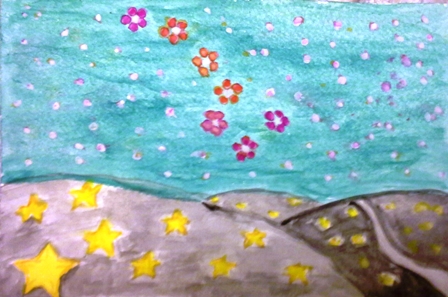
The watercolor below is my most recent offering, an almost obscenely cheerful and optimistic image, and way out of character!

20170112_153837-1_resized

***

(Pat Bertram is the author of the suspense novels Light Bringer, More Deaths Than One, A Spark of Heavenly Fire, and Daughter Am I. Bertram is also the author of Grief: The Great Yearning, “an exquisite book, wrenching to read, and at the same time full of profound truths.”) Connect with Pat on Google+. Like Pat on Facebook.
Being Strong

There is a saying making the rounds of Facebook that I can’t get out of my mind: Strong people know how to keep their life in order. Even with tears in their eyes, they still manage to say, “I’m okay” with a smile.

Are these really signs of a strong person? If so, I must be the weakest person alive. I have no idea how to keep my life in order; to be honest, I don’t even know what that means. But it’s the second sentence that really has me flummoxed because when I’m not okay, I don’t lie and say I am.

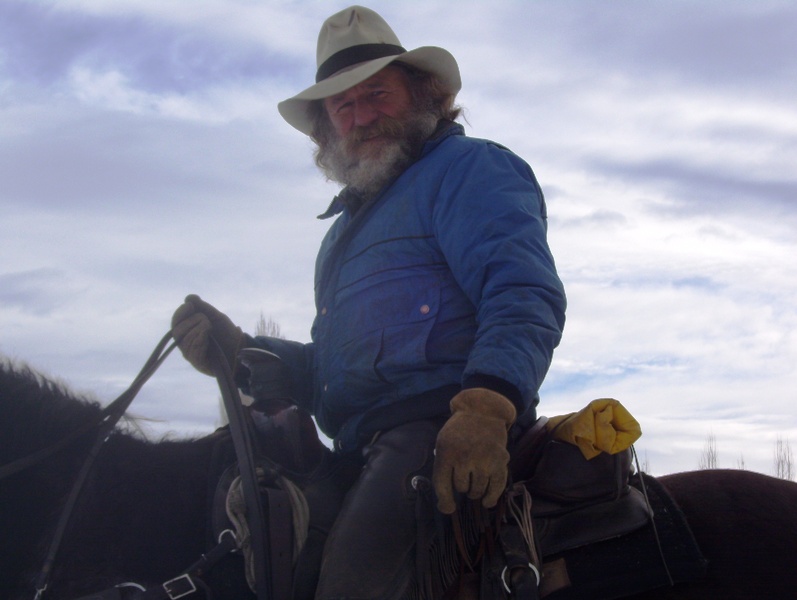
CowboyIf you have tears in your eyes out in public where someone can see you, and that someone asks how you are, and you respond, “I’m okay” with a smile, you have just closed them out. That’s not a sign of strength. It might be a sign of having reached your limits. It might be that you don’t feel comfortable telling your troubles to a stranger. It might be that you’re feeling sorry for yourself and are ashamed. It might even be the proper response depending on the circumstances, but it’s not strength.

If you say, “I’m okay” with a smile to people you know, that’s a sign of weakness. Strength is letting people in. Letting them know the truth of you.

Think about it — how would you feel if someone you knew well said they were okay, and you later found out they were dying of cancer? You’d feel shut out, regretful of the words left unspoken, sorry for hugs not given. But when it comes to your own drama, you prefer to simply say you’re okay.

It takes strength to allow people a place in your trauma, so if you want to dismiss people’s concerns by saying “I’m okay” with or without a smile, that’s fine. You might even feel as if you are protecting them from hurt, but what you are doing is protecting yourself from the blessings that come from allowing others into the center of your life.

We’ve been raised in a code-of-the-west culture where it’s considered important not to complain, to keep your troubles to yourself, never to quit, to tough things out. I don’t advocate complaining for the sake of complaining, but telling the truth about how you are feeling or what you are going through to a sympathetic listener is an important step towards healing. It takes strength to show vulnerability, to go against those ingrained ideals.

Saying “I’m okay” with tears and a smile seems like a recipe for loneliness. Come to think of it, isn’t being alone part of that western code? Maybe it’s time to find a different definition of what a strong person is.

***

(Pat Bertram is the author of the suspense novels Light Bringer, More Deaths Than One, A Spark of Heavenly Fire, and Daughter Am I. Bertram is also the author of Grief: The Great Yearning, “an exquisite book, wrenching to read, and at the same time full of profound truths.”) Connect with Pat on Google+. Like Pat on Facebook.