Creating a Peaceful Place

Daily writing prompt
Describe the most ambitious DIY project you’ve ever taken on.

The most ambitious DIY project I’ve ever taken on? That’s easy. Landscaping my yard.

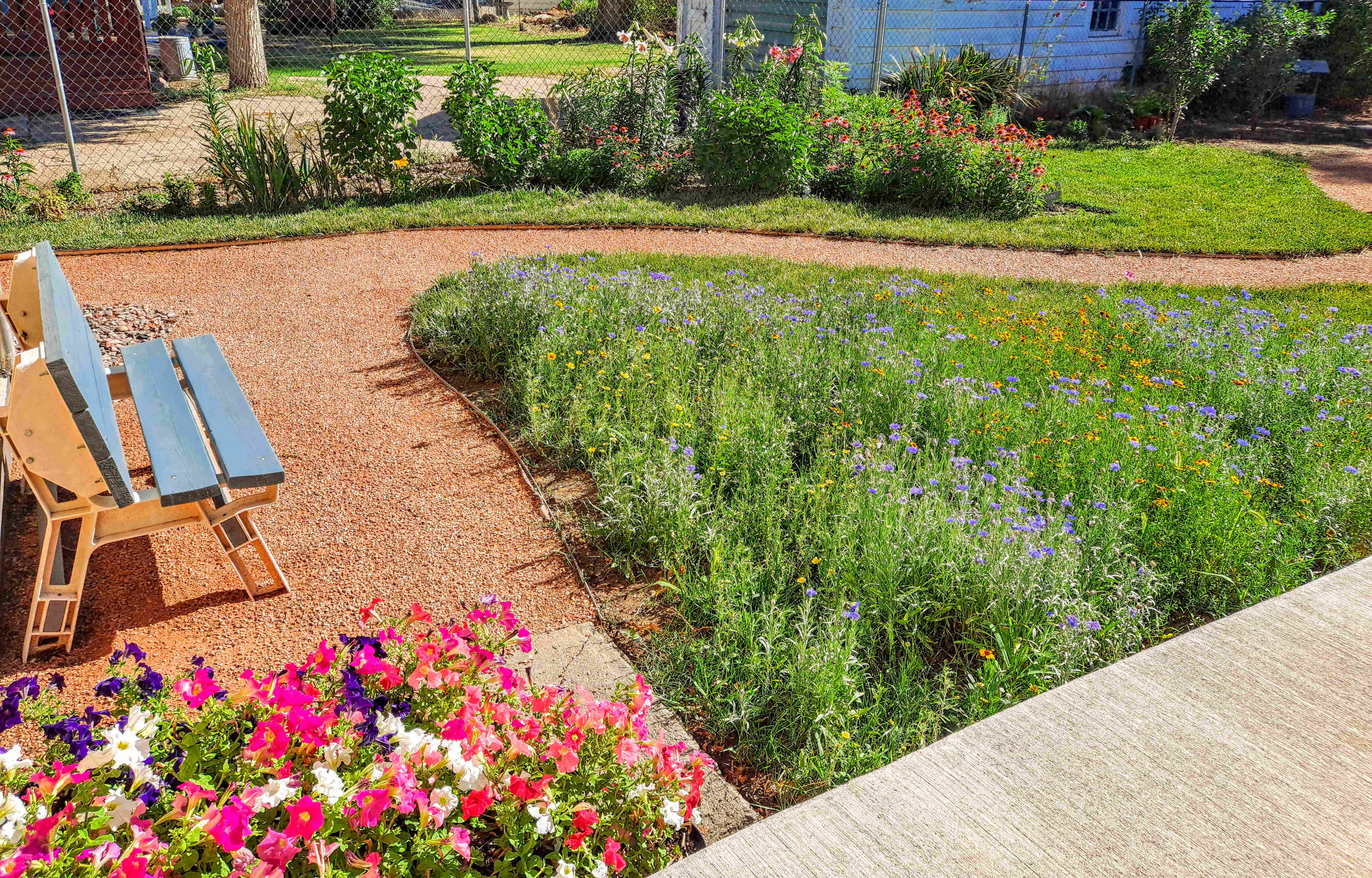
When I moved here, the yard was dirt and weeds. It looked okay because the weeds had been cut down to make the house look good when it was put on the market, but still, just weeds. I hadn’t planned on doing anything to improve the property because I didn’t want to have to take care of a yard, but there were things that needed to be done, such as rocks laid around the house to protect the foundation. Then, when I found out I was tripping on all the holes and rocks among the weeds, I decided I needed walking paths of crushed rock to keep from falling and breaking my neck. Or a hip, anyway.

Admittedly, I didn’t do any of the rock labor, but the finished work gave me a sort of yard pride that seemed to demand further work. So gradually, I planted a few bushes, a few flowers, filled in some of the gardens that were created by the walkways, and things escalated from there.

I had a lawn mower, so I put in a bit of a lawn since I didn’t want the mower to go to waste (a silly reason for a lawn, I know, but it’s the truth). I had sod put in, but when that all died (the people I hired put in the wrong grass), I dug it up and planted a more heat-resistant strain of grass.
And so it goes . . .

What makes this DIY project so ambitious is that there doesn’t seem to be an end to it. There’s a lot of work just involved in maintenance, so that keeps me outside for a couple of hours each day, which makes me see how much more I can improve. I can see spots that need to be filled in or bits of color that will improve the looks of one of the gardens. And then there are container gardens and hanging pots to be replanted every year.

Yep, an unending project when in fact, what I had wanted was a yard that took no work.

Oh, well, there are worse things than a garden demands attention. And truly, I can’t think of a better use of my time than creating this peaceful place.

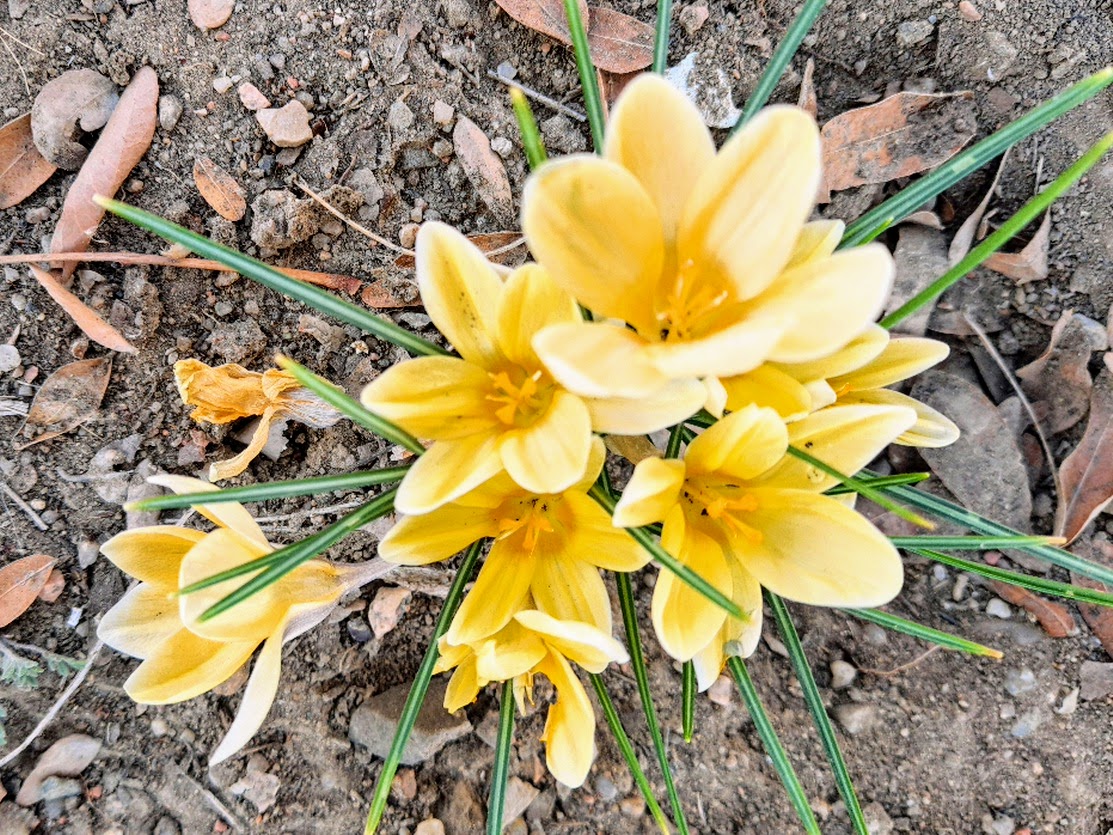
Besides, there all are the surprises I find, like this morning. Look! Crocuses!
***

Pat Bertram is the author of Grief: The Inside Story – A Guide to Surviving the Loss of a Loved One.

Dreaming up a Home

Daily writing prompt
Write about your dream home.

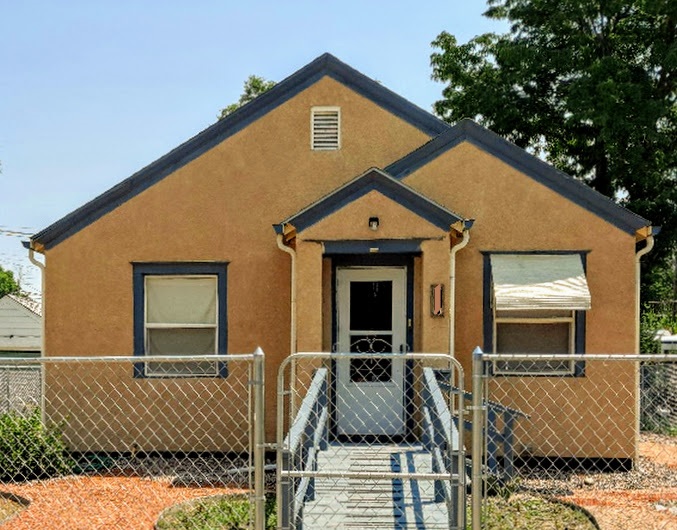
I’m sitting here with a smile on my face, thinking about my dream home. For me, my dream home isn’t a fantasy, it’s a reality. It’s the very house I am now sitting in. What makes it a dream home is that I dreamed it up.

Years ago, I went through a huge change in my life. My life mate/soul mate of thirty-four years, Jeff, died, leaving me stranded here in this world without a home (he was my home) and with a single responsibility left to me — to go and help care for my aged father. I also was left with a sense that somewhere after the dark present, there would be a brighter future for me. During those long years of grief, I held to that thought. After my father died, I was adrift again, becoming a serial nomad — renting rooms and taking long trips.

I never thought of owning a house. It seemed too far from reality to even dream of it — just the thought of the upkeep seemed burdensome to say nothing of all the financial obligations a house engendered.

I spent years trying to figure out what to do, then when a relative suggested buying a house, it hit a chord. I had a bit of savings, but nowhere near enough to buy a house, or so I thought. Except, there was one corner of the world where house costs were still unbelievably low. I visited the area, and it was okay — way out on the plains, far from any major city, but I didn’t care. I just needed a place to live out my years.

A realtor took me around, and though I didn’t find a house I liked or could afford or that was still on the market a day or two after it was listed, I made friends with the real estate agent. Then I went home, thought about all I’d seen, and I dreamed.

I dreamed of a house with a new galley kitchen, a bathroom that would still be accessible no matter what old age brought, a living room with lots of screened windows,

an office with a day bed for reading and working/playing on the computer. Oh, I dreamed and dreamed, dreaming every single detail of what I would like into existence.

Then one day I got an email from Zillow though I’d never signed into that real estate site and certainly never signed up for emails. The email showed a simple house and said I might like it. I checked out the photos of the inside and gasped in disbelief. There it was — exactly what I’d dreamed up.

It wasn’t so much the looks of the house that got to me but the inside since I live in rooms and don’t spend a lot of time looking at the outside of where I live. I immediately called the realtor. She went to look at it, told me what she found, arranged for an inspector, and when I asked her to arrange the sale, she panicked and had me sign an affidavit that it was my choice to buy the house unseen. But I knew it would work out okay. After all, it was my house.

Three things were not in the dream — 1) the town itself because at that point I didn’t really care where I lived, I just wanted not to have to worry; 2) friends because I moved for the house and my future; the friends I’ve made have been a true blessing; 3) a landscaped yard because I didn’t want to have to take care of a lawn or a garden, and yet, over the years, I’ve created a beautiful outdoor space for myself.

So here I am, sixteen years after Jeff’s death, seven years after the Zillow email, living in that brighter future I’d believed would come. Living in the very house I dreamed up.

***

Pat Bertram is the author of Grief: The Inside Story – A Guide to Surviving the Loss of a Loved One.

Gardens on my Mind

Yesterday, I watered my lawn. Perhaps it didn’t need the moisture, but when the temperature gets up to 74 degrees this time of year, it’s better to be sure the grass has the water it needs. I read and blogged about eighteenth century gardens. And I made a few sketchy notes in my new RHS Gardener’s Five-Year Record book, though there’s not a lot to record this time of year. Mostly, I just mentioned the weather and that the larkspur seedlings are making themselves at home.

This seems an odd time of year to be thinking of gardening, and yet for most people this is when the fun is — looking through catalogs and planning what to buy to fill in one’s garden. Not me, though. I usually wait until the local hardware store stocks up on plants and get whatever is available. Or I wait until fall and buy chrysanthemums and whatever else likes to be planted so late in the year.

Still, I have gardens on my mind. In the back of my Gardener’s Record Book, is a section to list any gardens I wish to visit. That’s a section that will remain blank. Any gardens I wanted to see, I already have, as well as a few gardens I’d never heard of until I was actually there.

For example, when I went to stay with a friend during my 2016 Cross-country trip, she took me to see Fort Worth Botanical Gardens. The highlight of that visit was the exotic butterfly garden in their conservatory.

She also took me to see the Chandor Gardens, a series of formal gardens created by Douglas Chandor, a renowned English portrait painter. Living artistry was certainly his calling!

The Calloway Gardens in Georgia was a garden I found on my own. I was lucky to get there just when the Azaleas were in bloom, and oh, my! So lovely.

Calloway Gardens calls the Overlook Azalea Trail the most beautiful place on earth, though that claim is rivaled by the Crystal Springs Rhododendron Garden in Portland. Another gorgeous place that a friend in Portland took me to.

Though not technically a garden, the Antelope Valley Poppy Preserve in California is up there with the best in beauty.

And though not a garden at all, the Painted Desert in Arizona certainly acts as if it is.

Despite all that loveliness, I have to say that there is nothing like one’s own garden. Even though mine doesn’t have the panoramic beauty of those gardens I visited, mine finds its beauty in the work I’ve done, the thought I’ve put into it, and the fact that it is here and not in some far-flung state.

***

Pat Bertram is the author of Grief: The Inside Story – A Guide to Surviving the Loss of a Loved One.

Gardens, Now and Then

I recently finished reading a book that was so unmemorable, just about the only thing I remember is how bad it was. I certainly don’t remember the title or the author. I do remember, however, all the talk of eighteenth-century gardens.

I didn’t know that there were various styles of gardens. I just figured people did what I am doing — create their own garden using the space, the climate, the soil, and their own sense of practicality to best utilize the area.

I started with a gravel border around my house to protect the foundation, which unfortunately didn’t keep one corner from collapsing. Luckily, that’s fixed, now. Whew!

Then I figured out where I would want to walk in the yard, and had pathways put in. When I moved here, there were only weeds and rocks and uneven ground to trip the unwary, so those pathways were important, especially as I knew I wouldn’t be getting any younger. (Though, who knows. Stranger things have happened, I’m sure.)

When the old garage was torn down, the concrete slab in front of that derelict building was left in place, so I used that as a foundation for a gazebo. And where the garage was, I had a raised garden built.

The rest of the yard, I filled in with bushes, grass, a couple of trees, and lots of flowers. That part of the garden is always a work in progress since plants die, seed themselves, and new flowers beg to be planted.

So, there is some balance in my yard: a few distinct areas, a couple of places to sit, grassy areas, places to grow vegetables. Best of all, it gives me something different to look at with every turn of the path.

Apparently, this isn’t the way everyone gardens, or even the way people used to garden. The Hanging Gardens of Babylon were definitely planned out. They weren’t actually hanging gardens (if they even existed), but were “overhanging” gardens, supposedly built as ascending terraces, planted with trees, bushes, and flowers, to create a luxurious green hill.

In the eighteenth century (what all this was leading up to), gardens were geometric, with the various pieces of the geometry shape enclosed by hedges to create outside rooms. A pleasure garden for picnicking. A kitchen garden. flower gardens. Topiary gardens. Gazebos and other outbuildings. Water décor such as fountains and ponds. And tree-lined paths to connect the sections.

Such gardens, as well as gardens before and after, needed architects to get everything correct. Even though in my haphazard way, I have a few elements of an eighteenth-century garden, such as distinct garden areas, paths, and a gazebo. Unlike eighteenth century gardens, I have grassy areas, as well as wild areas. But then, I didn’t set out to create such an historical garden. Didn’t even know they existed, to be honest.

Admittedly, my yard is a lot smaller than the usual eighteenth century garden, and I spent a fraction of the cost, but that was never the point. The point, for me, was . . . Hmmm. I’m not sure what the point was of creating my garden. What I wanted when I moved here was a work-free yard, one that took care of itself. And yet, what I have is . . . well, a mini park that takes a lot of work!

***

Pat Bertram is the author of Grief: The Inside Story – A Guide to Surviving the Loss of a Loved One.

Out With the Old, In With the . . .

Out with the old, in with the . . . same old, same old.

There isn’t any appreciable difference between December 31 and January 1 except for a new calendar. Of course, we pretend there’s a difference because . . . well, because we think there should be a difference. The only time there was a difference, at least in my life, was when it came to school years, and even then, the difference wasn’t appreciable since the first days of the new school year often duplicated the last of the old one as we reviewed the previous year’s work.

But now, as an adult, nope, there’s not any difference between the old and the apocryphal new. In fact, as far as I remember, I never did anything for the new year until after Jeff died. Then, I wanted to do as much as I could to make my new single life different from my old shared life, so once or twice, I even stayed up to midnight and toasted the new year with a glass of bubbly — sparkling cider, if I remember correctly. I wanted a change of focus, a turning away from the way I wished things were to the way things are and maybe even to the way things were meant to be. And that seemed to help me continue on without the person who’d been the focus of my life for so many decades.

What helped during those grieving years now seems ho hum. I do, sometimes, play around with New Year’s resolutions in an effort to make the new year seem new again, or at least to make myself seem new again, but resolutions don’t really help. It seems to me that making a resolution sets one up for failure. Because if you plan to do something for a year, chances are, you won’t continue when the year ends, and if the resolution is going to end, then why wait until the end of the year? Why not in June, or February, or even today?

Still, I did make one resolution I’d like to keep — to stay away from news and opinions of any kind. (Except for my own opinions, of course.)

There’s another resolution I’m planning to keep for a month — to stay away from sugar and wheat. Neither one of those things is good for me, and both create problems, but both are hard to stay away from permanently — no pizza ever again? I don’t eat it very often, maybe a couple of times a year, but still, even the thought of it can be a treat. And no chocolate? Heaven forbid! But I’m trying to do a body reset, if there is such a thing, and so I’m being careful what I eat.

A third resolution I plan to keep when I can — to walk every day. But that’s not much of a resolution when I allow myself an out from the beginning. I’m to the age where I notice every joint, every muscle, every ligament and tendon, and there’s no telling when I get up in the morning which of those things will be out of whack. When you think about it, that so many people live for many years, especially when they are young, without being reminded of a single body part is the true miracle. To think that all those parts once worked painlessly together is truly astonishing! Adding to the “out” of walking every day is the weather. I have no interest in going out in dangerous weather. (Dangerous to old bones, that is.) But, I’ll do what I can for however many years I can.

A fourth resolution isn’t so much a new year’s resolution, but rather a hope since I can’t do anything until spring. I would like to get my head more into gardening and lawn work than I did last year. Last year I went through the motions but didn’t really care. This year, I’d like to care, especially since a neighbor gave me a gardening record book, and I’d like to thank her by actually using it. Though admittedly, it will be mostly blank until March or even April.

And there’s a fifth resolution. Well, not actually a resolution, something that just happened. So far, I’ve blogged every day this year. Whoop-de-do! Two whole days! Sometimes I think I’d like to get back into blogging — I liked that it gave my days form and focus. Other times I wonder what the heck I’d been doing putting so much of myself out there for all the world to see. Did I really just spew out my grief, talk about my father and dysfunctional brother, show my new house and yard, let everyone peek into my private life? It was one thing to talk about author-y things back when I was writing, but the rest? Eek. Not smart! So far, the balance scale is . . . balanced. If I do, I do. If I don’t, I don’t. And either way is fine.

***

Pat Bertram is the author of Grief: The Inside Story – A Guide to Surviving the Loss of a Loved One.
Happy Bloggiversary!

Today is the eighteenth anniversary of this blog. Considering how little I’ve posted during the past couple of years, perhaps I should rephrase that and say that I started this blog eighteen years ago. The two sentences mean basically the same thing, yet the first seems to indicate an ongoing proposition, while the second acknowledges the truth of my inactivity.

Over the years, I’ve used this blog as a place to dump all the thoughts and feelings that didn’t otherwise leave me alone, and luckily, nowadays I’m seldom haunted or taunted by those tenacious circular thoughts (thought loops that continue to swirl ever tighter as one’s mind tries to cope with stress and negativity).

I can’t take credit for the lessening of those thought loops since I’ve never really learned to turn them off; it’s more that I’ve landed in a situation where I can control what goes on in my life. Mostly, of course, that situation lets me spend my time alone, away from anyone or anything that causes me unnecessary distress. And I have pleasant means of occupying my mind — there’s always reading (and I do mean always — it’s no secret why the library staff knows me well) and gardening, of course.

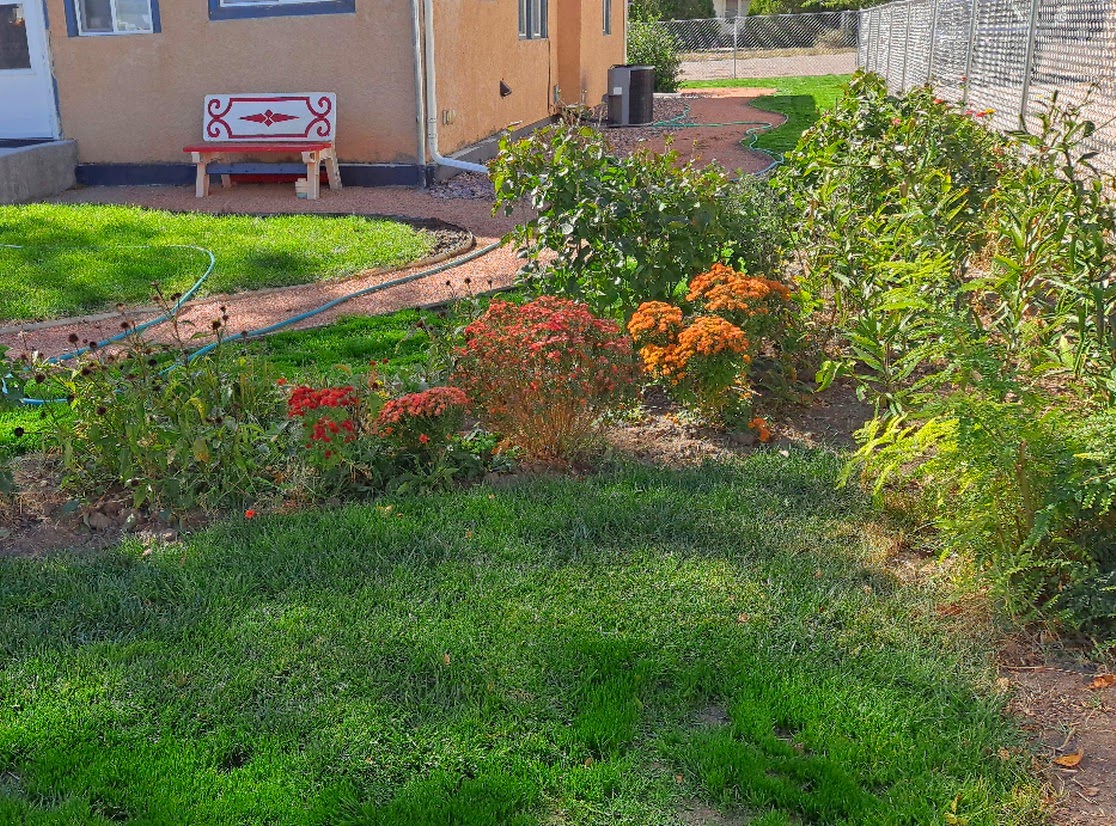
I started the gardening season with a sense of detachment — it seemed foolish, in a way, to care so much for something about which I have little control. No matter what I do, plants die, the sun sears, winds desiccate, unsightly weeds flourish. And yet, despite my sense of detachment, I did what I could, and this fall, I’m reaping the benefits of a beautiful yard.

I have learned, over the years of living here in this sometimes harsh and unpredictable climate, that the promise of spring dies in the heat of summer, so I’ve been spending more attention to fall plants. By autumn, the winds have lessened, the sun has moderated its intensity, pulled weeds stay gone, and flowers flourish.

And I find my mind calm, with seldom anything to write about. Except, of course, to mention that there isn’t anything to blog about on this eighteenth anniversary. I could, of course, talk about all the changes that have gone on during those eighteen years, both in my life and in the world, but thinking of all that tumult would put me back where I don’t want to be.

Still, I survived those years, and through it all, this blog was there for me. And for you.

Happy bloggiversary to us!

***

Pat Bertram is the author of Grief: The Inside Story – A Guide to Surviving the Loss of a Loved One.
Cosmic Thoughts

I just finished reading a science fiction novel about an alien civilization that set out to destroy the earth, and there was no way for us to stop it. Instead, there was a Noah’s ark scenario, where certain people, plants, animals, and a sampling of cultural items such as books were sent out into space. In itself, it wasn’t that great a story, but it did make me wonder what is here on earth that would truly be important to save if the planet were to be blown up. If there are other livable planets, they would have their own plants and animals that grew out of their own ecosystem. And if the planets were inhabited with sentient creatures, those beings would have their own culture and language, and anything from Earth would be merely a curiosity.

I can see where Earth’s trappings would be important to displaced earthlings, but is there anything here that is valuable or necessary on a cosmic level? If the planet and all its inhabitants were to be blown up by some earth-shattering (literally, earth-shattering) event, would the universe be diminished?

I can think of many things that are valuable to the earth and especially to those that abide on its surface, but I can’t think of any physical thing that’s necessary on a cosmic level. Personally, of course, I value many things. Reading, occasionally visiting with friends, working on my yard. None of these things would survive my demise (let alone the demise of the earth), probably not even my yard since it takes too much work, and people nowadays don’t seem to value that sort of outside experience.

Still, working in the yard has been a good experience for me. And for some reason, this year the yard seems to respond. From certain angles, it looks like a lovely mini park.

From other angles, it looks like a jungle.

I planted a few vegetables in my raised garden (one pumpkin, one watermelon, one zucchini, two tomatoes) and those plants are lush!

The zucchini was supposed to be the normal dark green garden squash, but somehow I ended up with an heirloom zucchini — a costata. A special treat, for sure.

This is also lily time.

I’ve had quite a sampling of blooms despite so many of the plants freezing in the early spring.

The lilies always come as a surprise.

I had no idea such perfection was available to the casual gardener.

Although not actually lilies, I’ve also had day lilies growing.

All this growth and color helps to mask the plants that didn’t come back this year. Also a touch of detachment helps to accept that so much of gardening is beyond my control.

Although taking care of my yard isn’t necessary on a cosmic level, and certainly wouldn’t survive a cataclysmic event, it’s something special on a personal level, and that’s all to the good.

Wishing you well.

***

Pat Bertram is the author of Grief: The Inside Story – A Guide to Surviving the Loss of a Loved One.

Detachment

As you can probably tell from my lack of posts for the past couple of months, I’m losing my emotional involvement with my yard. Usually spring offers plenty of gardening photo opportunities, but lately I tend to just look and pass on by rather than document the beauties I see. Oh, I’m still doing the yard work, still waiting to see what blooms, still taking some pictures, but I’m doing so at a degree or two of separation. I’m not exactly sure why I started losing my enthusiasm. Perhaps because of the difficulty of keeping things green and blooming in this dry and sometimes harsh environment. Perhaps of a general feeling of detachment from life and a sense of the passing years. Perhaps because of . . . who knows.

Oddly, even though it hasn’t been that hot compared to previous springs — we’re just now getting up into the 90s — and even though I’ve been keeping up with the watering, the sun is so intense that the grass is already burning and flowering plants are wilting. I feel as if I should care, but I don’t, not really. Or maybe it’s that I don’t want to care. It does take a lot out of a person to plant flowers and greenery and tend them only to watch them struggle.

In a way, it’s not that big of a deal. I can replant grass and flowers and other vegetation. Or I can plant something else in the place of plants that don’t make it. For example, I had one large swath of grass left from the original sod I’d put in, but half of it died over the winter. (Which is odd in itself since all the rest died in the summer heat.) I couldn’t decide whether to replant the grass come fall or plant something else. In the end, I planted wildflowers instead of leaving the dead grass, and if I decide I want the grass, well, autumn (the best time to plant grass around here) is still a long way away. For another example, half of my ice plant that has spread so rapidly over the years also died in the winter, but I was able to replant.

So, not a big deal, but still . . .

I make it sound as if my garden is failing, but the truth is, it was prettier this spring than ever before.

Plenty of flowers planted themselves, such as the red poppies, and the larkspur. Other plants spread nicely. And some not so nicely. (I try to stay away from flowers that take over, but that’s not always easy to control since what should grow here doesn’t always and what shouldn’t sometimes does.)

This is always a rather unpretty time of year, which adds to my disinterest. The summer flowers haven’t yet budded. The larkspur is finished flowering but hasn’t yet gone to seed, so it makes the garden look rather drab. Once the larkspur and other self-planted annuals are finished, I can then replant so that August and September will be nice, but now it’s just a matter of keeping the yard — and me — going.

It’s funny — I waited all winter for this and now?

I’ve been sitting here thinking, wondering about that “and now?” and I have no response to that.

I have a hunch that once we settle into summer, I’ll be okay. Hot, but okay. There’s been just way too many weather changes lately to suit my poor aging mind and body — cloudiness and humidity and sprinkles of rain followed rapidly by sun and heat and then a repeat of the cycle.

At least I will have plenty of work to do outside to keep me occupied. In fact, I better close this off and go mow the grass.

Wishing you well.

***

Pat Bertram is the author of Grief: The Inside Story – A Guide to Surviving the Loss of a Loved One.

Tulip Envy

In a garden, as in life, envy is not a good thing. One can appreciate the object of that envy, though one must be sure to be grateful for what one has, not what one wishes one had.

That’s cryptic, I know. Or rather, it would be if not for the title of this piece. Tulip envy. Yep. That’s the truth of it.

I was at a friend’s house the other day and was gobsmacked by the sight of her tulip garden. I stood there, frozen with awe, drinking in that vision. Except for photos in gardening magazines, I’d never seen such perfect tulips, such vibrant colors, such an awesome display of floral pulchritude. To say I was envious is . . . well, it’s redundant considering I’ve already mentioned the envy part a couple of times. (Just so you know, all the photos in this blog are pictures of my tulips.)

That’s when I realized it’s okay to be appreciative, but it’s not okay to compare. Her tulip garden is decades older than mine, so it’s had time to mature. It’s in the shade, which around here is necessary since the sun, even on cool days, tends to be intense. (And one of my tulip gardens is always a bit sickly since it gets more sun than the poor things can handle). And anyway, seen for what they are, each of my little displays is perfect.

Another thing I learned is that what you get is what you get. So much of tulip gardening in the dry high plains is a matter of weather and hence beyond our control. This year, for the first time since I’ve lived in this house, we had heavy snows at the beginning of November, followed by a few half-hearted snowfalls rather than the reverse, which is what we usually get. Because of that early snow, tulips that lay dormant last year burst forth with color this year. Even my poor sun-drenched garden put forth a few lovely blooms.

So, I’m celebrating my blooms. Focusing on that which is right beneath my feet.

At least when it comes to tulips, that is. What else is right beneath my feet is an incipient forest. A couple of springs ago, my neighbor’s ash tree flooded my yard with an inch-thick coating of seeds. I cleaned them up the best I could. Twice. (Because there was a second seed flood shortly after the first.) As it turns out, whatever conditions produced tulips this year also produced ash seedlings. Dozens and dozens of them. I can’t just let them be, can’t pull them up like weeds because some of those root systems are a foot deep, can’t kill them because I’d also kill the surrounding ornamental plants. So . . . dig, dig, dig.

And then, boo hoo, some of my newly sprouted lilies froze in the last frost. Something else I had no control over. They were eager to start growing during the warm days, but the poor things conked out during the frigid months.

With all that going on, it’s truly much better to concentrate on my lovely tulips!

***

Pat Bertram is the author of Grief: The Inside Story – A Guide to Surviving the Loss of a Loved One.

Just One Word