I used to like trees, but after digging up hundreds of sprouts from seeds blown into my yard from neighbors’ trees, I’ve become wary of them. The harsh winds occasionally blow branches into my yard, but at least those are easy to get rid of, especially if the owner of those branches hauls them away. But it’s the seedlings that cause the most work for me.
One next-door neighbor has locust trees, and those trees sure are prolific. Every year I find dozens of new baby trees to dig up. So far, the seedlings seem to be evenly distributed over the years, so I know what I’m getting into. Too bad that’s not the worst of it.
About three years ago, my other next-door neighbor’s ash tree had what is called a mast year — a year when it dropped a flood of seeds. I woke up one morning to find my entire yard a pale green. All the rocks around the house, the grass, the pathways, the garden areas were covered in ash seeds. I raked them, swept them, blew them, picked them up by the handfuls. I thought I’d gotten most of them, but two years later, I found hundreds of ash seedlings. That year, I felt almost kindly toward weeds — at least they were easy to pull up. Those seedlings? Not so much. They’d had an entire year to develop deep roots, and so each had to be dug up, not just pulled up. A not so fun year! I’m still finding seedlings, but now they’ve had an extra year to develop, and are harder to dig up because of that well-developed root system.
This year, Siberian elm trees belonging to both of my neighbors are having a mast year. A few days ago, the ground was almost completely covered in those tiny saucer-shaped seeds. The heavy winds we’ve been having do not blow those seeds out of my yard, only into it, so I get double my share of seeds no matter which way the wind is blowing. There have always been elm seedling for me to dig up because the normal amount seems to have a huge rate of germination, but I sure dread the work when this massive proliferation of seeds starts to sprout.
A mast year is also called “predator satiation.” Sometimes this satiation is cyclical, sometimes it’s an answer to a dry winter, and sometimes, I think, the trees just want to torment me. The satiation, of course, is to make sure that there will still be seeds left to become trees even after predators have eaten their fill. If I were out in the country, I wouldn’t care. If I didn’t spend so much time on my yard, I wouldn’t care, or at least not much. But as it is, I’ve come to dislike trees. None of my neighbors’ trees benefit me. I just get the mess and the work. And boy, talk about satiation! I’ve sure had my fill of trees trying to take over my yard.
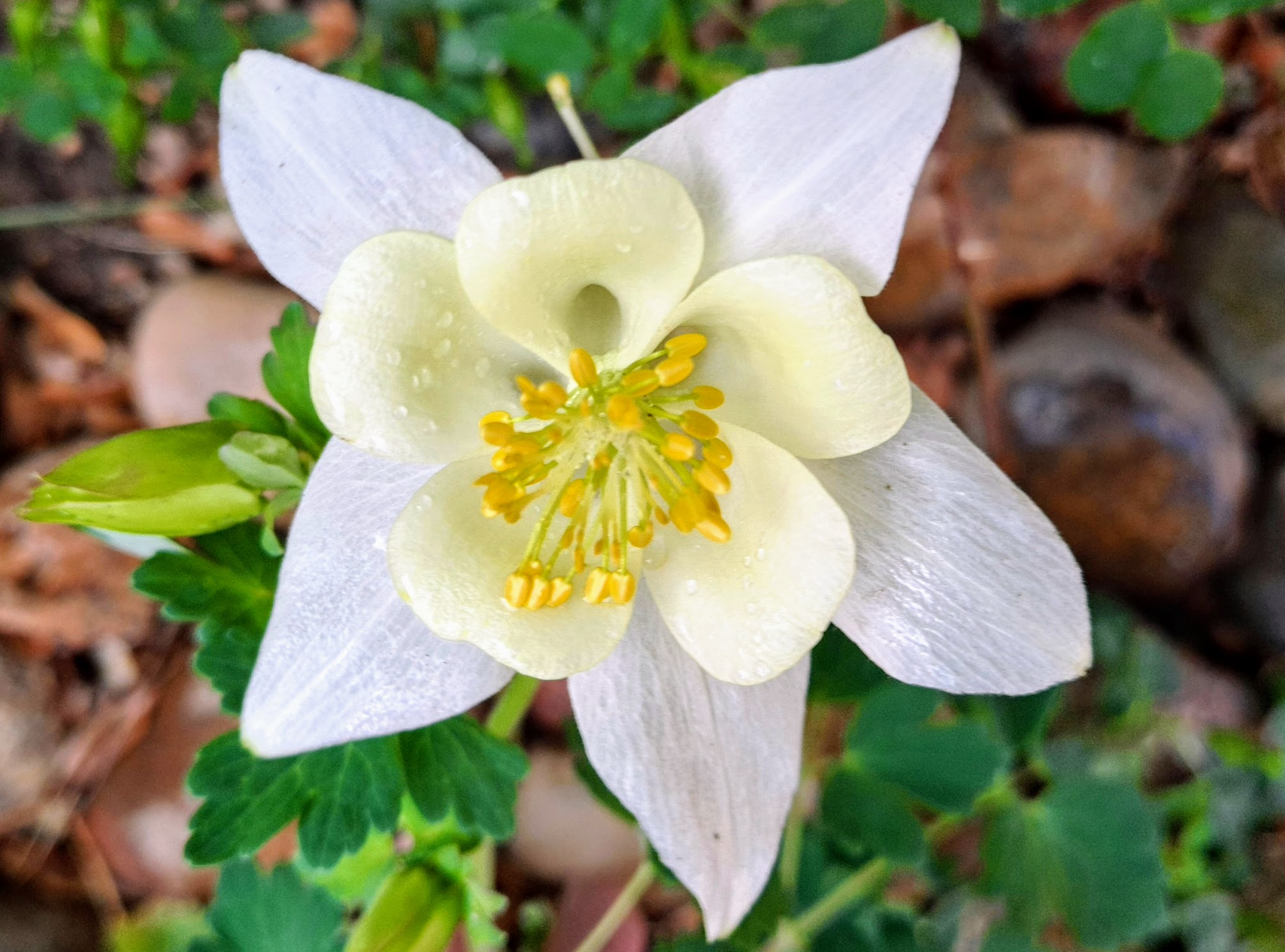
Oh, well. If it’s not one thing, it’s another. And sometimes that “another” isn’t a bad thing. A couple of years ago, a columbine seeded itself into my hen and chicks garden, and I hesitated to pick it. It doesn’t belong there, but it’s not a weed, either, and it didn’t seem to be a problem, so I just let it grow. I’m glad I did. It’s not like any of my other columbines, which are the more traditional bluish purple and white as well as a couple of bright yellow plants.
This creamy columbine is a small thing to offset the dread of the seedling invasion, but it’s an important thing since it reminds me of the unexpected beauty a garden can bring.
***
Pat Bertram is the author of Grief: The Inside Story – A Guide to Surviving the Loss of a Loved One.










