The Far Side of the Mountain

I still haven’t turned off my computer for an entire day, but I have been curtailing my online activities in an effort to live more of an offline life.

A couple of days ago, I went on a quest to find a trail to the top of a local mountain, but I never even got to the other side of the mountain to find the trail. Distances are deceiving in the desert, since there is no human-made structure for comparison, and it took me two hours just to get to the mountain and swing around it a bit. I had to save enough energy, strength, and water to get back, otherwise I would have made it around the mountain.

Bell Mountain. Elevation 3848 ft. The 30120th highest peak in the US.

Bell Mountain. Elevation 3848 ft. The 30120th highest peak in the US.

Today I did the next best thing — drove to the other side of the mountain and tried to hike up the far side. Did well for a while, but the steepness defeated me — even on flange of the mountain, there were places where it sloped greater than 45 degrees. (It’s the steepness that makes it a mountain, apparently. Otherwise it would be just another desert knoll.)

Getting closer!

Still, it was an interesting trip, and maybe I’ll try again someday.

The world below.

The world below.

I didn’t have any great insights, just the same one any intrepid mountain climber has about halfway up a steep slope: What goes up, must come down.

My car, far below, circled in red, near a water tank.

***

Pat Bertram is the author of the suspense novels Light Bringer, More Deaths Than One, A Spark of Heavenly Fire, and Daughter Am I. Bertram is also the author of Grief: The Great Yearning, “an exquisite book, wrenching to read, and at the same time full of profound truths.” Follow Pat on Google+. Like Pat on Facebook.

Laziness, Catness, and Patness

In an effort to add spontaneity, color and vitality to my life, I went to the county fair. Just walked around, ate giant onion rings and funnel cake, rode the Ferris wheel. (Could ride one of those all day. Maybe next time I’ll get a wristband for unlimited rides and just go round and round and round. I wonder if that would wind my life into a higher gear or maybe wind me back to a simpler time?)

I saw a white tiger, visiting from the local zoo, but as much as I would have liked to admire the poor thing, I couldn’t bear to see it in that cage. (Of course, I’d hate even more to see the thing out of the cage, stalking me!) As I passed the cage, I heard the handler tell the gathering crowd that cats were some of the laziest creatures in the world. Huh? Lazy? The poor cat was in a cage, singing for its supper. Okay, so it wasn’t singing, it was yawning, but still, it was the primary advertisement for the zoo, so it was working as hard as the man maligning it. Besides, laziness is a human judgment. A cat can only be a cat. Its nature is to take it easy until it is time not to take it easy. That is not laziness. That is catness.

And anyway, who’s to say laziness is wrong? Most of us have been raised with a work ethic that is almost religious, and who is to say that is the right way? I am not advocating living off other people or shirking one’s responsibilities, but if you’ve worked hard enough to pay your bills with a bit set aside for emergencies, why is it lazy not to put forth more effort?

Years ago, I did the billing for a law office. Worked one week a month. In that one week, earning just a dollar or two above minimum wage, I made enough for all my living expenses, paid for the upkeep of my car, went out to eat when I felt like it. (It was a simpler time, of course, and my needs were simpler than most people’s.) The rest of the time I walked, read, wrote snippets of poetry, and did whatever I felt like. I still remember the looks of incomprehension and disdain I would get from people when they found out what I did. It wasn’t the week I worked for the lawyers that concerned them but the three weeks I didn’t. They couldn’t understand why I didn’t feel the need to work, and they couldn’t understand how I managed to fill all those non-working hours.

Maybe that lifestyle wasn’t laziness, either. Maybe it was Patness.

But, back to the fair . . .

The excursion did what I wanted — gave me something different to eat and do and think. Not bad a bad exchange for a few dollars. And I did it mostly on the spur of the moment, which is one of the things I am trying to relearn — doing things without planning. I woke up with the idea of going to the fair, and as soon as it opened, I went.

Maybe next year I’ll see you at the fair! We’ll meet by the Ferris wheel . . .

***

Pat Bertram is the author of the suspense novels Light Bringer, More Deaths Than One, A Spark of Heavenly Fire, and Daughter Am I. Bertram is also the author of Grief: The Great Yearning, “an exquisite book, wrenching to read, and at the same time full of profound truths.” Follow Pat on Google+. Like Pat on Facebook.

Fishing For Life

Today is the 3 and 1/6-year anniversary of my life mate/soul mate’s death, and I’m still sad, still missing the spark to get my life going again. For thirty-four years, he was my spark — everything was so much more vibrant when he was in my life — and without something to spark my interest again, my life will continue to feel sad and flat.

A few days ago, in Dreaming My Life into Being, I wrote about my plans to go fishing for life. Well, today, I went. (The second part of that plan was to turn off my computer for a day, and as you can see, I didn’t do that, but following through on half a plan is better than doing nothing, right?)

Today’s fishing trip wasn’t a major journey by any means, just a long hike through the desert on a quest to find the trail to the top of Bell Mountain. I’d climbed halfway one day, but gave up when the trail petered out to 60-degree angle. There is no way I could have climbed that sort of slope with only my tennis shoe-clad feet and bare hands — who am I trying to kid;  there is no way I could ever have climbed that slope — so I turned around and came back. (Slid down halfway, I’m sure, though I don’t remember. It was in the midst of the worst of my grief, and there are blank spots of pain in my memory.)

Bell Mountain

Bell Mountain

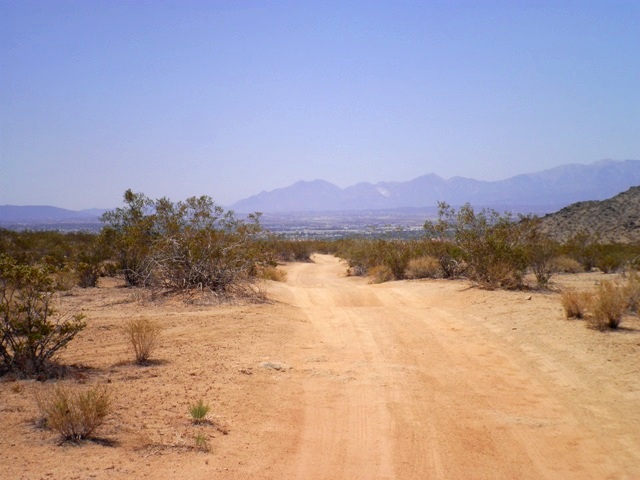
I’d recently read online that there is a trail to the top, though it’s on the other side of the mountain, so my quest today was to make my way to the other side and find the trail. Again, I had to turn back. I’d walked for two hours, and perhaps another two hours would have taken me around to the trailhead, but then, I’d have been too exhausted to make my way back. So once again, the mountain defeated me.

The way back.

The way back.

Just because one goes on a fishing trip doesn’t mean you’ll get what you went for, but still, it was a lovely day in the sun with just enough wind to keep me from dying of the heat. So I did catch something — a bit of life.

I also caught a thought. We talk about life being a journey, but it’s always a forward motion or maybe even sideways. No matter how far we go, we continue on from there. Unlike other physical journeys, such as a hike, we don’t have to return to home base. So we can give it all we have without needing to keep anything in reserve for the return trip.

I hope I remember that when next I feel as if I can’t continue my life’s journey.

***

Pat Bertram is the author of the suspense novels Light Bringer, More Deaths Than One, A Spark of Heavenly Fire, and Daughter Am I. Bertram is also the author of Grief: The Great Yearning, “an exquisite book, wrenching to read, and at the same time full of profound truths.” Follow Pat on Google+. Like Pat on Facebook.

Dead Man Walking

In the movie The Nature of the Beast, Eric Roberts tells Lance Henriksen that “dead man walking” refers to an inmate on death row when he’s on the move. Anytime they take the prisoner anywhere, they make sure all the other inmates are locked down and that the condemned man is accompanied by several armed guards. As they walk, they announce, “Dead man walking,” because this is the most dangerous sort of person in the world. He can do anything to anyone without any repercussions. He has nothing to lose. He’s already going to die, so what can they do, kill him twice?

prisonListening to that exchange, it struck me that we are all dead men walking. We are all on death row, condemned to die, just waiting for the day when life executes us.

When my grief was at its worst, a bereft friend who was also struggling for reasons to live told me about a woman who had lost everyone she had ever loved, was now alone in her old age, but was the most joyful person my friend had ever met. We marveled at that because it seemed incomprehensible to us, but perhaps the woman knew something we didn’t. Perhaps she knew that we are all dead men walking, the penalty of death has already been handed out, and so we have nothing left to do but live each moment until the sentence is carried out. Maybe the truth is that within the prisons of our aging (and sometimes disabled) bodies, within the prisons of our responsibilities and financial burdens and fears, we can do whatever we want.

Of course, most of us have no interest in killing, robbing, or doing anything that will land us in the slammer; our desires are more socially acceptable and carry fewer penalties. And perhaps it’s not even a matter of doing what we want, but simply living each day as it comes and being open to whatever happens.

A woman who lost her husband many years ago recently told me that things will get better in ways I never imagined. She said she believes that we are all blessed and will know joy to the degree that we have felt sorrow.

Perhaps that, too, is a lesson the old woman learned, and now she is experiencing that joy. Maybe someday we all will. If nothing else, it’s something to believe in, that despite (or because of) our sentence of death, we will be blessed with unimaginable joy.

***

Pat Bertram is the author of the suspense novels Light Bringer, More Deaths Than One, A Spark of Heavenly Fire, and Daughter Am I. Bertram is also the author of Grief: The Great Yearning, “an exquisite book, wrenching to read, and at the same time full of profound truths.” Follow Pat on Google+. Like Pat on Facebook.

Embracing the Play of Writing

I watched Talent for the Game the other day, and one of the points made in the movie was that baseball is big business. It seemed ironic to me that in our world play becomes business, and business, such as the business of writing, becomes play. (Most writers nowadays write for the love of writing, with always the dream of making a living at it as a goal, a dream that is slowly being eroded by the sheer masses of books, especially ebooks, on the market, so for most writers, the business has become play.)

Then it dawned on me that maybe writing, like baseball, has always been about play. Sure, both fields have their mega stars who make most of the money, but still, there are sandlot games and town leagues (mostly those leagues are softball, but let’s not let technicalities get in the way of a great analogy). Generally, anyone who wants to play baseball or softball can, but not everyone baseballmanages to turn the fun into profit. Writing is much the same. Anyone who wants to play can, but only a very small percentage ever makes a living at it.

I know people who won’t watch professional sports because they say the pros play for money and not for fun, that the players don’t seem to enjoy themselves, which takes the joy out of the game. In the same way, some of the major authors, the ones who are best at the business of writing, write the worst books. Obviously, most people don’t agree with me since they snatch the books up as soon as a new one comes on the market, but for me, after more than two or three books in a series, the authors lose their sense of play, and the books lose their luster.

Like baseball, writing is an inherently frivolous pursuit, made important only because of our frivolous lives. Okay, maybe our lives aren’t frivolous, but most of us don’t spend our days out in the wilderness gathering nuts and berries, hunting for meat to put on the table, chopping wood to keep warm, finding cover when it snows or rains. Writing in itself can’t do any of that, but wouldn’t it be nice if it could? I’d write a feast for us all, where we could come together and enjoy good food and good company at only the cost of a few words.

And no, I’m not advocating we junk civilization and go back to primitive times. I’m not much for the outdoors (except for walking) and frankly, I prefer indoor plumbing. But you have to admit, no matter how you look at it, writing is not a serious activity. It’s about making believe. Playing dolls and building worlds. We use words instead of toys, but basically, it’s the same thing.

Maybe we’ve been looking at writing all wrong. Maybe instead of celebrating the folk who embrace the business of writing, we should be celebrating those who embrace the play of it.

***

Pat Bertram is the author of the suspense novels Light Bringer, More Deaths Than One, A Spark of Heavenly Fire, and Daughter Am I. Bertram is also the author of Grief: The Great Yearning, “an exquisite book, wrenching to read, and at the same time full of profound truths.” Follow Pat on Google+. Like Pat on Facebook.

Life in Motion

I was driving in traffic today, running errands, when all of a sudden, the thought hit me: Is this all there is to my life? Just this constant motion — walking, driving, typing?

speedI didn’t have so much trouble dealing with the seeming foolishness of daily living when my life mate/soul mate was with me, but now that he is dead, so often it seems as if despite all the motion, I am simply running in place.

And yet, even if I am sitting still, going nowhere, everything is in constant motion.

It’s windy, and so the air is moving at about 20 per hour. The earth is also moving, of course, spinning on its axis at about 1000 miles per hour and it is hurtling around the sun at 67,000 mph. The sun is racing around the Milky Way Galaxy at 483,000 mph. And the galaxy is moving at perhaps 2,237,000 mph. The entire universe is also moving and expanding, at untold speeds.

And that’s not all. The very atoms of our bodies are constantly moving, creating and recreating themselves and us in the process. Thoughts are pinging around in our heads, sometimes faster than we can catch them, light is traveling at 186,202 miles per second, and sound is traveling at approximately 768 miles per hour in dry air.

All that motion. Constant motion. And for what? Just to be in motion? Is that all there is to life? Motion?

All this speed is wearing me out. I think I’ll go take a nap.

***

Pat Bertram is the author of the suspense novels Light Bringer, More Deaths Than One, A Spark of Heavenly Fire, and Daughter Am I. Bertram is also the author of Grief: The Great Yearning, “an exquisite book, wrenching to read, and at the same time full of profound truths.” Follow Pat on Google+. Like Pat on Facebook

Dreaming My Life into Being

JJ Dare, friend, fellow author and sister in sorrow, wrote a blog post today about Floating in the Sea of Dreams that got me thinking . . . again. . . . about how I am dreaming my life into being. The Sea of Dreams is like a primordial ooze where ideas and hopes rise up and evolve and then sink back into the deep only to ascend once more in a different guise. And every permutation of these dreams changes us, makes us grow, helps us reach our destiny.

A few months ago when my 96-year-old father (my current responsibility) seemed near death, the idea of living on the go appealed to me. I worry about settling down and stagnating somewhere, and moving from place to place would vanquish that worry, though of course, other worries would take its place. Weather, for example. It’s one thing to think of such a life in the puget soundstillness of a warm desert spring day, and another thing to consider the possibilities of snow and tornadoes, hurricanes and ice storms.

My father is doing well, so much so that it’s possible he could outlast me, and the thought of living on the road was subsumed into the Sea of Dreams. I’m back to taking life one day at a time, not thinking about the future, not making any long-term plans.

The other phase of my original idea of living on the go was to do an extended bookstore tour in an effort to introduce my books and my publisher to the offline literary word. That idea, as I have discovered, seems to be another overly rosy daydream. Since I couldn’t go on the road, I’ve been doing my bookstore tour via mail. Sending out letters, gift certificates, offers to interview booksellers.

There’s been little interest in my mailing, and unfortunately, it makes sense. Bookstores are in the business of making money, and since I am not a big name in the literary world (hard though it may be for you to believe), they have no incentive to stock my books. Of course, if/when I do become a big name, they will be interested in my books, but by then, I won’t need them. (If you are a bookstore owner and reading this, and you are interested in my books, let me know and I’ll send you a gift certificate. Or if you are interested in my interviewing you, you can find the interview questions here: Bookseller Questionnaire.)

So this dream of becoming an offline author, like many others I’ve had, is slowly sinking back into the depths, but already, some dreams are beginning to arise. I’m getting inklings of a desire to finish my works in progress. And the idea of being on the go is slowly evolving into something I can do now. I’m considering shutting off the internet one day a week (gasp!!) and taking myself on a fishing trip. (Not to fish for fish, of course, since such a hobby is only peaceful for the one fishing. The poor fish are scared, hurt, and fighting for their life.) My idea is to go fishing for life. Just take off for a day. Go wherever. See what I can see.

Meantime, I’ll continue floating on the Sea of Dreams, dreaming my life into being.

***

Pat Bertram is the author of the suspense novels Light Bringer, More Deaths Than One, A Spark of Heavenly Fire, and Daughter Am I. Bertram is also the author of Grief: The Great Yearning, “an exquisite book, wrenching to read, and at the same time full of profound truths.” Follow Pat on Google+. Like Pat on Facebook.

The Three-Year Anniversary of the Worst Day of My Life

Today is the three-year anniversary of the worst day of my life.

Oddly, the worst day wasn’t the day of Jeff’s death. (Jeff was my life mate/soul mate, a man with whom I’d spent almost thirty-four years of my life. Normally I don’t use his name when I write about my grief, but I need the comfort of seeing his name today.) The day of his death was a sadly inevitable day, one I had actually looked forward to. He’d been sick for so long and in such pain, that I was glad he finally let go and drifted away. I might have cried then. I might have been numb. I don’t really remember. All I know is that I sat there with him until almost dawn when the funeral services people came for his body.

I don’t remember when grief first washed over me, either, but I do remember the anguish building for days on end until I was nothing but a screaming bundle of raw pain. (You’d think that grief would start out strong and then weaken, but it doesn’t. It swells and continues to swell until it reaches some sort of breaking point, which gives you a brief moment of peace until it begins to swell again.)

We bereft are told not to make any major changes that first year since we aren’t always thinking clearly — we just want to escape the pain — but I had to leave our home to come take care of my then 93-year-old father. I put off sorting out Jeff’s things as long as possible since I could not bear the thought of clearing out what was left of his life, but I finally steeled myself to do the job.

I knew what to do with most things because toward the end he had rallied enough to tell me, but still, there were a few items that blindsided me, such as photos and business cards from his first store (where we met). Every single item he owned was emotionally laden, both with his feelings and mine, and I cried the entire time, huge tears dripping unchecked, soaking my collar.

How do you dismantle someone’s life? How do you dismantle a shared life? With care and tears, apparently.

Just thinking about it now makes me weep. If I could have waited a year or two, the task might not have been so traumatic, but the truth is, dismantling someone’s life is always filled with sorrow no matter how long you wait. I kept a lot of his things — things he asked me to save and things I couldn’t bear to get rid of such as his music tapes, games we played, a sweater he wore when we first met — and the thought of getting rid of those things still brings me pain.

I did manage to clear out some of those saved “effects” during that first year when I’d get angry at him for leaving me. (Silly, isn’t it? It wasn’t his choice, but I was still angry. Sometimes I still am.)

It’s amazing to me that I survived that day. It’s amazing to me that I’ve survived three years and 55 days of grief. It’s amazing to me that any of us do.

***

Pat Bertram is the author of the suspense novels Light Bringer, More Deaths Than One, A Spark of Heavenly Fire, and Daughter Am I. Bertram is also the author of Grief: The Great Yearning, “an exquisite book, wrenching to read, and at the same time full of profound truths.” Follow Pat on Google+. Like Pat on Facebook.

Robinades, Beauty, and Other Things

What is the surname of The Swiss Family Robinson? If you’re like me, you’d assume it is Robinson, but apparently, Johann David Wyss never actually used the name “Robinson” in the book. It turns out that “Robinson” is a genre based on Daniel Defoe’s Robinson Crusoe, which started the whole desert island survivalist fiction movement. (Some say Defoe started the whole fiction movement, that Robinson Crusoe is the first real novel, but I don’t really know if that is true. I do know that book-length fiction was called a novel, because it was “novel.”)

I found it interesting that I would come across a mention of this genre right before watching the movie Enemy Mine, which is a robinsonade in a science fiction setting. Dennis Quaid is stranded on a desert planet — an island in space — and in true robinsonade fashion, nature is viewed as harsh and ungiving (as opposed to The Swiss Family Robinson, which views nature in a more benign fashion). Although Enemy Mine doesn’t follow the genre form of building a civilization out of that wilderness, Quaid does find a way to survive and to form a civilization of sorts with his marooned enemy, a Drac, played by Lou Gosset Jr.

The tagline tells the story: Enemies because they were taught to be. Allies because they had to be. Brothers because they dared to be.

The set, designed by Rolf Zehetbauer is magnificent, as is the make-up, but for me the most interesting effect of the movie is the subtheme of beauty and ugliness. (The Terran and the Drac each see the other as ugly.) Every time I see this movie, I am struck by how normal the Drac looks to me by the end of the movie, and I think how seriously damaging it is for us to beatify beauty. Sure, beautiful people are nice to look at, but so are those who aren’t quite so spectacular looking. It might take a while to get to know the person or to become used to a less than eye-catching appearance, but in the end, beauty means nothing. (Well, in the end, we are all worm food or a box of cremains, but let’s not go into that.)

I know one thing, though. If you were living a robinsonade life, stranded on a desert island with a less than attractive companion, as in Enemy Mine, you’d soon focus on what mattered most — survival. It is only in a world where survival is almost a matter of fact (at least for a while) that the differences in appearance can loom so large.

***

Pat Bertram is the author of the suspense novels Light Bringer, More Deaths Than One, A Spark of Heavenly Fire, and Daughter Am I. Bertram is also the author of Grief: The Great Yearning, “an exquisite book, wrenching to read, and at the same time full of profound truths.” Follow Pat on Google+. Like Pat on Facebook.

The Wild Heart of the Desert

I met an old friend out in the desert today. It was nice seeing the Mojave green rattlesnake again since I hadn’t seen one for a couple of years. I didn’t even notice it at first. I was walking down the middle of a sandy path, minding my own business, when a hiss and a whirring rattle startled me. I stopped, looked around, and there it was, about eight feet away, sunning itself beyond the shadows of a creosote bush.

I edged away from the rattler, and it inched away from me, back into the protection of the bush. And then I continued my walk, a smile on my face. I don’t know why such encounters make me feel good, perhaps because it’s nice to know that there is a wild heart still beating beneath the calm veneer of the desert.

I also got to rediscover the truth: I am not afraid of snakes, just healthily wary, and rightly so. The Mojave green rattlesnake will not attack, but if disturbed or cornered, they will defend themselves. Apparently, bites occur if people accidentally step on a snake or purposely harass it, so if people are careful, they can keep from being bit.

I know people who will run down snakes if they see them in the road, and sometimes they even go hunting for them on the assumption that the only good snakes are dead snakes. The only time that makes sense to me is if the snakes leave the wilds of the desert for the tames of our neighborhoods, but that doesn’t happen very often.

Nor does it happen very often that I get to see such a fearsome creature, so meeting up with it has made my day.

***

Pat Bertram is the author of the suspense novels Light Bringer, More Deaths Than One, A Spark of Heavenly Fire, and Daughter Am I. Bertram is also the author of Grief: The Great Yearning, “an exquisite book, wrenching to read, and at the same time full of profound truths.” Follow Pat on Google+. Like Pat on Facebook.