Rubicon Ranch: Secrets — My Newest Chapter

RRBookThreemidsizeRubicon Ranch is a collaborative and innovative crime series set in the fictional desert community of Rubicon Ranch and is being written online by the authors of Second Wind Publishing.

In the current story, the  body of a local realtor is found beneath the wheels of an inflatable figure of a Santa on a motorcycle. The realtor took great delight in ferreting out secrets, and everyone in this upscale housing development is hiding something. Could she have discovered a secret someone would kill to protect? There will be suspects galore, including a psychic, a con man, a woman trying to set up an online call-girl service, and the philandering sheriff himself. Not only is the victim someone he had an affair with, but he will also have to contend with an ex-wife who has moved back in with him and a jilted lover, both with their own reasons for wanting the realtor dead.

We hope you will enjoy seeing the story develop as we write it. Let the mystery begin! Whodunit? No one knows, not even the writers, and we won’t know until the very end! If you don’t want to miss further chapters, please go to the blog and click on “sign me up” on the right sidebar to get notifications of new chapters.

(If the Christmas theme seems unseasonal, well . . . considering how long it takes to write a book at the rate of a chapter a week, in a few months, the season will catch up to us!)

Chapter 17: Melanie Gray
by Pat Bertram

Sunday, December 23, 2:45pm

A sharp rap broke Melanie’s concentration. She pushed herself away from the computer where she was working on the rewrites her editor had emailed—the last ones, thank heavens—went to the front door, and opened it.

A round little woman gazed anxiously up at her. “A lady is being held prisoner. You have to call the sheriff,” she said all in a rush.

Melanie gave her head a shake to clear it. Was this someone’s idea of a joke? The woman’s purple wig and the colorful chiffon scarves that fluttered around her body made her look like one of Cinderella’s fairy godmothers. The only things lacking were a wand and a sprinkling of fairy dust. But maybe the fairy dust filled the woman’s head?

“You don’t believe me.” The woman sighed. “There’s no reason you should. She is tied up, though. The sheriff won’t listen to me, but he’ll listen to you.”

“Who’s tied up? Where?”

The woman waved a hand toward the desert, her many rings flashing in the winter sun. “On this street somewhere.”

“And that’s what you want me to tell the sheriff? That a lady is tied up on this street somewhere? If that’s all the information you have for him, no wonder he won’t listen to you. And he certainly won’t listen to me.”

“He will. The two of you have a bond that even distance and distaste can’t break.”

Melanie peered at her. Perhaps the woman did know something. She’d summed up Melanie’s relationship—or rather non-relationship—with the sheriff perfectly. Distance and distaste. He was distant, and she had developed a distaste for him, though months ago, when they had met over the body of little Riley Peterson, it had seemed as if there were some sort of bond between them. Of course, she’d been vulnerable then, still so new to this thing called grief.

The woman gazed steadily back at her, and a feeling of unease crept over Melanie. “A lady is tied up. For real?”

“Yes.”

“Can you find her?”

“Maybe. The feeling is strongest toward the desert. That’s why I know she’s up the street somewhere.”

“Are you . . .” Melanie hesitated. Would the woman be insulted at being asked if she were psychic?

“Yes. I am psychic,” the woman said. “I’m sorry. I forgot to introduce myself. Celeste Boudreau. I live on Tehachapi Road. The house with the pyramid. And I know you, of course. You’re Melanie Gray. Your husband was killed by . . .” Celeste’s eyes clouded and then cleared after a second or two. “I’m sorry. I thought I saw who did it, but couldn’t catch the vision. It’s the way my powers work, you see.”

Melanie nodded. “Clairvoyance” meant clear seeing, but so often the seeing was hazy and not at all clear, which made it an easy con. In her travels with Alexander, she had met many truth seekers and true psychics, many fakirs and fakers, and though she didn’t know what powers, if any, Celeste might have, she could tell that the self-styled psychic believed in them.

Melanie grabbed a coat, and locked the door behind her. “Let’s just walk. Maybe you’ll get a sense of where she is.”

Celeste stood still, spread out her arms, took a deep breath, and brought her hands to her chest as if praying. Then her praying hands slowly moved downward until they were parallel to the ground. She started moving up Delano Road, pausing every dozen yards or so to repeat the procedure. They walked the whole length of the street that way, until finally they stood before the second to the last house.

“Here,” Celeste said, a quiet note of triumph in her voice. “I see her. Upstairs. Older woman. Pretty. Big eyes. Tied to a chair. Gagged. Rope burns.”

Melanie didn’t even have to ask if Celeste were sure. Sincerity had accompanied every word. She walked up the curving driveway and rang the doorbell.

Celeste scurried to catch up to her. “What are you doing? What if the guy who did this to her comes to the door?”

“Then I’ll ask him if I can see the lady of the house.”

“And if he gets rough?”

“I’ll take care of him. Maybe grab him by the throat and lift up his larynx a bit. That’s enough to make a grown man cry.”

But no one answered the door.

Now what? Call the sheriff? Break in?

Melanie looked at Celeste and held a finger to her lips. From deep within the house, she thought she’d heard a clank, but even though she strained her ears, she didn’t hear a repetition of the sound. She rang the bell again. And again. And again.

Finally, the door swung open. An attractive lady in her late fifties or early sixties wearing heavy makeup and long sleeves stood framed in the entryway. Her large hazel eyes opened wide in the guileless manner of someone with nothing to hide—or someone who wanted others to believe she had nothing to hide. She said pleasantly, if a bit hoarsely, “Yes?”

Melanie shot a puzzled glance at Celeste, but Celeste kept her gaze on the woman standing stiff-shouldered before them.

“Are you the lady of the house?” Melanie asked. The question sounded foolish, even to her own ears, as if the line were straight out of a bad nineteen-fifties film, but for the moment, it was all she could think to say.

“Yes?” the woman said again.

“We’re starting up a neighborhood watch.” Melanie forced a small laugh, and gestured to the vampire-wannabe that had crept close to the house. “We’re a bit late, but it’s time we reclaimed the neighborhood from the ghouls.”

“Sorry, not now. Late for an appointment.” The woman’s hoarseness grew more pronounced, and it seemed to Melanie as if she could see red marks around her mouth beneath the heavy makeup.

“May we speak with your husband?” Melanie asked.

“No husband. Live alone.” The woman shut the door.

“It’s her,” Celeste said. “I know it is. I saw her.”

“Well, she’s free now. So that’s good, right?”

“But she’s lying.”

Melanie shrugged. Maybe the woman had been tied up. Maybe she’d been involved in some sort of sex game. Maybe she’d even been held prisoner as Celeste had claimed. But if the woman didn’t want help, there was nothing they could do about it.

She trudged back down the driveway and after a moment, Celeste followed.

“There’s something strange going on,” Celeste said.

A pack of goth girls stood giggling in the middle of the street while two zombie boys circled them, making leering remarks.

Melanie took a deep breath and blew it out slowly. “There’s a lot of something strange going on.”


Melanie had just returned home and settled herself at the computer when her phone rang. “Yes?” she said, not at all graciously.

“I know you killed your husband.”

“Who is this?” Melanie demanded. “What do you want?”

“Money. I’ll let you know where and how much.”

The line disconnected. Still clutching her cell phone, Melanie ran out of the house, cut across the yard to the Sinclair house, and rang the bell.

Moody didn’t answer, so Melanie banged on the door. Finally, the door opened, and Moody stood there, giving her a wide-eyed innocent look. “Yes?” she said.

Feeling as if she were in a nightmare, forever doomed to repeat the same scenario of knocking on doors and being greeted by seemingly guileless women, Melanie glared at Moody.

“Are you okay?” Moody asked

“What do you know about my husband’s death?” Melanie demanded.

“I don’t know anything. Before she died, little Riley Peterson told me that she’d seen someone messing with your car, but that’s all I know. And I don’t really even know that. I always assumed it was another of her stories until you mentioned once that the sheriff thought the accident looked suspicious.”

“So then, why did you call me and tell me you know I killed my husband?”

Again that oh-so-innocent look. “Call?”

“Oh, for cripes sake. When you deepened your voice to disguise it, you sounded just like your father. And I happen to know for a fact Morris is dead—I found his foot, remember?”

Moody tilted her head. “Hmm. I sounded like my father? This has possibilities.”

“That doesn’t answer my question.” And then all at once, Melanie knew. “You have Nancy’s book of secrets, don’t you? What did she write about me?”

Moody didn’t even have the grace to look sheepish at being caught out. She simply smiled. “Nothing that I can read yet. The book is in code, though Nancy did jot down a few notes in her own version of shorthand. I saw the initials MG and a few words in quotation marks, ‘I know you killed your husband,’ as if it she were reminding herself to say that to you. She did, didn’t she?”

Melanie’s shoulders slumped. Every time she thought she’d found a clue to unraveling the mystery of her husband’s death, the clue dissolved into nothingness. Turning to leave, she caught a glimpse of a figure on the porch next door.

The house belonged to Eloy Franklin, an old man who had spent his days sitting on the porch in his rocking chair, watching everyone in the neighborhood. He had given Melanie the creeps at first, the way he had just brooded there like some baleful landlocked amphibian, but after a while, she had gotten the sense that he was more than he seemed. A protector of the neighborhood, perhaps. Eloy had moved away, and now the neighborhood had become overrun with even creepier characters than the old man.

Melanie turned to Moody. “Is Eloy back?”

Moody shook her head. “No. He’s gone for good. I heard that Nancy bought his house. Why?”

“Maybe nothing.”

Melanie picked her way across the fifteen-foot no man’s land that separated the Sinclair house from the Franklin house, and crept close to the porch. A figure sat sprawled against the white porch railing, a Santa hat on his head and a Santa beard on his chin.

No! Not again. Please. No.

Last night she had found Nancy’s body. This morning the crime scene had gone up in flames. Just a while ago she had gone to rescue a damsel not in distress. And now another body.

She couldn’t call the sheriff again. She just couldn’t.

Moody came and stood beside her. “You do have a talent for death, don’t you? I should make you an honorary Sinclair.” She bent over the figure. “He looks like he could be about six feet. Thin. Silver hair with a bit of black running through it. Maybe in his fifties or sixties. Does that sound like anyone you know?”

Melanie backed away.

“You want me to call the sheriff?” Moody asked, an unexpected note of sympathy in her voice.

Melanie couldn’t bring herself to respond. She took one last look at the ersatz Santa, and fled back to her house.

***

Pat Bertram is the author of the suspense novels Light Bringer, More Deaths Than One, A Spark of Heavenly Fire, and Daughter Am I. Bertram is also the author of Grief: The Great Yearning, “an exquisite book, wrenching to read, and at the same time full of profound truths.” All Bertram’s books are published by Second Wind Publishing. Connect with Pat on Google+

Writing With Life

I don’t have any use for heaven. The idea of eternity is a bit much for my poor human brain to fathom, especially eternity with a bunch of folks with whom I have no affinity. Think about it. Do you really want to spend forever and ever and ever with that jerk who cut you off today while you were driving and then gave you the finger as if you had done something wrong? And what about the abusive husband you divorced years ago and still cannot tolerate. Do you really want to spend eternity with such a jerk? Or what about . . . well, no need to go into more detail. You get the picture.

Some people believe that our jerkness dies with our bodies, that we immediately become wonderfully stellar creatures, but then what’s the point of striving to become more than we are here on earth if in heaven we automatically become that “more”?

Even more confusing, one person’s heaven is another person’s hell. For example, to some people, heaven would be filled with dogs, but to others, that would be pure horror. So, if there is a heaven, or even an after life where we are more than oblivious waves of energy, do we get to create it to our own liking? If we are active participants of creation instead of simply recipients, then heaven could be infinitely plastic, molded into whatever we wish.

Rheavenecently, I posted a saying by William Watson Purkey:

Dance like there’s nobody watching.
Love like you’ll never be hurt
Sing like there’s nobody listening
Live like it’s heaven on earth.

I keep thinking about that last line: live like it’s heaven on earth. If heaven is malleable, is earth also malleable? If we are participants in creation, can we create more than just art or crafts? Can we mold ourselves and our surroundings into something more than they are? Something . . . other?

Perhaps we are already forming our world with our thoughts. If everyone thought of a different world all at the same time, would our world change to that new vision? It’s difficult to get three random people to agree on anything, so getting eight billion people on the same wavelength would be impossible. Still, can one person remove herself enough from the collective consciousness so that whatever she writes with her life becomes manifest?

Maybe life isn’t what we think. Maybe it’s a tool, like a pen or a box of crayons, and we can write whatever we wish with it. What will you write? What will I?

***

Pat Bertram is the author of the suspense novels Light Bringer, More Deaths Than One, A Spark of Heavenly Fire, and Daughter Am I. Bertram is also the author of Grief: The Great Yearning, “an exquisite book, wrenching to read, and at the same time full of profound truths.” Follow Pat on Google+. Like Pat on Facebook.

Just When You Thought Facebook Couldn’t Get Any Scarier . . .

Just when you thought Facebook couldn’t get any scarier, they rolled out “graph search,” a more detailed way of searching for people, photos, and anything else posted on Facebook.

According to How to Avoid Digital Life Doom with Facebook Graph Search, an article by Tom Mason on a Trend Micro blog (Trend Micro is the virus protection I use), this new graph search is so powerful that anyone, even if they are not your FB friend or a friend of a friend, can find out enough information about you to steal your identity — name, date of birth, where you live, even if you’re at home at a particular moment. People can find out what apps you are using. They (or you) can search for people by city, age, gender, availability, and build a potential dating pool.

This doesn’t worry me because I want people to find me. Not me personally where I live, but me online. I want them to know I am an author, my books are published by Second Wind Publishing, and I have a blog. (Well, several blogs, to be honest.) I’ve been careful about what information I post online. I use a pseudonymous birthday, don’t post my address, leave my hometown ambiguous, remove tags from any photo I am tagged in, hide the pages I’ve “liked”, but other than that, my life is an open book. Or should I say an open blog? I mostly use this blog as a personal journal, posting my thoughts and feelings, the ups and downs of my life’s journey, even my hopes (or lack thereof) for the future.

I don’t really worry about “big brother” watching me. Anyone who did surveillance of any kind on me would be bored to tears after a few days. (That’s depressing, actually. Shouldn’t a woman sliding down the banister of middle age have at least some secrets she doesn’t want anyone to know? Maybe that should be a goal for my remaining decades — learn how to lead a mysterious life, full of intrigue with secrets that need to be protected at all costs.)

Be sure to check out Tom’s article if you want to know to protect yourself from “graph search” abuse.

***

Pat Bertram is the author of the suspense novels Light Bringer, More Deaths Than One, A Spark of Heavenly Fire, and Daughter Am I. Bertram is also the author of Grief: The Great Yearning, “an exquisite book, wrenching to read, and at the same time full of profound truths.” Follow Pat on Google+. Like Pat on Facebook.

Interview With a Character — Part 2

Yesterday I posted a part of an interview I’d once done with the hero of my grieving woman book. Talking with a character like this is a good way of solidifying ideas, especially for finding out who the character is and what she wants. Here is another part of that interview:

Pat: David was always so busy, he never had much time for you, but did he have time for your daughter?

Amanda: He always managed to make time for our daughter Thalia, for which I’m thankful. She loved him very much, though she doesn’t seem to be grieving. But maybe it’s different for her. She’s a grown woman with a life of her own, so she’s not panicking about growing old alone, or worrying about money, or any of the other things that go along with grieving a spouse. But everyone’s grief is different, so she could be internalizing it. Also, she feels betrayed. Apparently, she knew I was having a cyber affair. She doesn’t understand. Heck, I don’t understand. Can you explain it to me?

Broken heartPat: Perhaps you were at a vulnerable time, grasping at life any way you could. Perhaps you needed someone to help you through the worst time of you life. Perhaps you really did think you’d moved on and didn’t realize you’d been denying what David’s death would mean to you. The best way to show yourself that he no longer meant everything to you was to find someone else who meant something to you.

Amanda: But I do love Sam. He isn’t just a replacement. And anyway, he can’t be a replacement. He’s married.

Pat: Yeah, I’m sorry for that, but there’s no way around it. I mean, I could make him single, but then there’d be no story. You’d go from David’s life to Sam’s. Period. No identity crisis. (Do they even call it an identity crisis anymore?) No coming of age story. No money problems.

Amanda: Seems good to me. After all, I’m the one who has to go through all that turmoil and grief. Alone. Hey! How come I don’t have any friends?

Pat: Maybe you were friends with other preacher’s wives. They are as busy as you once were and have little time for you. That seems to be a growing theme in the story — no time for Amanda. David had no time for you — he was too busy before he got ill, and afterward he became reclusive. Thalia has no time for you — she’s busy with her work and she’s angry at you. Sam doesn’t have much for you any more. And your friends have no time for you.

Amanda: That makes me seem pathetic. I don’t like feeling pathetic.

Pat: I don’t much like it, either. A pathetic hero is not much of a hero. Maybe I should throw more trauma your way.

Amanda: As if losing my husband, losing my daughter, and losing my home isn’t trauma enough. Maybe you could plan a trip for me to meet Sam. I’d sure like to get naked with him!

Pat: You would, you hussy.

Amanda: Not a hussy. Just a woman lost. A woman who doesn’t see herself as special yet who managed to find two great loves. It was fate’s joke that the two loves overlapped.

***

Pat Bertram is the author of the suspense novels Light Bringer, More Deaths Than One, A Spark of Heavenly Fire, and Daughter Am I. Bertram is also the author of Grief: The Great Yearning, “an exquisite book, wrenching to read, and at the same time full of profound truths.” Follow Pat on Google+. Like Pat on Facebook.

Interview With a Character

Three years ago when I was deep into my own grief, I started writing a book about a grieving woman. It’s been so long since I worked on the novel that while I remember the story, I don’t remember everything I wrote. Today I discovered something interesting. (Interesting to me, anyway.) Apparently one day I couldn’t think of anything to add to the story, so I interviewed the character. Here’s part of that interview:

Pat: Who are you?

Amanda: I don’t know. Isn’t that your job? To create me?

Pat: I was hoping you’d do it for me. Writers always talk about how their characters take over and do things the writers never intended. It’s never happened to me, but I thought perhaps this time things would be different.

Amanda: Different? Why?

Pat: Because you’re me. Or part me. The character of a grieving woman is based on me since I only know grief from my point of view, but the story is not my story. Well, it is my story since I’m writing it, but it’s not the story of my life. That part is made up, though I’m hoping some deeper truth will emerge from it.

Amanda: What sort of truth?

Pat: Hey! Who’s the interviewer here? I’m the one who’s supposed to be asking the questions.

Amanda: But you’re the one with the answers. So how can you be the one asking the questions? And anyway, you’re evading me. What sort of truth are you looking for?

Pat: The true sort. The universal sort. A truth that will mean something different to everyone who sees it.

Amanda: Clear as a bell.

Pat: Good thing you’re not the writer—clichés are so passé. But we’re getting off course here. Will people believe that a woman grieving her husband can love another man? Won’t they think that new love negates grief?

Amanda: Seems as if it’s your responsibility as a writer to make people believe what you want them to believe.

Pat: The problem is that you’re boring. How do I make you interesting? I mean, you sound like a whiner, always screaming, “I can’t do this.”

Amanda: But if you notice (and you should since you’re the one who wrote it), every time I say I can’t do something, I do it. Isn’t that the point you’re trying to make, that I don’t know who I am? That even though I’m in my fifties (cripes, couldn’t you have made me forty-something? Fifty sounds so old), I’m a chrysalis, or maybe I mean I’m in a chrysalis. I’ve been alive a lot of years, but never lived. I’ve defined myself by other people — first as a daughter, then wife, mother, and now cyber-lover. I need to learn how to define myself by myself, to find my home within me now that David’s death has stolen my home from me. He was my home, not the manse we lived in for the past fifteen years. I have to leave the manse, too, since I’m no longer the preacher’s wife. And anyway, the church is selling it.

Pat: I never asked you if you wanted to be a preacher’s wife. Would you rather be a different character? A cop, perhaps, or a CEO?

Amanda: I don’t know what I want to be — isn’t what the story is about? Me finding out who I am? A coming-of-age in middle age story? For that purpose, a preacher’s wife is as good as anything. Also could explain why I led such a sheltered life. A CEO probably wouldn’t have defined her life by her husband’s life. A preacher’s wife, by definition, defines her life by his.

Pat: I just thought of something — how about if I make you the preacher?

Amanda: Wouldn’t work story wise. I wouldn’t get kicked out of the manse when David died, I wouldn’t have defined my life by his, and I’d probably have been too busy to have an online affair. Until David got sick and was forced into idleness, he never had much time. I guess I’m stuck being the preacher’s wife until we can figure out who I will become.

***

Pat Bertram is the author of the suspense novels Light Bringer, More Deaths Than One, A Spark of Heavenly Fire, and Daughter Am I. Bertram is also the author of Grief: The Great Yearning, “an exquisite book, wrenching to read, and at the same time full of profound truths.” Follow Pat on Google+. Like Pat on Facebook.

A Novel About a Grieving Woman

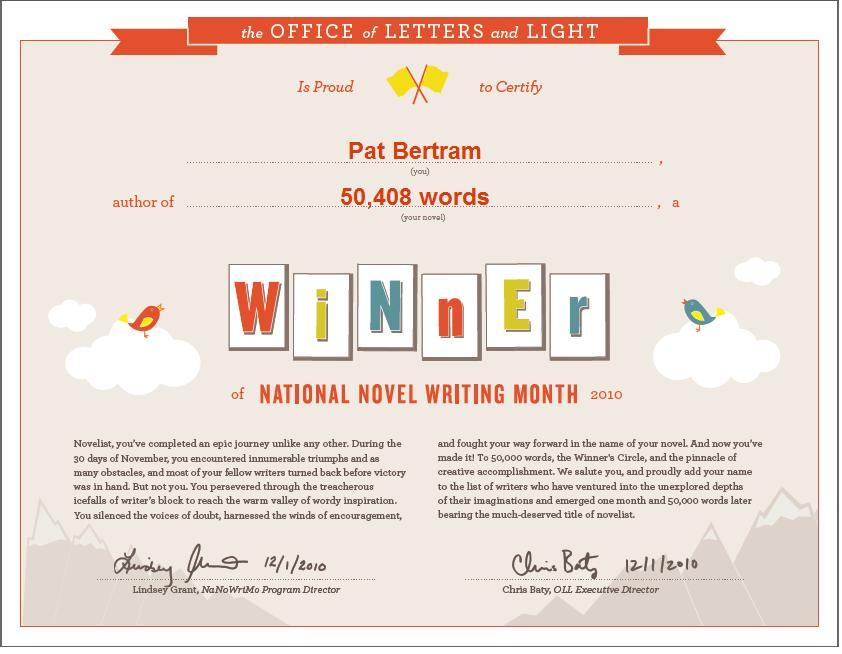
Several months after the death of my life mate/soul mate, I participated in the National Novel Writing Month. I’ve never seen the point of NaNoWriMo — if you want to write, write. You don’t need to be part of an international campaign to foist more hastily written tripe on an unsuspecting public. Still, in an effort to deal with my grief, I’d been trying all sorts of new things, and NaNoWriMo seemed like a challenge. I’ve always been a slow writer, and I wanted to see what would happen if I wrote without regard for any sort of cohesiveness or literary merit. Other people who had participated told me that when you let NaNoWinneryourself go, wonderful things happened, which, in my case, was not at all the truth.

Still, I did finish the word count. (And forgive me if I add that I see no benefit to counting words. What difference does it make if one person can write 10,000 words in a day, while another can only write 100?) What I mostly ended up with at the end of the month were disconnected scenes of a novel about a grieving woman. I wanted to get the emotion down on paper before I forgot the horror and agony of new grief, and that I did.

Well, now I’m typing up those long-fallow pages, and it’s been a surprise. The angst is there, but so is humor. How did I manage to write anything but the most sorrowful prose while still in the depths of grief? For example, here is a passage I typed up this morning:

Amanda made her way to the buffet table. The merry widows were huddled together, poring over the selection.

“Make sure Paula brings her meatballs to my funeral lunch,” Jackie said. “Katherine’s lime mold is something I’d just as soon not see.”

“You wouldn’t see it anyway,” Muffie cackled. “You’ll be dead. I like a good Jell-O mold, especially with marshmallows. Put that on my list.”

“Buffalo wings are my favorite,” Barb said. “They’re messy, so be sure to bring some of those wet wipes. Everyone will be dressed in their best, and I don’t want the men remembering me by stains on their ties.”

Amanda slipped away from the three long-time widows before they could see her. No way could she deal with them today. Usually she saw them as the fairy godmothers in the Disney version of Sleeping Beauty—brightly dressed, rotund, and into everyone’s business—but today they struck her more like the witches in Macbeth.

Would she become like them now that David was gone, with nothing better to look forward to than her own funeral? But there was Sam . . .

Okay, so it isn’t laugh-out-loud funny, but it is a lighthearted respite from the rest of the story. I wonder what other gems I’ll find that I’ve forgotten?

At the time I conceived the story, I wasn’t sure where to go with it — hence the disconnected scenes — but I don’t think I need to go anywhere with it other than finishing what I already have: a grieving widow, an angry daughter, a cyber lover, a gun, and hints of evil-doing by the dying husband (a preacher, incidentally, who supposedly led an exemplary life.) Sounds like an interesting story!

***

Pat Bertram is the author of the suspense novels Light Bringer, More Deaths Than One, A Spark of Heavenly Fire, and Daughter Am I. Bertram is also the author of Grief: The Great Yearning, “an exquisite book, wrenching to read, and at the same time full of profound truths.” Follow Pat on Google+. Like Pat on Facebook.

Another Stage of Waning Grief

Yesterday I wrote about how I am now feeling three and a third years after the death of my life mate/soul mate. I admitted I wasn’t feeling much. My life seems empty. There’s no oomph. No spark.

I wish I wanted something, was in love with something, felt something besides ever-fading sorrow. But I don’t know how to go from where I am to where I need to be.

And it’s not just me who feels this way. From the comments and emails I received, it seems as if many others who also lost their mates in 2010 feel the same as I do. Some people who lost their mates that year are in new relationships, have done something opening roseequally significant to jump-start their life, or have children to raise by themselves, but unless fate intervenes, the rest of us have to figure out how to accomplish a new beginning by ourselves. And we haven’t a clue how to do it.

I basically live the same way now as I did when I was coupled, but what took on significance when it was for “us” seems lame when it’s just for me. It’s not that I don’t think I’m worthy — of course I do because I am. It’s more that when the two of us were together, everything we did somehow seemed to help build our shared life. Every idea seemed to expand “us.” Every finished project seemed to fulfill “us.” Even something as simple as jointly preparing a meal was for “us.” Each of those things was also an act of love, a commitment to each other, even if it didn’t seem so at the time, which made them doubly or triply significant.

Now a meal is just a meal. A project finished is nothing more than a task completed. A bright idea is simply blog fodder.

If I were new, starting out in life for the first time, none of this would be a problem since everything is new and exciting when one is young, but I’ve done most of what I wanted to, or at least tried to do it. To be honest, the things I wanted to do were essentially cerebral — reading, researching, thinking, writing. I haven’t traveled the world but never wanted to. Haven’t lived lavishly but see no need for it. Haven’t partied till I dropped but never had the energy for it. I have done volunteer work but now there’s no cause I’m passionate about. (I’m still doing volunteer work, but it’s mostly online, so it doesn’t do much to give me something to live for.)

It’s possible this oomphlessness is simply another stage of waning grief — it generally takes four to five years to fall in love with life again (assuming one was ever in love with life) and most of us 2010ers are still many months away from that magic number. If this is the case, the emptiness will disappear by itself once I’ve come to term with it, or it will metamorphose into another equally confusing phase.

But it’s also possible this is what my life is, in which case I’ll have to find a way to make the insignificant happenings significant again, because frankly, spending the rest of my days feeling like this is unthinkable.

***

Pat Bertram is the author of the suspense novels Light Bringer, More Deaths Than One, A Spark of Heavenly Fire, and Daughter Am I. Bertram is also the author of Grief: The Great Yearning, “an exquisite book, wrenching to read, and at the same time full of profound truths.” Follow Pat on Google+. Like Pat on Facebook.

Fodder For the Facebook Machine

I have a discussion group on Facebook, Suspense/Thriller Writers, that is constantly evolving because of the site’s ever-changing policies, and what was once fun, has now turned into a burden.

In the beginning, when I was new to Facebook, the groups were pretty much worthless. They were mostly discussion groups where no one discussed, but I found a way to make it work. At the time, FB had separate areas for links and promos and such. I was fine with whatever anyone wanted to post — I just wanted the discussion group. And it was a great discussion group. Each week I’d ask a different author to pose a topic, I’d email the group members, and we’d have an interesting discussion. I learned a lot from those people.

Well, Facebook couldn’t leave well enough alone. They changed the group format, and since our original groups didn’t fit in with their new format — we had too many members — they planned to get rid of all of us. Eventually enough people complained, and they let our groups remain, but they changed them completely — got rid of the discussion forum, took away the ability for Facebookgroup administrators to send messages to the group, and combined everything else into one huge mess on the wall.

Members of the group left in droves. They couldn’t stand the constant barrage of promotion. Finally, we decided to ban any sort of promotion from the wall and turn it into strictly a writing discussion group. (No publishing, formatting, or promotion questions are allowed — this is strictly a group to discuss the craft of writing.) It actually worked well. As a thank you to the members for adhering to our rules, I set up a separate event every Saturday. Well, FB decided there was something wrong with that, and took away my ability to set up events. So I set up a separate group for promotion.

All went fine for a while until FB decided to change things again. Instead of ignoring groups, they decided to promote them — and the groups with the most members got the most promotion. Sounds great, right? Wrong! Now every author on FB who has a book to promote is made aware of our group, and we’ve been inundated with new members. Members, I might add, who don’t pay attention to the group rules, which are pinned to the top of the wall for all to see. (It’s amazing to me how often someone will “like” the rules or comment about how great the no promo rule is, and then immediately post a promo. I guess people think rules apply to everyone else but them?)

I spend way too much time every day deleting promos and banning those who posted the promo link. I used to give people the benefit of the doubt, but if I didn’t ban them, they’d simply post something else. (Doesn’t anyone get the point of soocial networking? You don’t constantly beat people over the head with the links to your books. You get to know them and then let them find you.)

I realize that FB is not a public site — we are all fodder for the great FB machine, and are subject to whatever changes they deem necessary — but all these machinations are burdensome. Still, the group is worth saving. How often on the internet, and especially Facebook, do you find a group of people who help each other with the craft of writing? So I’ll just deal with the frustration and hope that eventually the gods of Facebook decide to turn their attention elsewhere.

***

Pat Bertram is the author of the suspense novels Light Bringer, More Deaths Than One, A Spark of Heavenly Fire, and Daughter Am I. Bertram is also the author of Grief: The Great Yearning, “an exquisite book, wrenching to read, and at the same time full of profound truths.” Follow Pat on Google+. Like Pat on Facebook.

Move It Or Lose It! Back Up Your Files

In a recent post on the Second Wind Publishing blog, Move it or Lose it –by Sheila Englehart, Sheila talks about the importance of backing up files. Sheila Englehart’s paranormal novel Warning Signs was recently published by Second Wind Publishing, but some of her earlier works can never be published. As Sheila says:

fire damageRight now. Be honest. Exactly where are your treasured works saved? Desk drawer? Pen holder? Coffee mug? Decorative wooden box? External hard drive on the desk next to your computer?

I know that you’ve read many articles about the importance of back-ups and where to store them, but did you take action?

A storm just ripped through my neighborhood. Trees tore through power lines, blocked roads, and demolished homes. As I watched the 80 foot trees behind my house part like blades of grass, my first thought wasn’t getting to the basement for safety. No.

Is my backup in the safe? If a tornado takes my house, where would the safe land? … Continue reading →

***

Now that you’re back after reading Sheila’s article (if you cheated and didn’t read her article, please go read it) . . .

I do back up my files, but I’m not as careful as I should be. The disks and external drive are within a couple of feet of my computer, though I do send files from time to time to myself as attachments on emails. (That reminds me, I haven’t sent the most current version of my WIP to myself in a while. I’ll go do that right now.)

I have a partial manuscipt of another book I started a few years ago, but that is still on paper. I’d better type it up one of these days. Soon.

I hope you will take heed and back up your treasured works.

***

Pat Bertram is the author of the suspense novels Light Bringer, More Deaths Than One, A Spark of Heavenly Fire, and Daughter Am I. Bertram is also the author of Grief: The Great Yearning, “an exquisite book, wrenching to read, and at the same time full of profound truths.” Follow Pat on Google+. Like Pat on Facebook.

Rubicon Ranch: Secrets — My Newest Chapter

RRBookThreemidsizeRubicon Ranch is a collaborative and innovative crime series set in the fictional desert community of Rubicon Ranch and is being written online by the authors of Second Wind Publishing.

In the current story, the  body of a local realtor is found beneath the wheels of an inflatable figure of a Santa on a motorcycle. The realtor took great delight in ferreting out secrets, and everyone in this upscale housing development is hiding something. Could she have discovered a secret someone would kill to protect? There will be suspects galore, including a psychic, a con man, a woman trying to set up an online call-girl service, and the philandering sheriff himself. Not only is the victim someone he had an affair with, but he will also have to contend with an ex-wife who has moved back in with him and a jilted lover, both with their own reasons for wanting the realtor dead.

We hope you will enjoy seeing the story develop as we write it. Let the mystery begin! Whodunit? No one knows, not even the writers, and we won’t know until the very end! If you don’t want to miss further chapters, please go to the blog and click on “sign me up” on the right sidebar to get notifications of new chapters.

(If the Christmas theme seems unseasonal, well . . . considering how long it takes to write a book at the rate of a chapter a week, in a few months, the season will catch up to us!)

Chapter 15: Lydia Gavin
by Pat Bertram

Sunday, December 23, 2:20pm

Lydia sat by Zazzi’s pool, soaking up what rays she could. She had helped Zazzi open the umbrella over the patio table, but since it was too cold to sit in the shade, she’d moved a chair out into the sunlight.

Sun.

Fire.

Lydia stared up at the pale blue winter sky and shivered with delight at the thought of that burning ball overhead. Did the Goddess love fire as much as she did? Is that why she had created so many suns?

Lydia smiled, remembering the flames curling around the hideous living room furniture. She had lied to Zazzi about not being in the house when the fire had started, but she saw no reason to tell the truth. Zazzi sure as hell wasn’t being honest with her. Lydia might not be a cop any more, but she still had her cop’s nose, and that nose told her whatever business Zazzi operated didn’t bear scrutiny. Still, the woman had made her welcome and offered her a room for the night, which made Lydia think kindly of her. And anyway, Lydia had to admit her own life no longer could hold up under a close examination.

With Nancy and her prying eyes and magpie mentality out of the way, though, she was safe, at least for a while.

How much had Nancy known? In her mind, Lydia went over every detail of her husband’s death, and couldn’t see where she had slipped up. No one knew of her husband’s abuse, not even Seth. When she and Seth were naked together, she’d kept the lights dimmed so any welts and bruises wouldn’t show, and if he’d inadvertently aggravated the injuries, he’d mistaken her groans of pain as moans of pleasure.

She’d vowed that the beating her husband gave her for having the affair would be the last time he’d ever hurt her. Things were okay at first after she got kicked off the job—he’d liked the idea of a slave wife—but then came the day he’d lost a big case. He’d blamed her, of course, saying that she’d never be a proper lawyer’s wife. He’d raised a hand to her. She dashed away. He caught her at the top of the stairs. She pushed. He fell down the marble steps. Cracked his head. She stared at him for a moment, wondering if she should call an ambulance—he’d probably be okay with immediate care. Instead, she sneaked out the back door, went for a run, and left him to die.

Dozens of people had seen her jogging in her fuchsia shorts and lime green top, and though she’d been questioned, the cops never suspected her. Why should they? She had an alibi and she’d always played the loving wife in public.

But Nancy had found out. Or had she? When the realtor said in that oh, so ominous voice, “I know you killed your husband,” could she have been merely fishing?

It didn’t matter now. Nothing mattered but those lovely dancing flames. Even Seth’s love had never ignited her the way the heat of the fire had.

As she’d watched the flames devour the furniture, the stone Lydia had seemed to melt and flow like lava, and suddenly she’d been awash in a volcano of molten tears. She’d never known such life. Love. Ecstasy.

She’d managed to wrest herself away from the flames and rush outside before her new love could hurt her as much as her past loves, and although she wanted to continue her enthrallment with the blaze, she couldn’t bear to be around the gawkers. What could they know of the love that now burned in her heart? Only the paltry excitement of destruction kept them riveted to the scene.

Lydia had wandered off in a daze, and hadn’t come back to herself until Zazzi had confronted her. She’d managed to hide her rapture behind cop’s eye—that cold calculating look was not something you ever forgot how to give—keeping her secret safe in her heart.

Lydia stared up at the sun, and took a deep breath. The air smelled deliciously of smoke and ashes and charcoal and burnt offerings. Is this what the Goddess smelled every day of creation? Lydia stretched, like a cat on a warm hearth, and wondered where to go from here.

Home, probably. She could no longer remember why she’d come to Rubicon Ranch. Had she come just to be near Seth? To try to get back together with him? To get even? To remove her competition? To warn his new love of his philandering ways?

It hadn’t been hard to find out about his affair with Nancy. She’d simply followed him one day when he left the sheriff’s department and seen him meet with the realtor. She’d only made an appointment with Nancy to see what Seth preferred over her, but had stayed to watch the fun when she realized Seth had met his match.

Were all men so blind they couldn’t see what was in front of their very eyes? She had deeply loved Seth, wanting only the best for him, and he had thrown her away, calling her a vituperative bitch. Yet Nancy, who didn’t love him, and who truly was a vituperative bitch, he had kept.

But now she was through with men and their incomprehensible needs. She had found something better. Something that would never let her down. Something that would forever burn in her heart.

Fire!

***

Pat Bertram is the author of the suspense novels Light Bringer, More Deaths Than One, A Spark of Heavenly Fire, and Daughter Am I. Bertram is also the author of Grief: The Great Yearning, “an exquisite book, wrenching to read, and at the same time full of profound truths.” All Bertram’s books are published by Second Wind Publishing. Connect with Pat on Google+