Do you think writing this book changed your life?

Speaking of Daughter Am I, I wish I could say writing this book changed my life since would make a good story, but the fact is, it made little difference. It was the third novel I wrote. I’d already experienced the joy and sense of accomplishment completing a novel gives one, and I’d already experienced the disappointment that comes from having a novel rejected. I’d already experience the joys of being published and the disappointment that comes from not having the book take off immediately. Now, if Daughter Am I would go viral, that would change my life!

Here are some challenges other authors faced as they wrote their books. The comments are taken from interviews posted at Pat Bertram Introduces . . .

From an Interview with Harold Michael Harvey, Author of “Paper Puzzle”

Yes I do think writing this book has changed my life. After leaving the practice of law I had to redefine myself, reinvent me if you will. And writing has gotten me back to the original childhood dream of what I wanted to do in life. The joy of writing legal thrillers is a lot less stressful than fighting to keep the State of Georgia from killing my client with a lethal injection as deadly as those given to Michael Jackson by Dr. Conrad Murray.

From an Interview with J J Dare, Author of False Positive and False World

Writing my first book a few years ago gave me confidence. I believe it was an exercise to prepare me for the challenges I would shortly face in my personal life.

From an Interview with Noah Baird, Author of Donations to Clarity

I think people thought I was pretty weird before the book. They still think I’m weird, but I think I get a pass now because I’m a writer.

From an Interview with Calvin Davis, Author of The Phantom Lady of Paris

After penning the Phantom Lady, I was not the same person. The actual writing of the novel took about five and a half years. During that period, I wrote and rewrote again and again, etc. That said, the truth is, it took me all my life to write the Phantom Lady. The penning of my two other novels was preparing me to write TPLOP. The production of my countless short stories was also tutoring me on how to create the Phantom Lady. And during all this time of schooling, “the lady” was inside me clamoring to be liberated, as I was clamoring to liberate her. “Free me…free me,” she screamed. When I completed the last sentence of the novel, the lady was finally liberated. “Thank you, Calvin,” she said. “Thank you.” Finally, she was free…and so was I.

From an Interview with Sherrie Hansen, Author of Merry Go Round

I think each book that I’ve written has changed my life. I remember an episode of Star Trek, Next Generation, when Jean Luc Picard was swept away to live out his life on another planet. He eventually fell in love, married, had children, and learned to play a musical instrument. When his new world came to an end, he learned that he had never left the Enterprise, and that the whole alternate life experience had occurred only in his mind, in a few days time. I feel like that every time I finish a book. It’s like I’ve visited some alternate reality and lived the life of my character from start to finish, feeling what they feel and experiencing what they experience, when in reality, I’ve just been sitting at my desk, typing away. In a very real way, I think each book makes me a richer, more multi-faceted, more understanding person because when I’ve walked a mile (or a hundred) in my character’s shoes.
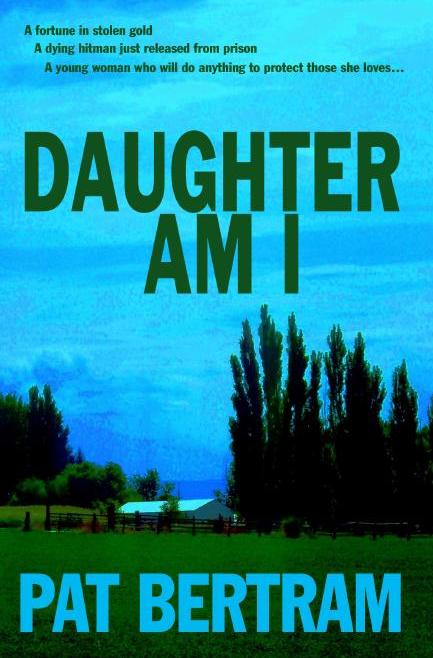

Excerpt From “Daughter Am I” by Pat Bertram

DAIDaughter Am I: When twenty-five-year-old Mary Stuart learns she inherited a farm from her recently murdered grandparents — grandparents her father claimed had died before she was born — she becomes obsessed with finding out who they were and why someone wanted them dead. Along the way she accumulates a crew of feisty octogenarians — former gangsters and friends of her grandfather. She meets and falls in love Tim Olson, whose grandfather shared a deadly secret with her great-grandfather. Now Mary and Tim need to stay one step ahead of the killer who is desperate to dig up that secret.

Excerpt:

Mary blinked in the sudden brightness, then blinked again when she saw Iron Sam. He seemed to be the personification of the inorganic being, as Happy called it. His skin looked ashen. Charcoal bags hung below slate eyes. His hair, still thick, still with the deep widow’s peak, had faded to pewter. The only hint of color in his face was the gold tooth visible between slightly parted gunmetal-gray lips.

He glanced up as they entered, but no other part of his body moved. Nor did he speak.

“Hi, Sam,” Lila Lorraine said.

The slate eyes shifted toward her.

“It’s me. Lila Lorraine.”

Iron Sam nodded, the merest inclination of his head.

Happy stepped forward. “Remember me? Happy?”

Again the tiny nod.

Mary wondered if he were paralyzed, but if so, wouldn’t he be in a wheelchair instead of an ordinary wooden chair?

Any compassion she might have felt withered when his eyes met hers. Feeling like a bug impaled on a pin, she gazed at him, unable to look away, unable to move a single muscle. After what seemed like a long time, but must have been only seconds, he turned his attention to Kid Rags, leaving her feeling limp and very thirsty, as if her vital fluids had been sucked right out of her.

With nonchalance Mary could only marvel at, Kid Rags pulled out his flask and offered it to Iron Sam. When Iron Sam nodded toward the plastic cup sitting on the bedside table, Kid Rags poured two fingers of bourbon and handed the cup to him. He sniffed it, inhaling deeply with closed eyes, then took a mouthful and held it a moment before swallowing it. His lips twitched — a smile perhaps? — then he took another sip.

The alcohol fumes mingling with the hospital odors and the stench of decay emanating from Iron Sam’s pores turned Mary’s stomach. She swallowed hard, then swallowed again, knowing she shouldn’t show weakness in front of Iron Sam, and somehow she managed to get her queasiness under control.

He flicked a look in her direction, as if sensing her struggle, then concentrated on his drink once more.

“My name is Mary Stuart,” she said when she could no longer stand the heavy silence. She introduced Kid Rags, Crunchy, and Teach, then explained about her grandparents’ deaths.

“What can you tell me about my grandparents? You might have known them as Jimmy Boots and Gina Dale.”

***

Pat Bertram is the author of the suspense novels Light Bringer, More Deaths Than One, A Spark of Heavenly Fire, and Daughter Am I. Bertram is also the author of Grief: The Great Yearning, “an exquisite book, wrenching to read, and at the same time full of profound truths.” Follow Pat on Google+. Like Pat on Facebook.

Steampunk Collaboration

I’m cheating tonight. I spent so much time writing a possible time travel scenario for the steampunk collaboration I’m involved in with seven other authors, that I didn’t have time to write a blog. So I’m posting the scenario. What do you think?

Possible time travel scenario:

A tourist is found dead in a time travel machine, clutching some sort of gizmo in his hand. Knowing that a death could kill business in what is supposed to be a safe traveling mode, the operators of the Time Travel Company decide to investigate.

They have some sort of recordings of where the traveler has been, one from each era he visited, (secret, of course, since if the tourists knew they were being recorded, it would put a damper on business) and the Time Travel Company sets employees to watching these tapes (crystals? discs? a sophisticated version of Babbage’s difference engine or analytical engine?). Since it’s real time, they all watch at the same time, otherwise it could take weeks for them to see what went on during the tourist’s trip. Perhaps news of the death leaked, and if they don’t discover the truth fast, they will be ruined, so time if of the essence. This is how we could get by the problem of doing five sets of eight chapters. After each set of chapters, the TTC operator and a trusted employee could discuss what they saw, see if there were any abnormalities, and when they don’t find anything out of whack, they continue watching the tapes.

Since our guy is by himself, posing as a tourist, chances are his reasons for traveling are personal. Considering that coal is such a polluter, perhaps his wife died of lung cancer, and if they weren’t wealthy, chances are they couldn’t get out of the city to clean air. Maybe he studies alchemy texts, finds a way to produce clean steam by means of cold fusion or atomic energy (supposedly the alchemists knew how to do this without producing radioactive side effects) or some other energy source, and he wants to go back to the past to find someone who will utilize the machine so that by the time his era comes around, there is no pollution. (There’s no point in his finding backers in his own time since his wife is already dead.) Another possibility is that he is looking for a way to blow a hole in time to change things, so that perhaps by the time he gets back to his era, things will have changed. He is killed before he can put his plans in motion. It would be up to you to decide why your character would want to kill him to maintain the status quo.

If he is lower class (or low middle class) his clothes would not be out of place in any period in the steam era. This would save him from traveling with an extensive wardrobe.

He and his agenda would be the unifying factor of all the POV characters. You tell the story from your character’s POV, but he is a major character in your substory. During each set of chapters, he grows more and more frantic, since he can’t find what he wants (someone to give his gizmo to, or perhaps a way to use it to blow a hole in time to change the future. We don’t see the end of his story, the TTC has to figure it out, because once he is dead, his story ends. We would not know in which era his story ended, because in the past, all time happens at the same time.

The benefits of this scenario are that the authors can decide what year/era they want their character to live in, can write their story without much regard to other authors’ stories (except to keep the tourist consistent), and the tourist would provide the unifying factor without having to spend weeks trying to figure out what all the chapters have in common. Another benefit is that the scenarios wouldn’t have to be based on history, but could be more personal as long as they were consistent with the time period you choose.

The drawbacks are that you might not be able to tell the story you want — you’d have to keep the story simple, focused on both your character’s agenda and the tourists, and somehow link them. You’d have to pick a past era, rather than a fanciful future era since a future era would do our traveler no good. And you’d have to pay attention to how the other authors develop the character of the tourist to keep him consistent.

If you don’t like this scenario, we can still do the one we talked about where all of our characters once were members of a think tank, and now someone is killing all the members. The remaining members (our characters) get together to figure out who the perpetrator is and why he wants them dead, and they discover that the assassin is one of them.

Either scenario would work for our purposes.

List of Loaths

I have a list of words and phrases I loath.

Giving 110% – – A physical impossibility, and even if it were possible, your energy and fluids and muscles fibers would be so debilitated that you might not be able to recover

24/7 — The only thing you can do 24/7 is breathe. This monstrous figuration is particularly loathsome when  used in conjunction with 110%. Giving 110% 24/7. Yeah, right.

Coed — This is a sexist term that was born in the nineteen thirties when women enrolled in previously all-male colleges, and it is a term that should have died there. Men were educated, women were coeducated. Not the same thing at all.

Intestinal fortitude This term ties my guts in knots. Use plain old “fortitude” or have the guts to say “guts”. Even better, use the word “courage”.

Veggies — I should have put this at the top of my list. This one really grates. What is wrong with “vegetables”? Are we children, that we need cute words to entice us to eat foods that are good for us?

Today, I’m adding a couple of new phrases to my list of loaths. With election year politics fouling the air, this is a good time to mention them since you are probably as sick of hearing these hyperboles as I am. These phrases refer to POTUS, the president of the United States.

The most powerful man in the world. Uh, yeah. Don’t even know where to start with this one. There are men and women in the world who head debt-free conglomerates who could buy and sell the United States. These folks buy presidents with petty cash. They shell out billions of dollars to lobbyists to make sure their agendas are met. They buy zillions of tickets to $1000 plate dinners to make sure that their needs are known.

Our government is basically a committee. The president has advisors, has to answer to appropriations committees and other congressional groups who have the power to squelch his demands. He has to answer to his party, and most of all, during his first year, he has to pay attention to the polls. The only goal a president has his first term is to get re-elected to a second term. Doesn’t sound all that powerful to me.

Perhaps POTUS is the most powerful celebrity, perhaps he is the most powerful elected official, perhaps he is the most powerful public relations icon. But he is not the most powerful man in the world. Nor, as I have heard several times lately, is he the most powerful man in the solar system. I can’t even imagine the foolish minds that come up with this stuff.

The leader of the free world. Says who? Does anyone in France consider POTUS their leader? Does anyone in England? Or Germany? Or Canada? And what is the free world anyway?

Please, before you use such in inanities in your writing, pay attention to what you are saying. I just a picked up a book where, in the first chapter, POTUS was called the most powerful man in the country. In the second chapter, he was called the most powerful man in the world. In the third chapter, he was called the most powerful man in the solar system. I didn’t stick around for the fourth chapter, where I’m sure POTUS would have been called the most powerful man in the universe. I many not know much, but I do know this: POTUS is not now, nor ever will be, the most powerful man in the universe.

What is Life? What is Death? And What do Such Questions Have to do With Grief?

I always like when people think out loud here on my blog, when something I have said strikes an answering chord, and often when they’re not sure if they are making sense, they make the most sense to me. The only good thing about my grief is that I’ve met some wonderful people who are struggling with the same questions I am, and I’ve had some thought-provoking discussions about the meaning of life, death, grief, and whether any of it matters.

Leesa from Leesis Ponders believes that it does matter. She wrote on her blog:

I have spent my whole life asking if there is a god and if so what does it have to do with me.

And for me, life matters.

The search for self that blends into all matters.

The way we act towards others matters.

The way we raise our kids matters.

The way we treat the less empowered matters.

Leesa has been here with me through almost two years of grief, letting me know that my grief matters, that life matters.

In a previous post, Falling Into Grief, I wrote: Before people fall in love, they haven’t a clue of its true power, and then it washes over them in a life-changing moment. Before you fall into grief, you haven’t a clue of its true power, but it too washes over you in a life-changing moment, and all but drowns you. Even though I’ve experienced so much of what grief does to a person, I still can’t believe its power. The way grief reflects falling in love as in a very dark mirror, there has to be a hormonal component. I know stress releases hormones, as does shock. Adrenaline courses through your body, and there are changes in brain chemistry that produce hormones. Your immune system goes on hold.

Leesa responded: one thing you are absolutely spot on about is that we don’t know the power of falling in love nor the power of grief, nor indeed the power of love when ones baby is born until we actually experience it. The reality of life seems to be that our most intense experiences in life are about our deepest connection to each other. These experiences are life altering and this goes way beyond the DNA imperative.

For me personally then questions upon questions arise. Why is this intimate connection our deepest need, our greatest joy?  What is pain about? What is the sense of being alone about? How does our idea of separating off into couples and nuclear families contribute to our sense of loss when death occurs? Why are we so interdependent on each other, on the planet on everything else. And, what is death about? 

I know that many people feel they have their answers to that last question, some theologically, some via science but personally I don’t. Another bunch of folk seem to think we can’t answer such questions. I don’t agree. I think since many of us have dumped traditional theological answers or scientific reductionist responses as inadequate we’ve kind of given up questioning. I think we need to keep questioning because whilst we are subject to many biochemical reactions to life events there is a deeper reality.

Of course none of this helps a person smack bang in the middle of grief. It still has to be lived through. But I’m convinced that we need to keep asking. I hope this makes sense to what you’ve written…I’m not sure it makes exact sense to me. I guess I just feel that once we truly understand more our experience of these events will be perceived differently…perhaps the pain will be the same but perceived differently. I’m not sure really but I am sure we don’t know enough to interpret meaning yet.

Leesa’s question, “What is death about?” haunts me. She’s right — many people do think they know the answer, but there is no way to know for sure, which is why it’s called a “belief” and not a “surety.” I do think there is a deeper reality, I’m just not sure our conscious selves are a part of it. We are so much a product of our genetics, our hormones, our brains (anyone who has had to cope with an Alzheimer’s sufferer or a loved one who had cancer in their brains, and found a stranger in that familiar body, knows how much the brain controls who we are), that I’m not sure how much of “us” survives.

There is a theory that our bodies are like television channels, receptors for certain wavelengths, so that our “souls” actually reside outside our bodies, but what does that have to do with life in our bodies?.

My friends laugh at me (affectionately) when I ask what we’re supposed to do with eternity. We have no mouths to talk, no hands to write, no arms to hug, no eyes to read or watch movies, no legs to walk.

On the other hand, if human life is a spectrum as I postulated a few days ago, then perhaps the spectrum of a human life is the same sort of spectrum as light — beginning long before the visible part appears and ending long after the visible part disappears. Of course, the non-visible parts of the electromagnetic spectrum aren’t light but sound and radiation and other invisible waves, so whatever exists outside of the visible human spectrum might be something completely different from we can ever imagine.

When I get lost in the questioning, I hold tight to Leesa’s credo that such such questions matter, that life matters.

“Reading Pat Bertram Gets Better and Better”

I got a wonderful review from Glenda Bixler today. She’s a retired professional book reviewer who now writes about books for fun, and she loves my novels!!

Glenda wrote: “I laughed with Pat while reading Daughter Am I, was scared by what happened in A Spark of Heavenly Fire, sighed with Pat’s Light Bringer (Click to read my reviews of the other books!)

“But, Wow! I sat in amazed suspense as I read More Deaths Than One . . . 

“The first reason I was amazed was that each of Pat’s books are so uniquely different,  The second was that, for me, this, last book was a mystery/suspense — my preferred reading — and therefore the most enjoyable . . . so far! I do hope she continues writing! Her imagination and creativity is exciting and diverse — readers may not be able to rely on what each book will cover, but we can be sure that it will be top rate!” (Click here to read the rest of the review: “Reading Pat Bertram Gets Better and Better”)

Ahhh . . . balm to a writer’s soul.

Some people hated the way I ended the book, thinking I should have shown Bob discovering all that had been done to him, but to me, the story has always been about Bob and Kerry and how they dealt with each other during the terrible revelations. If they had interviewed the perpetrator themselves, the relationship would have been between them and the interviewee. Any interaction between the two of them would have been delayed, and hence would not have had the same impact. By using an admittedly passive third party device, I could concentrate on Bob and Kerry and how the truth affected their relationship in the moment.

And Glenda got it. She wrote:

“One decision by the author proved to end this story in a unique way, one that responded to the need to provide a satisfying conclusion without going into the gory details that took place. The surprise ending was not totally unexpected, since the writer had shown us over and over that there was something strange going on . . . But I had no clue what it was until the last major revelation was made . . . Leaving out the action of those final days or weeks, leaves the reader with the romantic suspense as the primary plot line One that is memorable and, at the same time, allows us to get past what actually happened . . . which was too horrendous to dwell on. Kudos to Pat Bertram for effectively presenting this strange but plausible tale! If you’ve already read Bertram, you should consider this a must-read! Highly recommended!”

Click here to read the first chapter of: More Deaths Than One

Falling into Grief

I wonder how much of grief is hormonal. I often think of the young women who have their lives mapped out, want to accomplish so much, are on the fast track to success and then . . . whap. They meet the love of their life, and all of a sudden, their lives, their plans, their dreams all change. Those sex/nesting/procreating hormones are so powerful, they can derail your life, make you see things in a different light, make you do things you would never do. Women who never wanted kids start dreaming of cradling sweet-smelling bundles, look for houses in neighborhoods with good schools, invest in SUVs. People call this maturity, but basically, it’s just hormones and preprogrammed DNA kicking in. After all, in terms of genetics and evolution, we are just DNA machines, and everything works together to make sure we do our duty.

Grief does the same thing. It makes us see things in a different light, makes us want things we’d never thought about, derails all our plans, makes us do and feel things we never thought possible. Changes us. People think grief is a choice, but it isn’t — it’s something that’s thrust on us. There is no way we can choose to feel things we never imagined possible. I thought grief was a quiet melancholy, a sweet nostalgia, a pervasive sadness. Grief, for me was none of those things. (Well, that’s not strictly true — it’s how I felt when my brother and my mother died, but did not at all resemble how I felt after my life mate/soul mate died.)

A friend of mine wrote me: I have done therapy for 40 years. I have worked with people who have lost kids, spouses, parents, dogs everyone and every kind of pet. I had NO clue what it was really like in spite of losing my best friends and parents. I think a therapist who counsels someone in grief should have gone through a loss like you and I have before she/he tries to help someone. God knows there are enough of us out here who REALLY know grief. NOW I am one of them. (I hope she doesn’t mind I passed this on, but it is too important to keep to myself.)

Before people fall in love, they haven’t a clue of its true power, and then it washes over them in a life-changing moment. Before you fall into grief, you haven’t a clue of its true power,  but it too washes over you in a life-changing moment, and all but drowns you. Even though I’ve experienced so much of what grief does to a person, I still can’t believe its power. The way grief reflects falling in love as in a very dark mirror, there has to be a hormonal component. I know stress releases hormones, as does shock. Adrenaline courses through your body, and there are changes in brain chemistry that produce hormones. Your immune system goes on hold.

Do our bodies know we are no longer mated and ratchet back the DNA machine? I do know there is some effect on the limbic system. The lizard brain, which has been slumbering peacefully beneath our consciousness, wakes up and screams, “What?? I could die?? Say it isn’t so!” That’s a bit fanciful, so many of us feel it deep inside, the hurt of an animal who suddenly realizes there is an end. (As if there isn’t enough to contend with when if comes to grief.)

I don’t suppose it really matters what causes the physiological changes of grief — hormones, stress, agony, lizard brains. The primary cause is what matters. Someone we were deeply connected to died, and we fell into grief.

Dealing With Grief After a Loved One’s Long-Term Illness

There are so many misconceptions about grief that still, after two years of being steeped in the culture of the bereft, I am surprised by people’s comments. I met a woman the other day who asked about my experiences with the death of my life mate/soul mate, and when I told her that he had been sick for many years, she said, “It must have been a lot easier for you than if he had died suddenly in a car accident or something.” Um . . . no.

All deaths bring trauma to the survivors, and you cannot compare relative severities. If someone dies suddenly, the survivors have to deal with unbelievable shock, with the dreadful chores of laying the dead to rest, with the after effects of the loss, with the despair of not having been able to say good-bye, with finding hurtful troves of personal belongings that the deceased would have gotten rid of if they had known they were dying, and probably dozens of other issues of which I am unaware.

If someone dies after a prolonged illness, you still have the shock. Even though you know the person is dying, you get used to it. Their dying becomes a fact of your life, and you just somehow assume that is the way it will always be — their dying, your struggling to live despite it. And when they die, it comes as an unbelievable shock. And, as with any death, the total goneness of the person adds to the confusion and shock. You expected to feel the same way when they were gone as you always did, because, after all, you’d been preparing yourself for years for that eventuality. But you don’t feel the same, you don’t feel any way you could ever have imagined. The onslaught of physical/emotional/spiritual trauma is the same as if he had died suddenly, because all death is sudden. He is alive and then a fraction of a second later, he is dead. There is no in between state. And there is no way to prepare yourself for his total goneness. Nor is there any way to prepare yourself for the reactions of your body and mind. These reactions come without your knowledge, your consent, or your inclination.

Afterward, of course, you have to deal with the chores of laying the dead to rest and with the effects of the loss. Sometimes you have to deal with the despair of not having been able to say good-bye — often doctors hold out hope, wrongly assuming they are doing you a service, when in fact the truth would have been more compassionate. At the very least, you’d have had a chance to say good-bye. This might not seem like much to those who have not suffered a grievous loss, but I did have a chance to say good-bye, and it brought me enormous comfort over the past couple of years. I cannot imagine the pain of not being able to say good-bye or saying one last “l love you” or hugging one more time. Those are moments that are stolen from so many bereft, moments that can never be captured.

Those whose loved ones take many years to die end up with all sorts of traumas and issues because of the long dying. You hate yourself for having taken his dying for granted. You are appalled at yourself for all the times you got angry at or irritated by his infirmities. You feel guilty that you held fast to your own life while his seeped away. You wish you could take back every impatient word, every bristling stance, every horrible thought. (I remember once wishing he’d just die and put us both out of our misery. It was a fleeting thought, and understandable, but still, I wish I’d been less human at that moment and more humane.) All of these traumas add to your grief, because each has to be acknowledged, understood, forgiven.

If your mate died after suffering a long time, you do have the scant comfort of knowing he is no longer in pain, but you also have to deal with the agonizing corollary that he shouldn’t have had to suffer at all.

Even if it were easier to deal with death after a prolonged illness rather than a sudden death, (or vice versa) the truth is still the same, and still unbearable. He is dead, and there’s not a damn thing you can do about it.

***

Pat Bertram is the author of the suspense novels Light Bringer, More Deaths Than One, A Spark of Heavenly Fire, and Daughter Am I. Bertram is also the author of Grief: The Great Yearning, “an exquisite book, wrenching to read, and at the same time full of profound truths.” Follow Pat on Google+. Like Pat on Facebook.

Saying “Yes” to Life, and to Steampunk

I’ve been invited to participate in another collaborative novel, similar to the Rubicon Ranch project, only instead of a thriller, this collaborative effort will be steampunk.

I don’t know anything about steampunk. Know even less about the Victorian era. And know less than less about steam-driven machinery. So, of course, I agreed to do the project.

I crave anything that is different from what I know — different tastes, different experiences, different challenges. Ever since the death of my life mate/soul mate, it seems a waste (or a stagnation) to do what he and I always did. He might be moldering in the grave (or rather in a funerary urn) but it’s a disservice to both of us if I molder, too.

John Berryman wrote:

A voice calls, “Write, write!”
I say, “For whom shall I write.”
And the voice replies,
“For the dead whom thou didst love.

This quatrain could just as easily exhort, “Live, live for the dead whom thou didst love.”

Sometimes it feels as if this is still our life — his and mine — only I am here and he is . . . wherever. Perhaps I’m here to live for both of us. Or maybe, now I’m here to live just for me.

When we met, I was at my most spontaneous. Something about his being in the world made it seem as if life were full of possibilities, and I grabbed hold of life with both hands and ran with it. Years later, as he got sicker, as life took its toll on our finances, and the possibilities shrank, our lives became staid and planned to take his infirmities into consideration. He told me once he regretted that the constraints of our life destroyed my spontaneity, and he was sorry to be the cause of it.

It’s not something I like to face, but the last years, and especially the last months of his life were terrible for both of us. And, something I like to face even less is that his death set me free. The best way to honor my mate’s life and his great gift of freedom is to take back the thing he thought he stole from me, so I’ve been practicing spontaneity. Which means, saying yes to challenges. Saying yes to life. Saying yes to steampunk

So why steampunk? Why not? I’m a writer. I can fake it. I’ve also got the internet with all its research capabilities to help me. And it’s something I would never have considered writing. All good reasons.

Wikipedia defines steampunk as “a sub-genre of science fiction, fantasy, alternate history, horror, and speculative fiction that came into prominence during the 1980s and early 1990s. Steampunk involves a setting where steam power is widely used — whether in an alternate history such as Victorian era Britain or “Wild West”-era United States, or in a post-apocalyptic time — that incorporates elements of either science fiction or fantasy.”

In “How Do I Write A Steampunk Story?” Dru Pagliassotti says, “Steampunk fiction consists of two elements — the steam, or gaslamp aesthetic, iconography specific to the genre — and the punk, a critical ideology or political stance that satirizes, challenges, or subverts societal trends.”

Kat Sheridan, a friend who took a steampunk writing class wrote me, “Remember, steampunk is all about breaking the rules and throwing conventions out the window!”

Should be fun. I’ll let you know how it goes.

The Shoulder Season of Grief

I had a rough time around the publication of my new book, Grief: The Great Yearning, due partly to the fact that the story of me and my life mate/soul mate has been told and is now contained between the covers of a book, and partly to the realization once and for all that he is never coming back. I already knew that of course, knew it from the moment he died, and I came to that same realization dozens of times afterward, but this time I reached rock bottom of acceptance, and it took. Surprisingly, the last couple of days have been good ones. My emotional state evened out, and I felt light. It wasn’t just that my grief took a hiatus, but also that my anger had dissipated. I’ve been angry for so long, since way before he died, that it became my default state. Because of that, I didn’t even realize I’ve been angry.

For many years, we sustained loss after loss — his health, our business, security — and finally, his life. So many reasons to be angry. I haven’t been furious or enraged, just a quiet anger that went soul deep. So, why did the anger leave me, even if only temporarily? I don’t know. Perhaps because the realization he is never coming back brought the knowledge that the past really is the past. Or perhaps this is simply the latest stage of my grief, a letting go. Or perhaps it’s because spring is almost here.

Whatever the reason, I no longer fear the third year of grief. I expect to experience grief upsurges, but for the most part, I think I’ll be entering the shoulder season of grief.

In the travel business, the time between the high season and the low season is called the shoulder season. I’m coming up on the two-year anniversary of his death. I will probably have some unbearably sad days as the date approaches, but after the anniversary, I could be entering a time of not-grief but not non-grief, either, a bit of a shoulder between the wildness of my early grief and the road to the rest of my life.

I still don’t know what I’m going to do with my life, but I feel a quickening of interest. If I let myself, I still panic at the thought of growing old alone, of being old alone, of dying (although the idea of being dead doesn’t bother me, dying does — it can be a terrible thing) but I still have many good years left. I actually might accomplish something. Or not. I’m not sure if I want to “do” or if I want simply to “be”. I do have a new philosophy, though — the platinum rule. If the golden rule is to treat others the way you would want them to treat you, then the platinum rule is to treat yourself the way you would want others to treat you. So, I intend to be kind to myself, to be patient with my deficiencies, to be proud of my accomplishments. And I intend to encourage myself to be bold and adventurous.

Sounds like a good beginning to my shoulder season of grief.