Oh, Look! My Book!

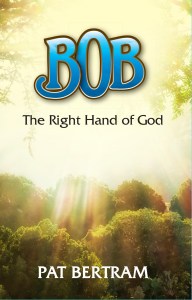
My new novel will be published on October 20, 2020. If you’d like to be notified by email when it’s available, click here: Bob, The Right Hand of God, sign up for email notifications, and Amazon will let you know the minute it is available.

All Chet Thomlin wants is to be left alone to care for the abandoned and neglected animals at his store, Used Pets, but his obnoxious customers and clinging mother make life miserable. And nothing ever seems to change.

On April Fool’s day, a gnome-like little man appears on television. He introduces himself as Bob, the Right Hand of God, and says that as part of the galactic renewal program, God has accepted an offer from a development company on the planet Xerxes to turn Earth into a theme park.

Chet laughs at the prank, but then bizarre things happen. Carrier pigeons return, millions of them, darkening the sky as they hadn’t done for over a hundred years. His mother and her entire subdivision are wiped off the face of the earth. And his friends disappear.

On Easter Sunday, a bright light appears, and Bob tells the remaining population of Denver that if they enter the light, they will be safe from the reconstruction zone. Chet watches people enter one by one, but he refuses to step forward, thinking that he’d rather have his freedom than to be in a dubiously safe place.

The light fades, and Chet gets what he wanted. He is left alone. Well, except for Bob. Bob won’t let him be. Bob calls Chet on his now defunct cellphone, taunts him, plays with his senses. Being chosen by The Right Hand of God is no fun!

Even worse, Chet gets more change than he can handle. Plumbing and all other signs of civilization vanish. Denver becomes a prairie of blue flowers that sweep into an inland sea where a prehistoric monster lives. Volcanoes grow at his feet.

And Chet has become prey.

Maybe going into that mysterious light wouldn’t be so bad after all . . .

***

Pat Bertram is the author of Grief: The Inside Story – A Guide to Surviving the Loss of a Loved One. “Grief: The Inside Story is perfect and that is not hyperbole! It is exactly what folk who are grieving need to read.” –Leesa Healy, RN, GDAS GDAT, Emotional/Mental Health Therapist & Educator

Kill Your Darlings

“Kill your darlings,” is a quote by Stephen King. No, it was William Faulkner. No, it was Agatha Christie. No, it was F. Scott Fitzgerald. Well, of course, they all said it, but the first use of the construction appeared in print a hundred years ago by Sir Arthur Quiller-Couch, who urged wannabe writers to murder their darlings. (Quiller-Couch was the inspiration for Rat in “The Wind in the Willows.” It’s amazing the things you can find out with a bit of research!)

By definition, darlings — those parts of our manuscripts that we love even when they don’t advance the story — are painful to kill, but some are more painful than others. Originally, More Deaths Than One was designed to be a series of stories told to Bob Stark (so named to remind me that he seems an ordinary fellow, but is stark of speech). It was through listening to the various stories that he was to discover the truth about himself, but though the idea had merit, the first draft was terrible. Bob barely surfaced in his own story, and the storytellers themselves seemed disembodied. I rewrote the book several times, trying to find the right way to tell the story, but it wasn’t until the fourth draft when I gave Bob a love interest, a waitress he met at a coffee shop, that the story took off. He had someone to butt heads with, someone to ooh and aah over his achievements, someone to be horrified at what had been done to him.

After the story took focus, the original idea of Bob learning about himself from tales told to him had to be scrapped, and some of those tales — those darlings — had to be scrapped. It was hard to get rid of those sections, but I did it for the sake of the story.

In my soon-to-be-published novel, I didn’t have any darlings — at least, I don’t think I do — because as I was writing the book, I remained focused on what I needed to accomplish. This is the first book I wrote with a theme in mind, and that helped considerably. If something didn’t further illuminate the theme of freedom (how much freedom we’re willing to give up for security, and how much security we’re willing to give up for freedom) I didn’t even bother to develop the scene.

Not everyone is able recognize let along kill their darlings, especially if those darlings are the whole reason for writing the book. For example, I just finished reading a novel that had been given to me by a friend of the author. It was readable, but his darlings destroyed the story. The book reads as if it’s a roman à clef, a story of the author’s struggle with alcoholism, which would be fine if that’s what he wanted. But apparently, he also wanted to write a political thriller, which gave the book a rather strange duality, as if two different stories had been cobbled together.

Authors, of course, can write whatever they wish, with unkilled darlings galore. But once they decide to write a particular type of story, they have to focus on the story they want to write, and to edit out anything that doesn’t fit. (Like a sculptor, chiseling away at all of the marble that doesn’t benefit the artist’s vision.)

Because the first half of this particular book was all about the personal story, the second half with the political intrigue was shortchanged. The author relied too much on current events to piece the story together, which kept him from having to fully develop the president or the situation he was involved with. The author just assumed everyone would know. Even worse, there was no conflict in the political part of the story, just internal vacillation as the character tried to decided if he wanted to finish the course of action he had started.

The author would have been so much better off using the personal part to add depth to the political part. Also, adding conflict to the political intrigue would have turned it into the thriller the blurb described.

The only reason this matters to me is that I read the book. If I hadn’t, I wouldn’t have cared because I wouldn’t know.

I suppose more than anything, this book is a reminder to myself to kill my darlings or, even better, don’t bring them to life in the first place.

***

Pat Bertram is the author of Grief: The Inside Story – A Guide to Surviving the Loss of a Loved One. “Grief: The Inside Story is perfect and that is not hyperbole! It is exactly what folk who are grieving need to read.” –Leesa Healy, RN, GDAS GDAT, Emotional/Mental Health Therapist & Educator.

Writing a Book Summary

Blogging is easy for me. It’s mostly a matter of letting my stream of consciousness flow through my finger tips onto the page. There’s not a lot of thinking, because either the thinking has been done or my thoughts are being processed as I write. The only time it’s hard is when my mind is blank — it’s hard to stream something that isn’t there. Often, though, I can start writing and an idea will show up that I can develop into a blog post, even if it’s only to say that my mind is blank.

Writing novels isn’t that difficult once I get started. It’s more a matter of sitting down and working out the puzzle and trying not to get bored by the necessary scenes. (The scenes that are necessary to the story, but that have been in my head so long it seems as if they’ve already been written.) What’s hard is getting started. To me, writing a novel is about finally getting the story out of my head, but if there is no story caroming around trying to get out, I have no real impetus to write.

Writing at someone else’s request is whole other situation. It feels too much like homework, and although I never minded homework when I was young, at least I don’t think I did, my mind now balks at having to do something by request.

This latest “something” isn’t onerous. It just feels like it because of the aforesaid balky mind. I’m supposed to be writing a summary of my soon-to-be-published book (my publisher is aiming for October 20!). Even though it’s been a while since I last worked on the book, I mostly remember it. (I’m looking forward to the day I completely forget so I can read it as if it’s new to me.) I just need to summarize it in a way that will entice everyone to read it. Because of course everyone will want to read the book, they just don’t know it yet. And it’s not as if I have to write a synopsis of the whole thing to get a publisher interested, because he already is interested and working on putting the book together. All I need is a short 300 word blurb and a longer 3000 word summary.

Shouldn’t be difficult, right? But apparently, I prefer to write about writing the blurb than to actually write it.

You’d think I would have been smart enough to have already written it, knowing the book was going to be published, but somehow, just like with homework, I’ve put it off until the last minute. (Actually, that’s not true. For the most part, I think I did homework right away so I wouldn’t have it hanging over me.) In this way, at least, I was much more disciplined as a child.

But I am thinking about the synopsis, so that’s something, right? Maybe if I think about it long enough, it will pretend to be a blog post and I can just let it flow through my fingers onto the page.

Then the real work starts: a bio. You’d think after almost 3,000 blog posts, many of them about my life, it would be easy to come up with something interesting to say in a bio, but nope. Total blank.

***

Pat Bertram is the author of Grief: The Inside Story – A Guide to Surviving the Loss of a Loved One. “Grief: The Inside Story is perfect and that is not hyperbole! It is exactly what folk who are grieving need to read.” –Leesa Healy, RN, GDAS GDAT, Emotional/Mental Health Therapist & Educator.

Celebrating Milestones

Today is my 365th straight day of blogging. A whole year’s worth of posts! That is certainly a milestone worth celebrating.

Tomorrow marks 100 days until the end of the year, another milestone worth celebrating. That is the day I make resolutions, if I need to make any. New Year’s resolutions are complicated because a year is so very long, especially this year. I can do 100 days. Maybe not easily, but it is possible. So, my resolutions are the same ones I always make — to blog each of those days, to try to lose a few pounds, to exercise more. And I’m sure I’ll continue my tarot studies, one card at a time.

Thursday, the final of these three milestones, will be my bloggiversary — the thirteenth anniversary of when I started this blog. That first blog post was a short one. It said simply:

Am I an aspiring writer? I have written 4 books, rewritten them, and will continue rewriting them until they are perfected.

No. I am not an aspiring writer. I am aspiring to be a published writer.

And that is what I became — a published writer. Soon, maybe even by the end of this year or the beginning of next year, my ninth book will be published. This particular work of fiction will be a real departure for me, not suspense (except to the extent that all novels are suspenseful), not a book about grief. Maybe it could be considered an allegory, maybe fantasy, maybe a lot of things. But always a Pat Bertram story.

It was a hard book to write because it was the last one Jeff brainstormed with me, and he died before it could be finished. It sat for years with only an occasional word being added because it was simply too painful to write. Every time I looked at the manuscript I was reminded he was gone.

But I did finish the book. And it will be published.

Although I haven’t been interested in writing (except this blog, of course), the first paragraph of a sequel to this special book recently popped into my head. And the novel does demand a sequel. With two children being born, one named Adam and one Eve, the book cries out for a second installment to the story.

Oops. Maybe I gave too much away with those names. Since there are religious overtones, I worried people would think it sacrilegious considering my — at times — irreverent outlook, so I had some of my religious friends read it, and they assured me it’s fine. As one reader emailed me, “As to your question about offending Christian readers, any Christian reader who gets beyond the title (which is perfect — enticing, with just the right level of warning, like one of those TVMALV ratings) will most likely delight in spotting Biblical echoes, enjoy the broken-creation and God/god themes, and eagerly wonder how on earth you’re going to end it. Your final scene is a perfect surprise — a beautifully apt and satisfying end to the tale, which really doesn’t need to fit any religious conviction; it creates and completes its own convincing artifice. I love it!

I can hardly wait for you to be able to read the book. And no, I won’t mention the title just yet — it will tell too much about the story, and I don’t want to give anyone else the idea for a story of their own before the book is safely in print.

The book was never supposed to have any religious overtones or undertones. The theme is actually more of a political one, eternally apropos, and never more so than today: How much freedom we are willing to give up for safety, how much safety we are willing to give up for freedom, and in the end, since freedom tends to be an illusion, it’s about embracing responsibility.

I got off the track of milestones for a bit there, but chalk it up to enthusiasm for my new book.

I have much to be grateful for this first day of autumn, which, come to think of it, is another milestone to celebrate. We made it through this endless summer and are now heading for more glorious days.

***

Pat Bertram is the author of Grief: The Inside Story – A Guide to Surviving the Loss of a Loved One. “Grief: The Inside Story is perfect and that is not hyperbole! It is exactly what folk who are grieving need to read.” –Leesa Healy, RN, GDAS GDAT, Emotional/Mental Health Therapist & Educator

Such an Adventure!

I haven’t been to the library in months. Even though it’s been closed because of The Bob, for a awhile I was able to get books by appointment. That was an interesting experience — they’d come to the door and hand the requested books to me, then quickly pull back inside as if we were doing some sort of undercover deal. Real spy stuff.

Then, even though we still hadn’t had a single case of The Bob in town, they completely closed the library. So I read all my emergency books — a hundred or so paperbacks I’d collected that I wasn’t particularly interested in reading — and then I started in on my emergency emergency stash. First I got caught in the spokes of The Wheel of Time, reading and rereading and rerereading all fourteen volumes comprising four million words. More recently, I’ve been reading books I had on my Nook, including a whole bunch of Clive Cussler books, Lemony Snicket’s A Series of Unfortunate Events, and aother books I had been eschewing.

The library has been open for about a month now. The hours were shortened considerably, and the number of patrons severely limited, so I kept up with my Nook stash so as not to add to the confusion. Besides, there was that wonky knee thing.

Today I ran an errand (walked, actually), which was rare for me this year. Although I’ve been doing well walking just to walk, I’ve been hesitant about carrying things. I had come out of the store with my few items and was thinking that it was about time I checked in with the library when I heard, “We miss you at the library.” There stood one of the smiling librarians. We talked for a few minutes, then, considering that a sign, I teased her that she’d shamed me into it, and I headed for the library.

Oh, so amazing! Books! A building full of books! A place where you can walk in empty-handed and walk out with a satchel full of books. Wow! What an experience!

They told me about an upcoming reading contest. I reminded them — jokingly — that I’d won the last contest, but The Bob had kept me from my prize. This contest will be fairer. For every five books read, your name is put in a pot, and at the end of the contest, they will draw a name. It’s the only way to give someone else a chance. Otherwise they might just as well forget the contest and simply hand me a prize. I’m being a bit facetious here with my tone, though this really is the truth of the matter.

I have no idea if any of the books I lugged home will be worth reading, but they are BOOKS! Real books made with real paper.

Such an adventure!

I might have to try this again sometime.

***

Pat Bertram is the author of Grief: The Inside Story – A Guide to Surviving the Loss of a Loved One. “Grief: The Inside Story is perfect and that is not hyperbole! It is exactly what folk who are grieving need to read.” –Leesa Healy, RN, GDAS GDAT, Emotional/Mental Health Therapist & Educator

The Glad Game

When I was a girl, I often got hand-me-downs from a much older and thinner cousin, which gave me a bad body image way too young and many years before it became a “thing.” My books, most of which had been published in the early part of the twentieth century, were also hand-me-downs from her. Looking back, some of the books themselves seemed old even then, so they might have been handed down to her first — odd to think I never thought to ask where the books originated.

I read as much then as I do now, so whenever I got sick and had finished reading all my library books as well as those of my siblings, I’d reread these novels. I had a few Nancy Drew, a lot of Judy Bolton, some miscellaneous stories, and a boxed set of five Pollyanna books that chronicled her life way past childhood. One year I was absent from school so often that I must have read these books three or four times. (I remember thinking I was pretending to be sick so I didn’t have to go to school, but once when I told my mother this, she said, “You really were sick.” But silly me, I never asked what my illness was.)

Way into my late teens, whenever I wasn’t feeling well, I’d reread these books. I don’t know what happened to the mysteries, but a friend wanted the Pollyanna books, and so I gave them to her. (She doesn’t remember this, but it was a long time ago, and I’m sure her receiving the books wasn’t as emotionally charged as my giving them.)

I was particularly enthralled with Pollyanna and her glad game, and I even tried playing it myself, but being the pragmatist and realist that I am, I couldn’t always see “gladness” even in the things she found to be glad about. The game began when her missionary parents received a “missionary barrel” of donated items, and the only thing for a little girl was a pair of crutches. Her father told her, and she believed, that she could be glad she didn’t need them.

To my way of thinking, she could have been just as glad not to need them if she had also received the doll she wanted, and the doll would have lasted a lot longer than the gladness for not needing the crutches. But then, of course, if it had worked out my way, there wouldn’t have been a story.

What made me think of all this is that my co-worker is a real-life Pollyanna, though her key words are not gladness but “this is a good thing because. . .” I’d seen her in action before, trying to keep our charge from descending into a funk, but her skill really struck home yesterday.

The client (for lack of a better word) and I had spent our time together grumping about the things going on in the world today. Being a grump has its place, I think. Facing the reality of widowhood and age certainly has its place. Mostly we just acknowledged the various situations we talked about, and then went on to something else without dwelling on the issues.

When our friend and coworker came home with her gladness, it struck me how very different two valid points of view can be. I’m ashamed to admit that I burst out with, “You’re a real Pollyanna!” Not only is it rude to make personal remarks like that, but the word “Pollyanna” is also sort of trite and meaningless nowadays, devoid of any literary context, especially since others have used the word to describe her. I tend to think it’s different for me, steeped as I have been in the whole Pollyanna literary mystique for so much of my life, not an offhand comment so much as a reflection of the hundreds of times I’d read the Pollyanna books. I could actually see my co-worker in that dauntless girl, changing the world around her with her attitude.

For a few minutes, I considered emulating her, but then I remembered my previously failed Pollyanna-isn-ness. And I remembered how much good I’ve done by dealing with certain realities — such as grief — in all their stark horror, bleakness, and pain by saying, “yes, this is hard, and it will always be hard.”

One thing that I can be glad about — because of this episode, I downloaded the first two Pollyanna books (the two written by the original author) as well as a couple of others she’d written with that same “life is beautiful” attitude.

And the author is right — life is beautiful.

Even when it’s not.

***

Pat Bertram is the author of Grief: The Inside Story – A Guide to Surviving the Loss of a Loved One. “Grief: The Inside Story is perfect and that is not hyperbole! It is exactly what folk who are grieving need to read.” –Leesa Healy, RN, GDAS GDAT, Emotional/Mental Health Therapist & Educator
Odds and Ends

Yesterday I got the courage to get down on the floor to do some stretching exercises. Ever since I damaged my left knee, I haven’t ventured to floor in case I couldn’t get back up. Although I am right-handed, I am left-legged, and I didn’t want to stress the knee. It was a bit iffy, but I managed to get back on my feet. Oddly, it was harder getting down than up. I’m not going to try it again for a while. I’ll continue to do other knee exercises, as well as walking. I walked a mile today — walked, not trudged! The muscles around the knee are a bit sore, but I hope that they will soon get back in shape.

Do you care? Probably not. I don’t blame you. Other people’s ills get to be a bore.

I’m sure my talk of the tarot is every bit as boring. The only interesting thing (to me, anyway) is that except for an occasional card warning me not to take things for granted, to accept what comes, to live each day to the fullest, and to make good choices when it comes to opportunity, most of the cards speak of harmony, of peace, of good fortune, of being in the right place. It’s possible I’d read these things into any card because that’s my current situation. Also, if I don’t like the first interpretation I find, I search around for another interpretation. (For example, the ten of swords is a card of death and misfortune, but since I refused to accept such a meaning, I delved deeper and found that the card could also mean a renewal or even simply accepting your present circumstances.)

I mentioned yesterday I’ve been reading a series of spy/adventure novels. I remember back in the days of Glasnost thinking that a whole genre of cold war spy novels, Russia vs the USA, had suddenly become defunct, and that sure seemed to be true. In the following years, spy novels centered more on the Mideast, which killed any interest I had in the genre. But now, all these years later, those old Russia vs. USA novels are current again. And the mention in one of these book about the Chinese and their bioweapons program sure struck a chord.

Come to think of it, at the beginning of The Bob, people talked about the Chinese being held accountable, and then suddenly, that whole topic of news disappeared. I wonder what that’s about? I could create all sorts of scenarios based on these old spy books, but to be honest, it doesn’t really matter where it came from. It’s here, it’s killing people as well as destroying a way of life and the world economy, and no reparations can ever make up for all the problems it caused. (Hmm. I didn’t realize I’d adopted such a laissez faire attitude. Maybe it’s because I’m abstaining from the nastiness of Facebook.)

For some reason, the sun yesterday was exceptionally hot. It seared my skin and desiccated the plants that had been watered the day before. All summer, watering every other day was fine, and yesterday? Not the hottest day of the year, but it sure seemed like it!

Today is supposed to be a bit cooler, though I’m glad I got my walking in early. And my blogging. Now I can sit back and read for the rest of the day.

***

Pat Bertram is the author of Grief: The Inside Story – A Guide to Surviving the Loss of a Loved One. “Grief: The Inside Story is perfect and that is not hyperbole! It is exactly what folk who are grieving need to read.” –Leesa Healy, RN, GDAS GDAT, Emotional/Mental Health Therapist & Educator
Skullduggery

I’ve been reading a series of spy/crime/adventure thrillers. Many of the novels revolve around a race for finding treasure, and all of them incorporate plot devices such as torture, murder, and theft on a grand scale.

While reading this latest book that involves discovery and theft of Incan artifacts going back to Francis Drake days, it suddenly dawned on me that I can’t relate to these folks at all. It might make me seem incredibly naïve, but I simply don’t understand them and their need — their greed — to take things for themselves that belong to others. To steal from a museum so that only they can see the priceless artifact. To kill people if necessary, in order to possess something no one can ever know they own.

I realize there are such people in the so-called real world. In fact, most of the great fortunes were founded by those who became known as “robber barons,” emphasis on “robber.” Even today, no one can make a huge fortune without some sort of skullduggery that skirts legality. Lesser fortunes also often come from some sort of crime before the owners of the fortune go legitimate. It must take an incredibly narcissistic person, as well a sociopathic personality to see nothing, to feel nothing but one’s own desires.

I truly cannot relate to such self-absorption and criminal tendencies, though without ever condoning the crimes, I can sort of understand those who steal on a very small scale.

Supposedly there have been several break-ins and some theft a few blocks from here. The discussion of these break-ins revolves around the myriad pot shops in town (some people say the shops contribute to crime, others say they don’t, though I have a hunch what side of the issue a person is on depends on whether or not the person partakes of the product.) Other people blame the nearby coalition for the homeless where people from all over the state (and even other parts of the country) come to get off whatever substance they are on and find a way back to the homed population. This facility has a distinct effect on the town because people who can’t or don’t want to stick with the program wander away and instead of going back where they come from, they hang around here and add to the problems of this already beleaguered town. Not only do they contribute to the crime rate, but they are also a drag on the city’s limited resources.

These people are desperate for food or a fix, and they are looking for something to sell to sate their elemental needs. Although I’ve never been in that situation, I can understand. Sort of.

I don’t understand, can’t understand, using force to take what one wants, on any sort of scale, especially when it comes to being held up at gunpoint, as happened to me once.

People always say that our differences are what make life interesting, but I don’t agree when those differences revolve around criminal behavior. I think life would be plenty interesting without greed and murder and theft and even unkindness, though I suppose, for most readers, thrillers would be a lot less interesting without skullduggery.

***

Pat Bertram is the author of Grief: The Inside Story – A Guide to Surviving the Loss of a Loved One. “Grief: The Inside Story is perfect and that is not hyperbole! It is exactly what folk who are grieving need to read.” –Leesa Healy, RN, GDAS GDAT, Emotional/Mental Health Therapist & Educator
Big Excitement for the Day

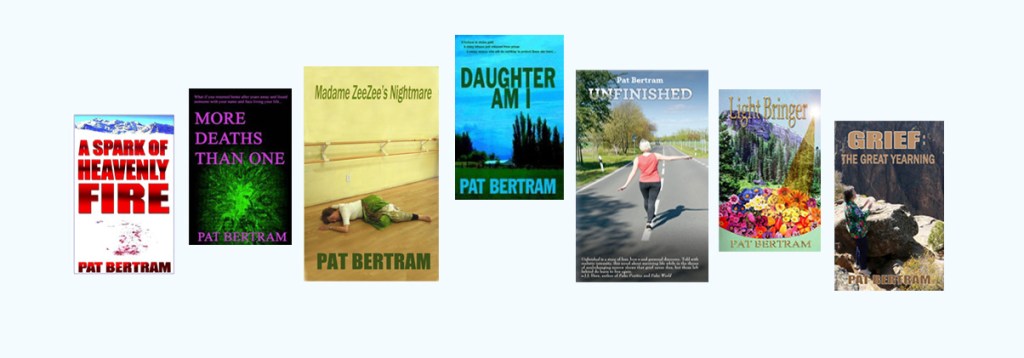
I’m reading a book about a consortium that is about to release a virus that kills with acute respiratory distress. The victims gush blood and die. I was thinking about this book in relation to what is going on today, but it sounds a lot like my own novel, A Spark of Heavenly Fire, which was published the year before this one.

In my book, the disease is full-blown, and Colorado — where the disease originated — is quarantined to keep the pandemic in check. In the book I’m reading, there have only been a few test cases, and the consortium has yet to unleash the virus on the world. They’ve been working for the past ten years on a cure, and after releasing the virus into the general population, they are planning on holding the cure hostage until their demands are met. Or maybe they’ll just spring into action with a cure, which would then afford them millions in sales and stock. Either way, it’s a planned pandemic for money.

A couple things about the book interest me more than the possibility of that scenario being played out in the world today. One, the book is a Robert Ludlum book, which is why I started reading it. Not that I like his books. The truth is, I’ve never been able to get past the first chapter or two of any of his books, but I figured this was a good time to struggle through one of his books since I have nothing better to read. Only it’s not a Robert Ludlum book. Oh, it has his name on the cover, but it was written eight or nine years after his death. A true ghost writer!

The other thing that interests me is the hero took a transport from Andrews Air Force Base that landed in the Southern California Logistical Airport near Victorville before taking a helicopter to Ft. Irwin.

So many books, movies, television shows take place in Southern California or touch on the area in some way, and now, having lived there for so many years, I know what these places are. I remember watching a CSI show many years ago, and somehow the Las Vegas crew ended up in Victorville. I’d never heard of the town, hadn’t a clue where it was, and then, in a strange twist of fate, there I was. Well, not Victorville itself, but the Victor Valley area.

And several times I happened to drive the Air Expressway that took me past the turn-off to the Southern California Logistical Airport.

Not that it matters — I have read thousands upon thousands of novels where I couldn’t correctly place the story (and didn’t care) but still, it’s fun to know where places are. And for some reason, Victorville shows up a lot in stories — perhaps because of the nearness to the desert wilderness where bodies can disappear forever. But then, how to explain Bear Lake? That’s another place that often shows up in books. In fact, it was mentioned in the book I just finished, whatever that was. (Obviously, the story was utterly unmemorable. See why I was willing to take a chance on a Ludlum book?)

So, that’s the big excitement for the day — coming across “Southern California Logistical Airport” in a terrible book by a writer who is published under the name of a dead author I never liked.

***

Pat Bertram is the author of Grief: The Inside Story – A Guide to Surviving the Loss of a Loved One. “Grief: The Inside Story is perfect and that is not hyperbole! It is exactly what folk who are grieving need to read.” –Leesa Healy, RN, GDAS GDAT, Emotional/Mental Health Therapist & Educator

Maybe Rereading “Dune”

I’m rereading Dune. At least, I think I’m rereading it. I’m beginning to wonder if I ever read it at all until now.

I remember thinking I liking the book when I was young, and several times over the intervening years I’d end up with a copy and try to reread it, but I could never get into the story again. Admittedly, when I was young, I had a lot more patience for books that were mostly descriptions of day-to-day living, whether on this planet or another (the first 150 pages of Dune seem more like setting the scene than the beginning of a book) and I lost that patience in later years. It’s also harder to keep whole books in my head now, so that adds to my impatience with dragginess.

It’s possible the book gets better (I’m not even halfway through), and it’s possible it has a great ending that would make me feel good about the book. And it’s possible that something in the latter half will strike a chord of memory, but so far, there isn’t so much as a ding. Even if I can’t remember books I read decades ago, if they impressed me in some way, I have some sort of lingering impression of them. Most books, of course, leave no impression — there is simply no “there” there. I’m not sure where Dune would fit in the book spectrum because it is different enough that I should remember something or hear a faint echo of recognition in the back of my mind. But nope. Nothing. I can’t even figure out why I would have read it. I have never liked authors who have to create incomprehensible names for people, things, and places. The strange spellings seem to take up space in my brain that would normally be used for following the story.

Even more confusing, I see the cover in my mind’s eye — a reddish cover with a fellow trudging across a wide expanse of dunes. I spent some time looking at Dune covers today, and there is not a single one of them that looks familiar. (Except for the one I bought at a library book sale a while back and redonated unread.)

It makes me wonder what book I did read. It’s possible I read some other book and misremembered it as Dune. It’s possible I misremembered the cover. (If there even was a cover image. It could have been a rebound book from the library.) And I could have found the book completely unmemorable.

Too bad there’s no way to rewind a memory to see the truth of it.

What I am seeing is a lot of similarity to The Wheel of Time series, at least in small things — the witches, the truthsayers, the uncanny powers, the manipulation of people and events. Of course, these are all fairly common archetypes and scenarios for the hero/savior story, but people often compare The Wheel of Time world to The Lord of the Rings, and I don’t see it at all. (But then, that’s another iconic series I haven’t been able to slog through, so I could have missed any similarity.)

One thing that amused me — in a book that uses so many strange-sounding names and words, at one point, Frank Herbert describes someone as having olive skin. Couldn’t he have come up with a more interesting word? I have always hated “olive” applied to skin because it takes me out of the story and makes me wonder what color the character is. I still remember the first time I came across that descriptive word. I couldn’t figure out if the character had green skin or black. It took years before I realized the word referred to the color of the inside of a black olive.

So, I can remember being puzzled by olive skin, but I can’t remember anything about a book I thought I read and thought I liked.

The life of a reader does get bizarre at times.

***

Pat Bertram is the author of Grief: The Inside Story – A Guide to Surviving the Loss of a Loved One. “Grief: The Inside Story is perfect and that is not hyperbole! It is exactly what folk who are grieving need to read.” –Leesa Healy, RN, GDAS GDAT, Emotional/Mental Health Therapist & Educator