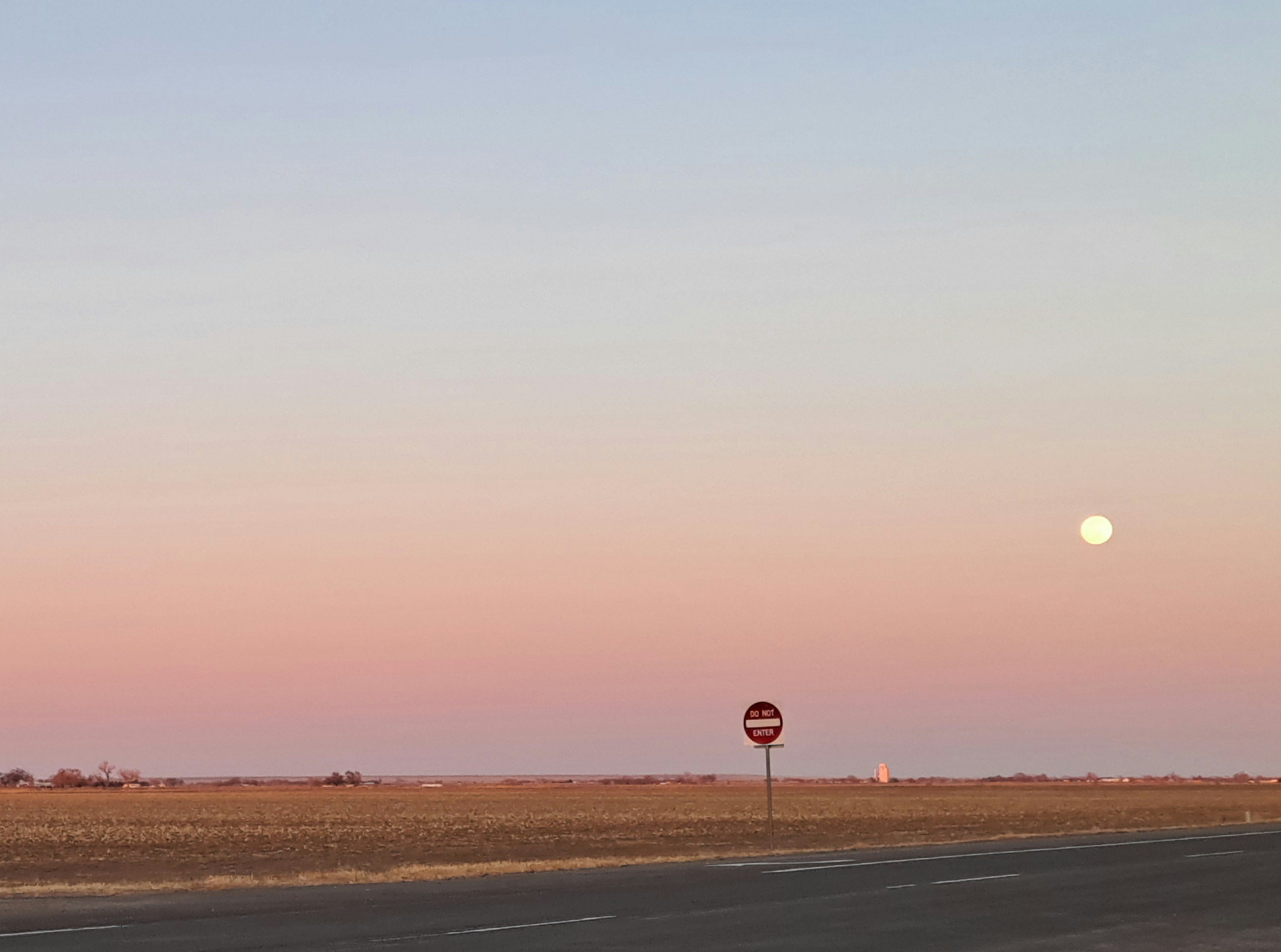
Zero Degrees of Separation

During a meeting I attended yesterday in the early afternoon, one of the women talked about relatives who’d come to visit. She mentioned how busy she was but managed to attend the meeting because her company had gone to a nearby town to visit other relatives.

Just chit chat. You know how it goes.

A couple hours later, when I was at my caregiving job, a couple knocked on the door. The woman explained they were in town visiting their cousin and wanted to see my client, who was the mother of the woman’s lifelong friend. They were a bit hesitant because they didn’t know me or why I was there, and since I didn’t know them, I too was a bit hesitant for a brief moment until I realized who they were.

I exclaimed in amazement, “I know you. You’re L’s company. She was just talking about you.”

Writing it out like that, it doesn’t sound all that amazing, and perhaps it isn’t, especially for a small town, and especially for a small town where half the people have lived here their whole lives and whose families have lived here for generations.

Still, I do find it amazing. I barely knew any of my relatives. My father was a bit of a slow rolling stone. He moved away from his family to start his own, and when we grew up, he moved away from us. And I have no friends I’ve known my whole life, though in recent years I did reconnect with some high school classmates.

Generally, in my life, there were many degrees of separation between the people I know and the people I meet. And yet around here, there’s barely a degree of separation.

I don’t suppose it will take long for me to become part of that lifestyle. Because of the woman I take care of, I know how many of the people here fit together, and in turn, the people I meet are figuring out who I am and how I fit in.

Of course, I’ll never really be part of that zero-degrees-of-separation life, because even if I live here until my expiration date, I’ll still be a newcomer. Luckily, people here like newcomers.

***

What if God decided S/He didn’t like how the world turned out, and turned it over to a development company from the planet Xerxes for re-creation? Would you survive? Could you survive?

A fun book for not-so-fun times.

Click here to buy Bob, The Right Hand of God.

Sociological Aspects of Grief

Ours is not a culture that values emotions except for those we label positive, such as love and joy and happiness. We are taught that being emotionally stable means to show a determinedly happy face, to hide our sorrows, to show public anger only in matters of what we deem to be injustices. Because of this cultural conditioning — and the lack of any enlightenment on the subjects of death and grief — the wild grief at the loss of a life mate shocks us, terrifies us, and angers us. It also tears the fabric of society, leaving us isolated, living a lie, and being manipulated by other people’s feeling about our grief.

Although we all pride ourselves on being independent individuals, we are, at bottom, herd animals. Society functions to keep each of us in our place. If we need space to be our own person, to feel what we feel or to think our own thoughts, we either have to fight for the right (hence all the vituperative political discussions we are subjected to during an election year) or we have to keep our thoughts and feelings to ourselves. Big brother and sister are watching us, but it’s not the “authorities” who are doing the watching; it’s our friends and neighbors and family. For example, I know several women who did not want to get the “Bob” vaccine for various reasons, but their families more or less blackmailed them into getting it. (“We won’t come to visit you unless you’re vaccinated.”)

If we are grieving, those same sociological effects are at work. People try to chivvy us out of our grief with blatant platitudes. They try to cheer us up because society needs us to be happy and productive, not morose and sad and grieving. They urge us to move on because they need us to move on, not because we need to.

The more they try to bring us back to the fold (yes, the sheep metaphor was chosen on purpose), the more it isolates us, and so the more we withdraw. We stop talking about our grief. We try to act “normal” around others so they don’t know how we are still suffering. For the most part, the only way to deal with our pain is to keep it to ourselves.

Oddly, while they are trying to pull us in, they themselves are pushing us away. Our grief triggers the survival mechanisms of those around us. To avoid facing the unfaceable (death), people close to us will indulge in self-protective behaviors that shut us out.

Sometimes old friends, especially couples, draw away from us. The death of our spouse and the demise of our couplehood change the dynamics of our friendships. People fear we will now be uncomfortable in the company of couples. At the same time, they are uncomfortable with us because all unwittingly, we are a reminder of how fragile life — and couplehood — really is.

A strange aspect of all this is that when we do start to “move on,” whatever that means, it’s also the wrong thing to do. Society, in the guise of friends and family, acts as if it has the right to say when it’s time. If we move on too soon (meaning finding someone else to keep company with or even marry) that’s every bit as bad as holding on to our grief too long.

I dislike the cliché that everyone’s grief is different because during the past eleven years of writing about grief and talking to people in person, in emails, or in the comment section of my blog, I have discovered that there are more similarities than differences in grief when it comes to the loss of a spouse. A new connection or even remarriage, however, is an area where the cliché is true: everyone is different. We will each of us find our way to a new relationship when (if) we feel the need, when the time is right, or when we meet the right person.

It’s no one’s business but our own if we struggle on alone or if we find comfort in the presence of another person, though often family and friends disagree.

I know someone who basically lost his children after he remarried. The teenagers would have nothing to do with him or his new wife, and chose to live with their mother’s sister. The preteen remained at home, but she made their life hell until he finally agreed to let her go, too. It’s only now that the children are on their own that a couple of them realize they made a mistake and are finally talking to him. (One still refuses to speak with him.)

Ironically, one woman’s daughter urged her into another marriage, then hated her mother for following through, perhaps because the daughter thought the new groom would not just be a replacement for her father but would be her father, and it came as a shock when the fantasy did not hold true.

As a blog reader pointed out, it’s possible his grown children’s lashing out over his new relationship might be their way of avoiding the painful process of coming to terms with the fact their mother is gone. I wonder if part of the lashing out is also resentment because of what they assume is his too easy acceptance of their mother’s death. And, of course, it’s that sheep herding thing in action: they need their remaining parent to be what they need him to be, not what he needs to be.

No matter what societal pressures are put on a bereaved person, the person’s grief is theirs alone. And how they deal with it going forward is also up to them.

When we are new to grief, so often we are told to look for support from our family and friends, and in an ideal world, this would be a good idea. But we don’t live in an ideal world — we live in a herd. It’s just another one of the ironies of grief that sometimes the very people who should be offering emotional support are the very people are adding to the whole quagmire of painful emotions we call grief.

***

This post was written at the request of a fellow griever. If anyone wants me to write about a certain aspect of grief, feel free to leave a suggestion. Since little of grief is truly unique to any one of us, chances are I went through whatever you’re concerned about.

***

Pat Bertram is the author of Grief: The Inside Story – A Guide to Surviving the Loss of a Loved One. “Grief: The Inside Story is perfect and that is not hyperbole! It is exactly what folk who are grieving need to read.” –Leesa Healy, RN, GDAS GDAT, Emotional/Mental Health Therapist & Educator

War Zone

It sounded like a war zone around here last night. From before dark until long after midnight, many people around here were shooting off firecrackers. There must have been thousands and thousands of dollars spent on the ridiculous things, especially the illegal ones. Although Colorado has banned any fireworks that leave the ground, the sky was alit with so many fake stars that the natural firework show was often obscured, but still I got to enjoy the sheet lightning that so often shows up on the fourth of July.

Can you tell I don’t like fireworks? I can’t imagine how military veterans who had actually been in a war zone felt like last night. Even if they hadn’t suffered from flashbacks or PTSD, the constant booms and cracks as well as the whine of rockets probably brought it all back. My nerves are generally pretty steady, but even I had to jump when explosions seemed to sound right outside my window.

It’s odd living so close to a state line. People in Kansas come here to buy the marijuana that’s illegal there, and people here go to Kansas to buy the fireworks that are illegal here. I suppose it’s a fair trade for a lot of people, but neither of those products have any meaning to me.

Whatever happened to glow worms and sparklers and homemade fireworks like dried cattails?

I probably sound curmudgeonly, but there is a good reason for that — I am curmudgeonly! Or at least, I am becoming so.

If previous years are any indication, tonight will be a repeat of last night as the seasonal firework peddlers sell of the last of the their wares. But luckily, eventually things do quiet down.

***

Pat Bertram is the author of Grief: The Inside Story – A Guide to Surviving the Loss of a Loved One. “Grief: The Inside Story is perfect and that is not hyperbole! It is exactly what folk who are grieving need to read.” –Leesa Healy, RN, GDAS GDAT, Emotional/Mental Health Therapist & Educator

Why Don’t People Read?

I read a column in the local paper about why people don’t read any more. His rather glib response to the question was to blame it on the Dick and Jane books schools used to teach reading from 1940 to 1970. Admittedly, those were not riveting books even for a first grader, but some of us still managed to develop a love of reading. Those books fell out of favor more than fifty years ago, so they really have nothing to do with the low book-reading rate today. In fact, most of those who read on a regular basis seem to be those who learned from the Dick and Jane books. Younger folks grew up in a later era with a large array of diversions to choose from, and perhaps books are simply too labor intensive for them, though I don’t know for sure. I do know that many of my acquaintances don’t have the time to read; some can’t sit still long enough; and others just don’t see the point.

To be honest, I don’t care. I read and I have access to a library. That’s what counts to me.

The one thing that the columnist said that struck a chord, and why I am writing this piece, is his comment: “Maybe the government should give people an additional tax exemption for every book report they attach to their tax return.”

Such a brilliant idea! If you take all the money the government hands out to literacy programs and programs purporting to get people to read and put it in a separate account to pay for book reports, it might not do much for literacy, but it sure would be a windfall for us readers.

One of the big problems with getting kids to read is that their parents don’t read books, so they don’t have any reading role models. And since the parents don’t like books, they don’t urge their children to read. But if they got money for each book report they or their kids did? I bet they’d be more willing to help their youngsters read. I imagine there would be a lot of cheating in such a program, but it wouldn’t really matter. If a kid copied a book report from the internet, it would be enhancing their non-game-playing computer skills. And if the parents wrote the reports for the kids, they’d have to at least scan the books, which would allow the kids to see books in their parents’ hands.

Come to think of it, from my standpoint, it might not be such a good idea. I do tend to be rebellious, and if I am being urged to read, I might feel the cold fingers of the government prodding me, which would make me dig in my heels.

Though perhaps not, because . . .

Reading!

It’s what I do.

My Father reading my novel Light Bringer

***

What if God decided S/He didn’t like how the world turned out, and turned it over to a development company from the planet Xerxes for re-creation? Would you survive? Could you survive?

A fun book for not-so-fun times.

Click here to buy Bob, The Right Hand of God.

Happy Halfway Day

Today is halfway day, and as I am typing, right this very moment (12:00 pm), we’re exactly half way through the year. I wouldn’t even have known it except that I received a rather nice halfway present from a relative who enjoys celebrating offbeat holidays. It’s hard to think that in 183 days we will be celebrating the New Year. It seems as if we just came off winter, and summer, too, now that I think about it, since we had a very cold late winter and a very hot early summer. For the past few days, we’ve had a respite from the heat, so for all I know, it could be fall.

It’s a good thing I try to take the days as they come otherwise my mind would be in a whirl trying to keep track of the unseasonal seasons. But I am enjoying the respite from our usual excessive heat at this time of year.

What I am not enjoying are the fireworks. People around here start shooting them off at the end of June and continue for a week beyond July 4th. I’ve never understood the point of loud noises, but then, there a lot of things I don’t understand, so I’ll add “fireworks” to that every-growing list.

Offsetting somewhat the annoyance of the nerve-shattering bangs are the newly blooming zinnias. I considered planting a garden full of zinnias, but didn’t get the seeds in time, so I only have a partial garden of zinnias. I’ll have to rectify that next year. If I were really dedicated, I’d start some zinnias inside in the spring and then plant the seedlings along with the seeds so I’d have a longer growing season, but that would take more planning than I plan to do. I’m still very much of a spontaneous gardener, doing what I can when I think of it. But someday, perhaps I’ll get into the habit of starting seeds indoors. But then, the seedling would have to be planted, and it’s oh, so much easier just throwing seeds out there and then hoeing a bit of dirt over them.

Luckily, I don’t have to think of that until next year, which is much closer than I imagined.

Anyway, here are some flowers for you. Happy Halfway Day!

***

Pat Bertram is the author of Grief: The Inside Story – A Guide to Surviving the Loss of a Loved One. “Grief: The Inside Story is perfect and that is not hyperbole! It is exactly what folk who are grieving need to read.” –Leesa Healy, RN, GDAS GDAT, Emotional/Mental Health Therapist & Educator

Tarot Classic

The tarot deck I am using this month is called “Tarot Classic,” and is based on medieval woodcuts. As with most decks, the given meanings of the cards are brief because tarot readers are supposed to assign their own interpretation to the cards based upon their impulses, subconscious, and conscious association of ideas with the symbols. I suppose some people can do that, but I am stuck with traditional interpretations because I look at the cards and feel . . . nothing, really. Luckily, I have a notebook full of various interpretations, so I can get a general idea of what each card is supposed to signify.

Today starts my second year of doing a daily tarot reading. Up until now, I’ve just picked one card per day, but it’s time to expand my studies, so today I picked two cards. Wow! So daring! I’m being silly, but I suppose in a way it is daring. It was hard enough to relate one card to my daily life, I can’t image what I will do with two. Still, it’s a way of using the dozens of tarot decks that were handed down to me from my now deceased brother.

Most layouts seem to be done with five or more cards, but even with two cards, there are myriad ways of reading. For example, the first card can demonstrate a strength, the second a weakness. Or perhaps the first can represent an emotion, the second a thought. Other possible readings:

Valid fear/invalid fear
Fear/reality
Perception/reality
Mistake made/lesson learned
Pros/cons
What empowers/what disempowers
Situation/main challenge
If this, then what
What to act on/what to leave alone.

A two-card layout can be about almost anything. So can a one-card, really, but I stuck with “What do I need to know today?” I decided to stick with the same question as well as adding an addendum for the second card, “What do I need to let go today?”

The first card was the Empress, the second the four of swords. (I got a kick out of the four ones for the Roman numeral four rather than the usual IV.)

The Empress is about beauty, creativity, entering a period of growth, feeling rather than thinking, being grateful for the bounty that surrounds you. The four of swords is about rest, replenishment, letting go of anxiety, taking time out to restore your energy.

I suppose those two cards fit — if what I need to know today is that I’m going to be entering a time of growth, then for sure I need to let go of any anxieties that might be keeping me back.

Even if that’s not what the cards mean, apparently the tarot means whatever anyone wants it to mean, so that’s what those cards mean to me today.

***

What if God decided S/He didn’t like how the world turned out, and turned it over to a development company from the planet Xerxes for re-creation? Would you survive? Could you survive?

A fun book for not-so-fun times.

Click here to buy Bob, The Right Hand of God.

Stuff as Story

I watched Judge Judy the other day with the woman I help care for. The episode was a particularly bizarre one, or rather, it was one of the judge’s more bizarre rulings. The case itself was rather simple. A woman was moving, and she had three things she wanted to get rid of. The man who was helping her move knew someone who wanted those items, and with the woman’s permission, the man gave the keys to his friend to remove those items from the woman’s basement. Somehow, he got his wires crossed and ended up telling the friend he could take anything from basement. So the friend cleared out several things the woman wanted to keep. He also somehow broke her grandmother’s China, a cherished legacy.

Judy told her she didn’t have a case against the man’s friend, because the man was acting as her representative, and he had given him permission to take the stuff. Then she dismissed the case. “But what about my grandmother’s China,” the woman wailed. Judy waved her off with a curt, “It’s just things.”

That took me aback. Things are never just things. To a certain extent, stuff is story. After a certain age, it seems, everything we own is imbued with its own story.

For example, earlier I was using a paring knife, and every time I use this particular knife, I am reminded of the story of how I ended up with that particular utensil. Jeff and I had made an excursion to Walmart, which was about thirty miles from where we lived. As we wandered the aisles, we came across a sign with an offer for a free knife. The knife giveaway would be in a couple of minutes, so Jeff continued shopping, and I waited to get the knife. Once a crowd had gathered, the shill started his spiel. It was like one of those television commercials, where he demonstrates all the things the knife (part of a set) would cut — things no one in their right mind would ever think of cutting with a knife. After more than five minutes of this, I got bored and started edging away. The shill saw me, feigned surprise that anyone would walk away from his speech, and said asked me to give him another minute. So I stayed. He started in on the next part of that “television commercial,” the part where they tell you the price for the whole set, then tell you all the other things that come with the deal. And that’s not all!! You also get this and that.

Angry at the fellow for wasting my time, feeling like a fool for letting him waste all that time. I finally got the knife. “You lied,” I told him. “You said the knife was free.”

“It is free,” he insisted.

“No,” I countered. “It’s not free. It cost me at least fifteen minutes of my life.”

That might not be an interesting story, but it is the story connected to the knife. Everything I have has a story. China from a relative. Furniture from various friendly sources. My car represents, which represents fifty years of stories. A sewing machine that’s almost as old and has almost as many stories. A set of Melmac dishes my mother got at a Safeway giveaway and gave me for Christmas when I was a child. (The story of those dishes is here: My Life as Told by a Set of Dishes)

Stories. All stories.

Admittedly, most of my stuff is merely utilitarian and isn’t worth anything to anyone but me. The stories, too, have meaning only for me.

I’m sure it was the same with that woman’s grandmother’s China. All those stories that had accumulated over the decades were broken along with the dishes, and she was offered no compensation because the dishes were just things.

***

Pat Bertram is the author of Grief: The Inside Story – A Guide to Surviving the Loss of a Loved One. “Grief: The Inside Story is perfect and that is not hyperbole! It is exactly what folk who are grieving need to read.” –Leesa Healy, RN, GDAS GDAT, Emotional/Mental Health Therapist & Educator

Then More Stuff Happens

We live in an strange literary climate where books published by small independent publishers are held to a higher standard than anything published by one of the handful of major publishing houses.

I’m currently reading a book published by one of the major companies, and nothing happens. Well, that’s not exactly true. Stuff happens. Then more stuff happens. And even more stuff happens. But I am now three-quarters of the way through the book, and all I’ve gleaned from the story is that a lot of stuff happens.

But nothing happens to move the story forward. I presume all this “stuff” — murders, crooks double-crossings, political shenanigans, human trafficking — will lead to a cohesive ending, but I’m not sure if I will ever know what happens. For one thing, the story is too convoluted with at least a dozen point-of-view characters, mostly criminals, and I haven’t sorted all of them out yet. (A serious problem is that too many names are closely related, like Donnie and Danbury and Donaldson). So even if I read to book to the end, chances are I won’t know the whole of it. And for another thing, I’m ready to give up. I really don’t care to read about women (and men) crime bosses and gambling and prostitution and all sorts of other nefarious behavior gotten up to by the bad guys. There has to be at least an equal amount of action by the so-called “good guys,” but so far, I haven’t identified any good guys.

I do know that any such book written by an unknown and published by an independent company would have been panned by any readers, not acclaimed as “gripping,” and “raucous” and “unflinching” and “exceptional.” Though, come to think of it, those are rather namby-pamby words to describe a bestseller, as if even the reviewers had a hard time coming up with something good to say about this book. Actually, looking more closely at the reviews, they seem to be about the series as a whole rather than this particular book, so perhaps the reviewers couldn’t finish it, either.

Although it might seem like it, I’m not really picking on this book, just using it as an example of today’s literary climate. Another book I recently finished by a bestselling author who has been around forever, read like a junior high school kid’s attempt at writing a novel, with way too much repetition and explaining, and way too little in the way of characterization. Still, that book made some sort of sense. Stuff happened, but that stuff seemed to tie into the main storyline.

I suppose I have to take the reader (me) into consideration. I have read so many books (about one a day) for so many decades that I could be a tad jaded.

***

Pat Bertram is the author of Grief: The Inside Story – A Guide to Surviving the Loss of a Loved One. “Grief: The Inside Story is perfect and that is not hyperbole! It is exactly what folk who are grieving need to read.” –Leesa Healy, RN, GDAS GDAT, Emotional/Mental Health Therapist & Educator

My Formative Years

I did not grow up watching television. My father refused to have a set in the house until we all left home because he did not want us to have that sort of influence in our lives. Some of my siblings went to a friend’s house after school to watch, but I didn’t. Any free time I had — then and now — I spent reading. Consequently, it’s given me a different worldview from most people my age (and younger) because we had completely different influences in our formative years. Well, our early formative years. As far as I can see, I am still in my formative years, though I can’t really say what I’m being formed into. I just know that I am not yet a finished product.

Despite my disclaimer of not watching television, over the years I have managed to get a sampling of the programming I missed. One such program was “All in the Family.” I think about this particular show whenever I put on my socks and shoes. (It seems odd to say socks and shoes rather than shoes and socks, but since socks go on first, it seems as if “socks” should be listed first.) The episode I saw was Archie Bunker berating his son-in-law (at least, that’s who I think the younger man was) about the way he put on his socks and shoes. Like me, the young fellow put a sock and shoe on one foot, and then put a sock and shoe on the other foot. I’m not sure why the character put his shoes on that way, but for me, now that I’m getting older, it’s simply easier to do one foot at a time.

It’s weird to think that putting a foot on a knee, pulling on a sock, then putting the foot down, putting the other foot on a knee, pulling on that sock, then putting that foot down, and then repeating all that motion to put on shoes has become so arduous that it’s simply easier to do one foot at a time. Yet, for me, it is so.

Still, Archie Bunker wouldn’t approve; he claimed it was a stupid way to put on socks and shoes. “What if the second sock has a hole in it?” he asked his son-in-law to the accompaniment of a raucous laugh track. “Then you’d have to take off the first shoe and sock and do it all over again.”

Even though he does have a point, I continue do it the “wrong” way, at least according to Archie. There have been times the second sock did have a hole in it, so I’d limp to my dresser — one shoe on and one shoe off — and drag out another sock. Luckily, I buy socks in batches, so chances are there will be another matching sock in the sock drawer, but if there isn’t, I’ll wear an unmatched sock of the same color because really, if anyone is close enough to my feet to notice that two white or two black socks don’t exactly match, then I have a greater problem than unpaired socks. On occasion, though, I do take off the shoe to go get another sock, but that’s because I don’t like tracking dirt around the house, and has nothing to do with the right sequence of putting on shoes and socks.

Come to think of it, perhaps my father had the right idea about no television. If a single episode of a single show has this sort of influence, I can’t imagine what a steady diet of television programming would have done to me in my formative years.

***

What if God decided S/He didn’t like how the world turned out, and turned it over to a development company from the planet Xerxes for re-creation? Would you survive? Could you survive?

A fun book for not-so-fun times.

Click here to buy Bob, The Right Hand of God.

Unlearning

When I left school and started reading books not in any curriculum, I discovered that some things I had learned as fact simply were not so. George Washington did not cut down a cherry tree, the little Dutch boy did not stick his finger in a dike, the graphic showing the gradual but steady rise of human evolution — though logical — did not happen in that way.

Consequently, I spent most of my adult life laboriously unlearning what I had so laboriously learned as a child. As far as I know, 2+2 still equals four, at least in base ten, which meant there were some things I didn’t have to relearn, though when it comes to English as a subject, many of the words I learned how to spell are now spelled a different way due to the debasement of the language. (Some people think the language is evolving to suit the needs of today’s younger generations, which might be true, but it seems like a devolution to me, and I don’t feel any need to learn their way of reading and writing and speaking.)

Because of this concerted effort to find out the truth, it came as a shock to learn that there is at least one “fact” I still “know” that may or may not be true. And if there is one such untrue fact, there has to be others, right? Luckily, I am no longer as interested in unlearning as I once was, so I am willing to forego the search unless a possible untruth falls in my lap as did this one.

So what’s this fact that may or may not be a fact? That crude oil is a fossil fuel formed by the decay of plant and animal material, and that it is finite. As it turns out, there are two different theories about crude oil. The fossil idea is considered a biotic theory because of its relation to erstwhile living things. It was first postulated by a Russian in 1757.The other theory is an abiotic one, and was also postulated by a Russian, albeit two centuries later. The senior geologist at the time said, “The overwhelming preponderance of geological evidence compels the conclusion that crude oil and natural petroleum gas have no intrinsic connection with biological matter originating near the surface of the earth. They are primordial materials which have erupted from great depths.” Other geologists think it is a renewable resource, that the earth keeps creating the oil, which is why some wells in the Gulf of Mexico are being depleted at an astonishingly slow rate.

Does it really matter io me what this particular truth is? Of course not, though I did find it interesting that there was such a gap in my knowledge base. Not that I know everything, of course, but I do know bits and pieces of a lot of things — the result of a lifetime of study and research.

And now I know this. I know that there are two explanations for the creation of oil, as well as a possible third or even fourth explanation — that both theories are correct, or that neither theory is correct.

And so, surprisingly, the unlearning continues.

***

What if God decided S/He didn’t like how the world turned out, and turned it over to a development company from the planet Xerxes for re-creation? Would you survive? Could you survive?

A fun book for not-so-fun times.

Click here to buy Bob, The Right Hand of God.