Surveillance: Poisoning the Soul of a Nation

The National Security Agency was created on November 4, 1952 under Harry S. Truman. For twenty-five years, only the people involved knew of the existence of this secret agency. In fact, the NSA was so secret even the name was classified — most of the people working for the agency didn’t even know the name of the organization that employed them. Now, of course, the NSA is a staple for conspiracy buffs and thriller writers, though the truth is even spookier than fiction.

In 1980, way before computer usage was common, way before surveillance devices had become as sophisticated as they presently are, the NSA monitored 400,000 calls a day. 146,000,000 calls a year. And that was thirty-two years ago. Today, there are no limits to what the NSA knows or can track

Although their activities might still be secret, the NSA is now far from being a secret organization. They almost seem to delight in showing us their strength as witnessed by the two billion dollar facility they are building in Bluffdale, Utah. This Utah Data Center will be fully operational before the end of 2013, and then the last vestige of our privacy will be gone.

John W. Whitehead of The Rutherford Institute says: “At five times the size of the U.S. Capitol, the UDC will be a clearing house and a depository for every imaginable kind of information — whether innocent or not, private or public — including communications, transactions and the like. Anything and everything you’ve ever said or done, from the trivial to the damning — phone calls, Facebook posts, emails, bookstore and grocery store purchases, bank statements, commuter toll records, etc. — will be tracked, collected, catalogued and analyzed by the UDC’s supercomputers and teams of government agents. In this way, by sifting through the detritus of your once private life, the government will come to its own conclusion about who you are, where you fit in, and how best to deal with you should the need arise.”

It’s possible that the mass of information itself will protect us. One piece of information is worthless. When there are trillions and trillions of bits and bytes out there, why single out one from another? A collection of information, however, could be damning, depending on what light the NSA chooses to view it under. What if they put the pieces together and came up with a version of you that simply isn’t true?

(Incidentally, that originally was the premise of Light Bringer, but the book metamorphosed away from the NSA and their supposed interest in poor Philip’s life, and focused instead on an international organization’s global agenda.)

Have you ever wondered why your attention is kept focused on such unimportant matters as what outrageous thing today’s celebrity-of-choice is doing, what wonderful new gadget is on the market, what the fashion gurus are presenting, what foolish thing the president said or did? It’s sleight of hand to keep you focused on the trivial while the world as you think you know it slips away from you.

Even worse, as Whitehead says, “Whether or not the surveillance is undertaken for innocent reasons, does not surveillance of all citizens gradually poison the soul of a nation?”

And you thought Facebook was bad.

How Many Books Are Going to be Published in 2012? (Prepare for a Shock)

I hadn’t planned to write any more about the book world. For one, it’s too depressing, and for another, I’m getting to where I’m okay with it. I’ve never had much use for 99.99% of books published anyway, so it doesn’t really matter if the world is being overrun with terrible books. It always has been. And, truth be told, I don’t enjoy reading much any more. After having read more than 20,000 books, I’m way past the first flush of enthusiasm when it comes to new books. (Okay, I admit it, I’m jaded.) When people start writing before they have read thousands of books, they don’t know that the story they are telling has been written a zillion times before. Nor do their equally unread readers know or care. It’s new and fresh to them. So, perhaps I should leave the book world to those who still embrace it.

So why am I writing about the book world again? I came across a statistic tonight that totally staggered me (All information comes from Bowkers, the company in the U.S. who issues ISBN numbers).

300,000 books were published in the U.S. 2003.

411,422 books were published in the U.S. in 2007.

1,052,803 books were published in the U.S. 2009.

Approximately 3,000,000 books were published in the U.S. in 2011.

And . . . drum roll, please . . . in an online interview, Seth Godin suggests that 15,000, 000 books will be published in 2012.

15,000,000. Yikes.

Google estimates that as of August 2010, there were 129,864,880 books in existence. Which means that the total number of books that could be published in 2012 is more than 1/10 of all the books in existence. That is an unfathomable jump, a 500% increase in a single year. (That is correct, right? 3,000,000 times 500% = 15,000,000.) Unbelievable.

I got an email from a book marketer today, wanting me to write an article about what the publishing landscape will look like in 2016. I cannot imagine what it will look like. Even if the number of books published returns to the more typical 200% increase per year, by the year 2016, we will have doubled all the books that were in existence in 2011.

Who is going to read all those books? Who is going to buy them?

What To Do (And What Not to Do) When Someone is Grieving

Every few weeks I decide to stop posting articles about grief and my grieving process. When one talks, the words dissipate into the atmosphere and are soon forgotten. When one writes, the words last until the paper is lost or destroyed. But when one posts to a blog on the internet, the words are eternal. And I’m not sure showing such vulnerability forever is healthy. As I gather strength and courage to face the challenges of my new life as a woman alone, as I change and grow into the person I will need to become, the vulnerable me of these grieving years will still exist in cyberspace. I don’t know how much this ever-living past will shadow my future; at the very least, it will be a perpetual reminder of a very dark time.

But life doesn’t seem to want me to give up these posts quite yet. Today’s decision to stop posting was forestalled by an email from a grieving friend who thanked me for voicing what she could no longer say. Any mention of her grief worried her family, and they suggested therapy so often, she now hides her grief from them. And if she writes about grief, relatives call up with advice about moving on or looking for someone new.

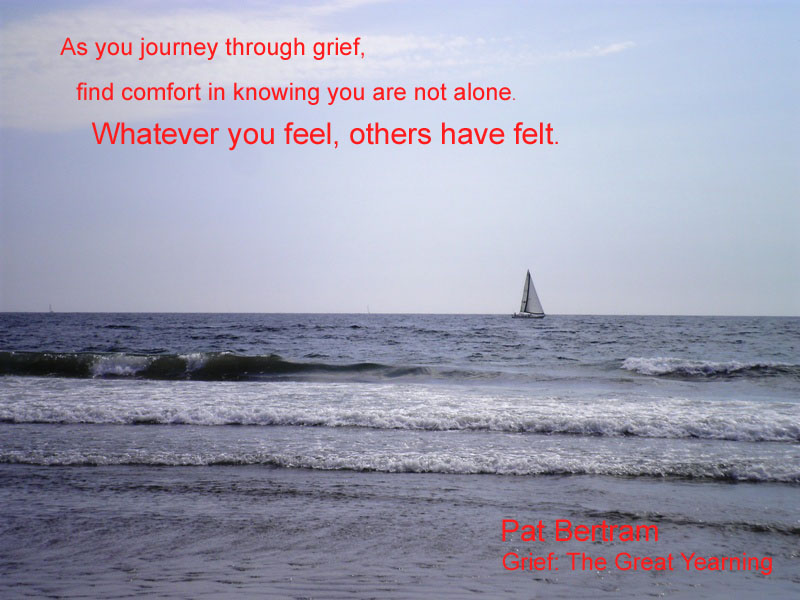
People often worry about what to say to someone who is grieving, but they should be more worried about what not to say. Saying almost any heartfelt words will do. We bereft see beyond the sometimes bumbling, often touching attempts to breach the grief gap, and we appreciate the effort.

What we don’t appreciate and have no use for is advice. Generally, the people who offer advice have not a clue what we are going through, so it seems to them a simple matter of just moving on, and they are quite free with suggestions of how to accomplish this. (I cannot think of a single instance where someone who suffered a grievous loss offered me advice, probably because they know how unwelcome and unproductive it would be.)

When I started writing about grief, the whole point was just to say how I felt so others would know that what they are feeling isn’t abnormal even though it feels dreadfully abnormal. I never asked for advice. I never wanted advice. I simply laid out my feelings. And yet I got advice. I tried to be kind and understanding, realizing that the advice-givers felt helpless and wanted to do something to ease my pain, but the truth is, advice does more damage than good. As with my grieving friend, so often the only way we bereft have of staving off advice is to hide our grief, and that is not healthy for anyone.

So, what can you do to help when someone you knows loses a spouse or a child to death?

1. Do something tangible. Offer to clean the house, take care of the kids, take the bereft to lunch, go grocery shopping. Almost as useless as advice is the typical, “Call me if you need help.” How is a person who is totally devastated by grief supposed to find the energy to call? You call. Don’t leave it up to them. And don’t leave it open ended with a “Let me know what I can do.” Be specific. “I’m going to the grocery store. Do you need anything? Milk? Coffee?” or “You’ve had a lot of people tramping through your house. Can I help clean up?” The best thing anyone did for me was clean the house before I moved. I will never forget that, will appreciate it as long as I live.

2. Let the person talk. Don’t try to make it better. Don’t offer advice. Simply listen. A woman I knew casually invited me to lunch, and she asked questions about him, let me talk, listened. It made me feel less alone, less of a pariah.

3. After the first month, the thing that helped me most was sharing stories with other bereft. (In the beginning, the whole thing was so overwhelming, I couldn’t deal with anyone else’s pain; I couldn’t even deal with my own.) As depressing as it was to find out that people still had occasional grief upsurges after ten years or that they never stopped missing their loved one, it helped knowing that others had gone through the same thing I was experiencing, and it helped knowing what I was up against. But if you haven’t suffered a similar loss, please do not talk about the death of your 100-year-old grandmother, or your dog, or your cousin. Even though these losses are important to you, they don’t offer any comfort to someone who has just lost the love of her life, especially if he died at a relatively young age.

4. Always, a shoulder to cry on and a comforting hug are welcome, and are worth a million times more than advice. Even better, cry with us. A few days after my life mate/soul mate died, I stopped by the grocery store where he and I shopped. The clerk asked where he was, and when I told her, she hugged me and cried with me. Not enough tears had been shed for him — no amount of tears will ever be enough—so those tears gave me comfort. His life — and death — shouldn’t pass lightly. No one’s should.

Introducing the Best Multi-Author Blog in the Blogosphere

Have you checked out the Second Wind Publishing blog lately? If not you’re missing a treat. It’s turning out to be one of the best blogs around, certainly the best multi-author blog and the most multi-talented.

Today’s feature is the brilliant and vastly amusing Pet Fashion Faux Paws by Mickey Hoffman, author of School of Lies and Deadly Traffic:

“Next we have the Sex Kitten look. Unfortunately (or conversely if you’re so inclined) this section does not describe feline sex. If you want to hear about that, kitties, you’ll have to read a different publication. The Delta Pet Inquirer is a family-friendly magazine! Anyway, ruched lace, chiffon and sequins are not alluring when draped on a fur coat.  From our research we’ve come to understand that the entire purpose of a lace nightie is to show bare skin and unless you’re a member of the hairless cat breed, that’s not going to happen” [Click here to read the whole post.]

Noah Baird, author of Donations to Clarity, gives us an irreverent but hilarious look at the Easter Bunny and various other goodies in You Don’t Know Easter:

“So, why the egg? I tell my kids the rock used to cover JC’s tomb happened to be shaped like an egg. Presto! Tradition! The reality is more mundane. Christians didn’t eat meat or dairy during Lent. Back in JC’s day, eggs were considered . . . dairy. Dairy was any animal-derived foodstuffs rendered from an animal without shedding its blood. This is way before we had a FDA or a congress to tell us what food is. Considering congress classified pizza sauce as a vegetable, things haven’t improved much.” [Click here to read the whole post.]

Coho Ihle, author of She Had to Know, talks about her The Rude Awakening when she discovered that a friend had skin cancer.

“Since I was an entertainer much of my adult life, I did a lot of sunbathing both in the sun and in tanning booths. I can remember being a bit reckless about wearing sunscreen, too. Witnessing this experience sent me directly to my dermatologist for a skin cancer screening for the first time. I can’t believe I’d never had that done before. I came out just fine, but I implore all you out there who think you are immortal, like I did, PLEASE go for a screening right away. It could save your life.” [Click here to read the whole post.]

Sherrie Hansen, author of Night and Day and the Maple Valley trilogy, explains why becoming a writer after the age fifty has it’s advantages in What Story Is Your Life Telling?

“I was recently approached about answering some questions for an article because I was an author who was over 50, a writer whose career as an author didn’t begin until I was past 50 years old.  The question’s implication resulted in a lot of things floating through my evidently half-addled, 55 year old brain: What does she think I am, older than dirt? That it’s a miracle I can still write, old as I am? Once I got over my indignation, however, I started to think about what it is really like being 55, and how life is different now than when I was 25, 35 or even 45.” [Click here to read the whole post.]

JJ Dare, author of False Positive and False World talks about expecting one thing and getting another in Southern Heat and Naked Books.

“ ‘Never judge a book by its cover’ takes on new meaning when you realize that the cover is more than the jacket. It’s everything. The promotion and hype, author appearances, and interviews are parts of the cover. While the overall “cover” of the book can increase its popularity, the true test comes once the naked story is laid bare.” [Click here to read the whole post.]

What is the Price of Creativity?

The book business continues to dishearten me. The recent pursuit by the government against the major publishers and Apple on antitrust charges gives Amazon a virtual monopoly with the ability to charge whatever prices they want, eternally undercutting the competition. This also gives Amazon control of the royalties the authors earn, which is little enough to begin with, and makes self-publishing on Amazon an even more attractive option. Which gives Amazon even more control.

Perhaps the publishers were charging more than people would have liked, but frankly, as much as I hate the major publishers, there is more at stake here than simple manufacturing costs. Admittedly, it doesn’t cost anything beyond an initial investment to produce an ebook, but what about the value of the contents, the creative output, the artistry of the writing itself? No one complains that the painting they bought for $100,000 is overpriced even though it merely cost the artist a few dollars worth of paint and canvas, so why do readers begrudge writers compensation for their creativity? What didn’t exist now does. Shouldn’t there be value to that?

And that is the real issue here. Value.

Readers don’t seem to care that the art of writing no longer has any value. They can get an endless supply of books free or close to free. They seem to believe that good writing will rise to the top, that bad writing will simply fade away, but that is not true. What sells is adequate writing, writing that is just good enough to get the job done. Some good books might find a readership, but if they don’t, it does not negate the inherent value of the book. Nor does a barely adequate book become a good book simply because it sells.

Huge numbers of people shrug and say, “Ebooks are here, get over it.” They are thrilled at the disappearance of any “elitism” that might once have been conferred upon published authors. Anyone can write. Anyone can publish. What everyone believes they can do, no one values. People are reading more now because of the low cost and ease of ebooks, but are they reading anything of value, are they becoming better human beings because of the books, or are they simply passing time?

I was shocked the first time I heard that books are considered entertainment, that books compete with movies and video games for entertainment dollars. Books are more than entertainment. Or they should be. The written word becomes part of us. What was conceived in one mind comes to life in another. It’s a connection between two human beings who have never met. Isn’t that of greater consideration than a fight over entertainment dollars? Through books you can travel to other places in the world, and you can travel to other places in your own mind. You can experience feelings, ideas, philosophies that you never knew you had. Isn’t that more than mere entertainment?

I’m not sure I want to participate in a book world that places such a small value on the written word. I’ve been trying to find a reason to write again, but frankly, I don’t I see the point.

Help! I Need Blog Talk Radio Topics

I’m scheduled to be interviewed on a blog radio show in a couple of weeks. I’m not sure how that happened because I never actually said I’d do it. Still, there it is. Or rather, there I will be. The problem is, they want me to send them a list of five things I would like to discuss about me and my work, and I don’t have anything in particular I’d like to say. (Seems strange, doesn’t it? It’s their show, so obviously they have some sort of agenda. I have no agenda, yet I have to supply the questions.)

So, I’m asking you: what topics should I send them? Is there anything about my books or writing you’d be interested in hearing about? Any noteworthy questions you were asked in an interview that you’d like to pass along? Any questions about books or writing that haven’t been asked ad nauseum? Anything?

The Internet is My Tranquilizer

I read an amusing, beautiful, and wise article on Malcolm’s Round Table yesterday: The Internet is Drugs.

Malcolm R. Campbell wrote: As I sit here in the sunny kitchen of my father-in-law’s farmhouse, I’m going through withdrawal because the Internet does not exist here. On a typical morning, I would have checked e-mail (pot), looked at several news screens (cocaine) and read everything in my Facebook (meth) news feed.

My Facebook status would be a no-brainer: blitzed, spaced out, and higher than the summit of Mount Everest. I recall those old, fried-egg-in-a-skillet public service announcements: This is your brain. This is your brain on drugs. Any questions? [Click here to read the rest of the article.]

Malcolm makes the very good point that on the internet, everything is instant gratification, whereas on the farm, everything moves slower, can’t move at the speed of light from one location to another, can’t give you the drug-like gratification one gets from the internet.

For me, the internet is a tranquilizer. It’s a quiet place (since the sound on my computer is turned off), and it quiets my mind. Grief brought me much confusion, not only because of the pain of losing my life mate/soul mate and the loneliness of struggling on by myself, but because of the eternal questions that haunt me.

A couple of days ago I wrote about the physiological changes that grief brings (Grief and Our Lizard Brain). Besides these physiological disturbances and the more commonly known psychological anguish, people who lose a life mate are subject to spiritual and philosophical traumas that upset our normal way of thinking. Death gives life a whole new perspective, and so we are compelled to rethink everything we thought we knew, everything we held dear. Some people find a deeper comfort in religion while others are assailed by new doubts. I found myself with a multitude of questions.

Who am I now that I am no longer part of our survival unit? If he is in a better place, why am still here? If life is a gift, why was it taken from him? In the presence of life, what is the meaning of death? In the presence of death, what is the meaning of life? So many questions!

Yet on the internet, there is no question of who am I. I know who I am. I can see me on Facebook. I can Google me. I can check me out on my website, on my publisher’s website, on Amazon. And I know why I’m here. I’m here to make an impression so maybe people will read my blogs and perhaps buy my books. I don’t need to question the meaning of life and death, because the internet is eternal. (Or at least the electrons are.) As long as there is an internet, there I am.

Walking out in the desert in the real world brings a semblance of peace, but along with that peace come the questions: Who am I? Why am I here? What is the meaning of life and death? Where do I go from here?

As my grief fades a bit, some of the bigger questions are fading, too, and I’m mostly left with the last question. Where do I go from here? On the internet, I am always “here.” In real life, I will need to relocate, to find a place to start over. But that question, for now, is as unanswerable as all the others that haunt me, so here I am, on the internet, where there is an answer for everything. And if there isn’t, I’m too tranquilized to care.

File Not Found

While searching for information about ravens for my upcoming chapter of Rubicon Ranch, the collaborative novel project I’m involved in, I clicked on a dead link. Instead of getting a generic “error” page, I landed on the following, which was just too amusing not to share:

The page which you requested was not found on this server, or the server was instructed not to let you have it. There could be a number of reasons for this error. The most common include:

– The Web Master for this page is a Lazy Git. The page which you requested may not have been built yet, and as such is not available for viewing.

– The page which you are looking for may have moved, or been deleted.

– The Web Master may have been working on these pages very late at night, and run out of caffeine. This causes frequent minor errors such as misspelled hypertext links, misplaced files, and mystery documents which disappear into thin air (or thinner electrons). You may have been directed to the wrong page. Mea Culpa. I’ll try not to do it again.

– You yourself may be working under the influence of too little caffeine, and have typed in the address incorrectly. Double check the address, and try again.

– The little spiders living in your computer are feeling neglected, and have decided to play tricks on you. Tell them you love them, beg with them, plead with them, and try reloading the page. Maybe they’ll give you what you’re looking for on your second attempt.

– You might simply not exist. This server regularly refuses service to people who do not exist. Double check your reality, and come back when you have the answer to life, the universe, and everything. (Are you really sure it’s 42?)

If all else fails, you could try sending email to the webmaster with a description of the problem you encountered, and perhaps the universe will see fit to serve you better in the future.

Thank you for your understanding, tolerance, and sense of humor.

***

The website I stole that from is: Shades of Night/Aviary.

It’s good to know about the neglected spiders in my computer. I cajoled my arachnids and told them I loved them and still, the page didn’t load. But my computer works much better now.

***

“If Dreams could be bottled… if the essence of Night could be distilled and captured in a jar… Who would not have a storehouse of poison and passion?”

Way Cool Global View of My Blog!

Here is a global view of the views of my blog for the last week:

As you can see, the vast majority of my blog views come from the United States, but here are the number of views I’ve had from other countries during the past week:

United Kingdom FlagUnited Kingdom 111
Canada FlagCanada 106
India FlagIndia 59
Australia FlagAustralia 55
Philippines FlagPhilippines 19
Singapore FlagSingapore 18
New Zealand FlagNew Zealand 11
Malaysia FlagMalaysia 10
Viet Nam FlagViet Nam 8
Germany FlagGermany 6
Pakistan FlagPakistan 6
Botswana FlagBotswana 6
Denmark FlagDenmark 5
Nepal FlagNepal 5
South Africa FlagSouth Africa 5
Switzerland FlagSwitzerland 5
Turkey FlagTurkey 4
Taiwan, Province of China FlagTaiwan 4
Japan FlagJapan 4
Greece FlagGreece 3
United Arab Emirates FlagUnited Arab Emirates 3
France FlagFrance 3
Lebanon FlagLebanon 3
Thailand FlagThailand 3
Finland FlagFinland 3
Norway FlagNorway 3
Georgia FlagGeorgia 2
Czech Republic FlagCzech Republic 2
Belgium FlagBelgium 2
Qatar FlagQatar 2
Iceland FlagIceland 2
Bulgaria FlagBulgaria 2
Bosnia and Herzegovina FlagBosnia and Herzegovina 2
Sweden FlagSweden 2
Hong Kong FlagHong Kong 2
Ethiopia FlagEthiopia 2
Portugal FlagPortugal 2
Russian Federation FlagRussian Federation 2
Netherlands FlagNetherlands 2
Korea, Republic of FlagRepublic of Korea 2
Jamaica FlagJamaica 2
Trinidad and Tobago FlagTrinidad and Tobago 2
Poland FlagPoland 2
Brunei Darussalam FlagBrunei Darussalam 1
Uganda FlagUganda 1
Ireland FlagIreland 1
Spain FlagSpain 1
Bahamas FlagBahamas 1
Indonesia FlagIndonesia 1
Albania FlagAlbania 1
Brazil FlagBrazil 1
Armenia FlagArmenia 1
Tunisia FlagTunisia 1
Cyprus FlagCyprus 1
Paraguay FlagParaguay 1
Argentina FlagArgentina 1
Namibia FlagNamibia 1
Peru FlagPeru 1
Chile FlagChile 1
Costa Rica FlagCosta Rica 1

There was also one view from Italy, which didn’t show up on the table for some reason.

If you have a WordPress blog, you too can see these amazing statistics for your blog. Just go to http://wordpress.com, log in, then click on the My Stats tab on the WordPress home page, then scroll down a bit to find the global stats. If you’d like to see your views by country for a week, click on summaries. Isn’t that cool?

So, where do your viewers come from?