New Month, New Tarot Deck

Every month I’ve been using a different tarot deck in an effort to see if the deck feels the same as the rest, or if it resonates with me. Although I like a couple of the decks better than any of the others, either because of size or feel or the artistry, I haven’t felt any special affinity with any of the cards.

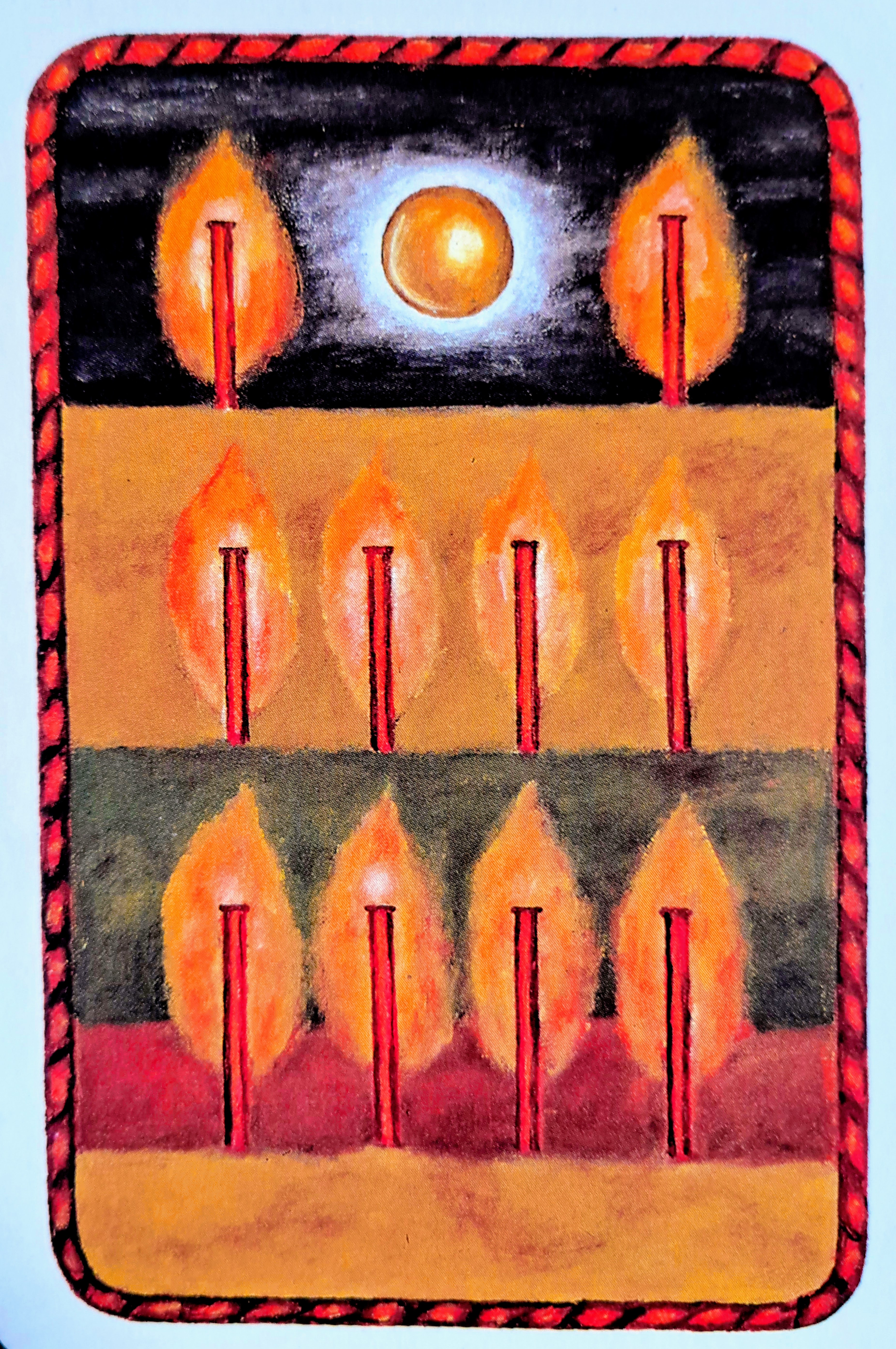
This month’s choice of decks is the Jungian tarot, which is based on archetypal images designed to activate the imagination. According to the designer of the deck, most of the current values assigned to the various cards were arbitrarily developed in the nineteenth century by occult groups. By contrast, he says the attributions in the Jungian Tarot were painstakingly researched in an effort to relate tarot interpretation to more ancient traditions.

Sounds good, right? Well, today’s card, the ten of wands activates my imagination not at all. The image gives me the impression of being weirdly inappropriate since it seems sinister, and the ten of wands is a rather benign card relating to careful management, functioning within a large organization, success, the loneliness that comes from success, and reacting defensively to badly organized ideas. Which is not a whole lot different from the meanings assigned by other tarot interpreters. Most say the card is about success and the perhaps oppressive responsibilities one has to take on because of that success; a need for prioritizing, delegating, and sharing your burdens. (None of which seem to have any relation to my life at all.)

It almost seems as if the major arcana (the cards most people have heard of, such as the fool, the hanged man, the sun, the moon, etc) are the cards that every tarot artist and interpreter spend most time on, and the others are “also rans.” (Which is why so many readings, such as online readings, use only those twenty-two cards rather than all seventy-eight cards.)

When I do graduate from picking just one card to doing a periodic reading (weekly or monthly), chances are I will only use those twenty-two cards until I get familiar with how the cards fit together to show . . . well, to show whatever it is they are supposed to show. I still don’t know. I do know the tarot isn’t really about foretelling the future; it’s more about communicating with our deepest being, but so far, there’s not a hint of what I might be hiding in my innermost depths. It could be I have no such depths. It could be the cards are not speaking to me, and if they are, I haven’t learned to listen. It could be that the whole thing is hokum.

So far, the only imagination it has activated in me is the possibility of using the cards as story telling cards — using each of the face cards as a character, and surrounding them random cards to see how their lives would unfold. But the idea has gone no further than that. Nor have I deepened whatever intuition I might have or learned anything I don’t already know.

But I have the cards, so it does me no harm to pick one every day just to see what I pick.

***

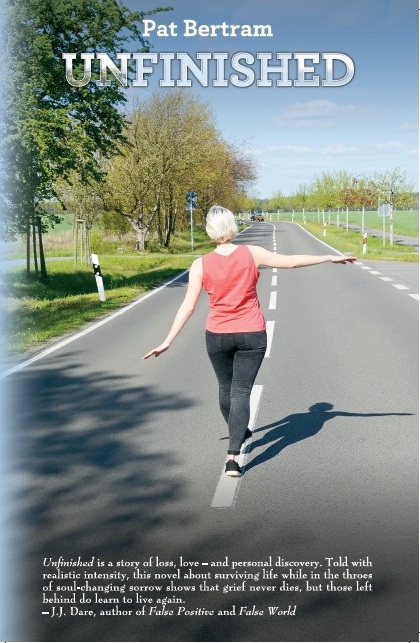
While sorting through her deceased husband’s effects, Amanda is shocked to discover a gun and the photo of an unknown girl who resembles their daughter. After dedicating her life to David and his vocation as a pastor, the evidence that her devout husband kept secrets devastates Amanda. But Amanda has secrets of her own. . .

Click here to buy: Unfinished

Contemplating ESP

One benefit of being an eclectic reader is that once the cover of the novel about the sabotage of the electric grid system in the US was closed, the emergency was over. Not in real life perhaps, but as one reader pointed out, there are a million ways the universe is out to get us (since, after all, the end result of our lives on this planet is our death); 999,999 of those ways won’t get us, so why worry about them.

Now I’m on to another book-induced worry. Well, not “worry” exactly, more like a train of thought. This time about psychic powers, artifacts infused with psychic powers, and the ways these artifacts can be used for good or ill.

When I was young, I thought the various forms of extra sensory perception were an indication of a more enlightened being. I felt bad that I wasn’t one of the chosen, and I hated the thought of being just like everyone else. Now, I am exceedingly grateful for my normalcy. It’s hard enough dealing with life with the tinge of intuition I do have. Apparently, I have a built-in lie, manipulation, and insincerity detector, though it manifests as confusion in the case of lies and manipulation, and nausea in the face of insincerity. (Which is why I cannot watch any news, cannot listen to any politician.) The problem with such low-level perception is that often I don’t know what the lie is, just that it is. Which, of course, adds to the confusion. Even more confusing, it took me most of my life to realize what was going on.

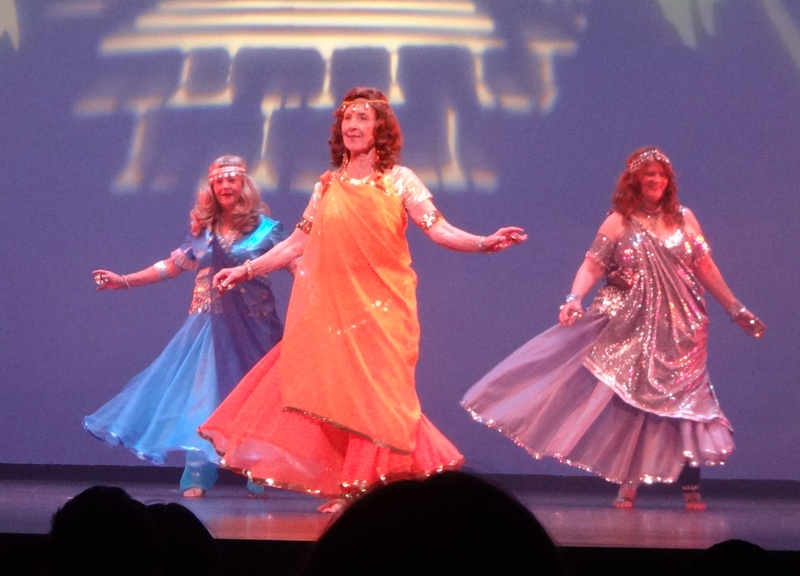
I also have a bit of an ability to pick up vibes. For example, back when dancing with my class, I could feel the energy flowing in sync from all of us, as if it were lifting our arms and feet at the same time. I thought it was a universal feeling, that all the other dancers could feel the same thing, but that wasn’t the case.

Also, sometimes I sense an affinity with people I just met. Of course, we all have that sense of affinity at times. It’s just a matter of learning to trust it.

But to actually be able to read someone’s mind? To be able to move things with mental energy? To be able to see auras? To have visions, whether of the future or of things that have already happened? To be able to view things remotely? I don’t think so. If my life is steeped in confusion now, I can’t imagine the sort of extreme confusion I’d be afflicted with if I had such powers.

As long as I am reading the novel, I will be aware of such things and contemplate the possibility of extra-sensory perception, but I’ll be glad when the book is closed and I can go on to something more mundane.

Like a serial killer, maybe. Or perhaps covert activities. Or, even worse, a romance!

What about you? Would you like to have some sort of ESP? Do you think it would enhance your life or make it even more complicated?

***

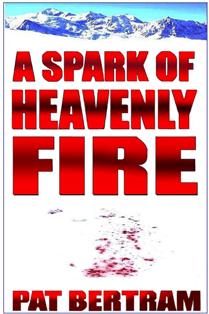
If you haven’t yet read A Spark of Heavenly Fire, my novel of a quarantine that predated this pandemic by more than ten years, you can read the first chapter online here: http://patbertram.com/A_Spark_of_Heavenly_Fire.html

Buy it on Amazon here: https://www.amazon.com/gp/product/B0024FB5H6/

Download the first 30% free on Smashwords: https://www.smashwords.com/books/view/1842

Unwanted Thoughts

It’s interesting to me that so many of my daily one-card tarot readings talk of good fortune, windfalls, and such. I don’t really believe what the cards say because each reading negates the previous one, and the cards aren’t always positive, but I have come to believe that things are going to go well for me financially. So when things don’t, I feel affronted. I mean, how is my house insurance going up by 25% good fortune? It seems like a huge increase, though perhaps with more people staying home there are more claims? Or the weather in the area has been more damaging this past year? Or the company took a huge hit because of all the wildfires in the Colorado last year?

This particular area has inordinately high insurance rates, anyway, but whatever the reason for the increase, it isn’t good fortune! Or maybe it is? I guess I could consider myself fortunate that I’m not one of those who had to deal with damage.

It’s things like this — huge increases in expenses that aren’t reflected by increases in income — that made me not want to ever own a house, but I’d be paying it one way or another anyway. If I were still renting, the rent would go up to reflect the current insurance rate.

Luckily, once I get over the panic and affront of the higher rate, I’ll be okay for now because I am working, and so will have enough to pay the bill. Even more luckily, once it’s paid, I won’t have to think about it for a year. It does make me glad I didn’t reward this particular insurance company by switching my car insurance over to them. I would have saved a bit on the house insurance, but my car insurance would have gone way up, so I’d still be in the same position.

I did talk to my insurance agent in case there was a clerical error. Unfortunately, it wasn’t an error, though she too was shocked by the huge increase. She’ll look around to see if she can find a better deal for me, but back when I first got the insurance, this current company was by far the better price.

I really shouldn’t even be writing about this — it’s not anyone’s problem but mine — but it is on my mind, and writing about what I am thinking is how I get rid of unwanted thoughts, and I really don’t want these thoughts in my head!

***

“I am Bob, the Right Hand of God. As part of the galactic renewal program, God has accepted an offer from a development company on the planet Xerxes to turn Earth into a theme park. Not even God can stop progress, but to tell the truth, He’s glad of the change. He’s never been satisfied with Earth. For one thing, there are too many humans on it. He’s decided to eliminate anyone who isn’t nice, and because He’s God, He knows who you are; you can’t talk your way out of it as you humans normally do.”

Click here to buy Bob, The Right Hand of God

Peace Without Words

Someone asked me if I would purposely stress myself out to get into a creative mood, and my response was an unequivocal “Absolutely not!” I’ve had enough stress in my life to ever want to put myself in such a state, but I have to admit, being stressed out, in pain, or even just confused makes it easier to write. If I am in a mellow mood, which is where I try to be — balanced and in harmony with myself and my surroundings — I find it hard to find something to write about.

Writing has generally been a release for me. If I put chaotic feelings into words, they become more orderly and easier to deal with. There is also a lot to say when one is struggling to find one’s way, but once there, there’s not much to talk about.

Writing fiction is also a release of sorts. If a story is in my head and is struggling to get out, then I have to write it to put it and my mind to rest. But if no story wants to be born? Then there’s nothing really to say. (Though I suppose there will come a time when I decide to write another story just for something to do. In that case, I will then try to put a story in my head.)

So here I am, in a pleasant and harmonious state, trying to find something interesting to write about. After 480 days of straight blogging, I’m not about to give up for a lack of words. Nor am I about to grope around in my mind for the stress that once was there or to do something to unbalance myself (though I don’t know what that would be).

I’m lucky, actually, to be in such a state. There have been many years where I needed the words to relieve the stress that it seems ironic to think I would need stress to find the words.

Someday, I’m sure, there will come an upsurge of grief, a problem with other people (though to have problems with people, you have to be around them, and with this isolation, I hardly see anyone except the woman I visit a few times a week.

Meantime, I will enjoy the peace, even if the peace comes without words.

***

Pat Bertram is the author of Grief: The Inside Story – A Guide to Surviving the Loss of a Loved One. “Grief: The Inside Story is perfect and that is not hyperbole! It is exactly what folk who are grieving need to read.” –Leesa Healy, RN, GDAS GDAT, Emotional/Mental Health Therapist & Educator

Hesitating

The demise of Adobe Flash Player made my old web builder defunct, so I’ve had to create a new website using a more current web builder. Although intimidating at first, the new web builder was actually easy and fun and intuitive. (I prefer intuitive programs because I don’t have to watch boring videos or read long articles of instruction. I can simply . . . do.)

Now, to the best of my knowledge, the new website is finished. I just have to click “publish” for it to go live, but I hesitate to take that final step. I don’t know why. It’s not as if the world as I know it will end. The old site will end, of course, with no way to get it back, but most of what was on there is posted in other places, so I can recover any information I inadvertently leave off the new site. And I can always redo the new site if I need to make changes.

But still, I hesitate.

Partly, I don’t want to have to go through the site once it’s published to make sure I did everything right. I’ve read through everything so many times that I’ve developed a blind spot for those words. Partly (even though this justification of my procrastination is something I just now thought of rather than a real reason for delaying), the longer I wait, the fresher those words will seem and so I’ll be able to read them as they are rather than as I wish them to be. And partly . . . who knows. Stubbornness, maybe, or contrariness. Although I like the new site better than the old one — it’s much more professional and easier for people to use — I’m still being forced to change, and I don’t like the feeling of being herded.

So I hesitate some more.

I’d considered pausing here and hitting the “publish” button so I could brag that I did it, but . . . well, I didn’t.

Maybe this weekend I’ll gather the courage to publish my new site. Or not. We’ll see.

***

“I am Bob, the Right Hand of God. As part of the galactic renewal program, God has accepted an offer from a development company on the planet Xerxes to turn Earth into a theme park. Not even God can stop progress, but to tell the truth, He’s glad of the change. He’s never been satisfied with Earth. For one thing, there are too many humans on it. He’s decided to eliminate anyone who isn’t nice, and because He’s God, He knows who you are; you can’t talk your way out of it as you humans normally do.”

Click here to buy Bob, The Right Hand of God

Note to My Grieving Blog Visitors

During the past ten years and ten months, ever since the death of my life mate/soul mate, I have been writing about my grief. My grief. Not yours, not anyone else’s. Mine. Many people find comfort in reading about my struggles to live with my grievous loss. Others find resonance with what they are feeling. But whether my grief posts strike a chord with you or not, they are ultimately my thoughts, my feelings, my attempts to make sense of my life both before he died and afterward.

I am not a therapist. I am not an expert. I have no degrees. I have only my own experience of grief to guide me through the chaos, and I don’t pretend to anything more.

I don’t object to your reading what I write; after all, that’s why I post my thoughts on a blog rather than in a private journal. I don’t object to your printing out a blog or two to take to your therapist (as many have) so that the therapist can understand more about the grief experience.

I do object to your chastising me. If you don’t like something I write, if it doesn’t make sense to you at your grief age (how long it’s been since your spouse died), it might in later years. Or not at all.

My experience strikes a chord with many people who have lost “the one,” which made me realize how un-unique my grief is. But although grief is universal, how we express it isn’t. Some people get sick. Some get angry. Some scream. Some cry for months on end. Some do all of those and more.

If you’ve lost someone dear to you to death, chances are I know how you feel. And you know how I felt and still sometimes do feel. Empathy works both ways. I don’t castigate you when you disagree. And you shouldn’t castigate me. I am not the voice of your grief. What I say changes nothing about what you are experiencing.

Often over the years when people were less than kind, I wondered if it were time to pack it in, but enough people find my words and my story inspiring that I keep going. But I don’t have to continue to write updates about grief and what I’ve learned. I don’t get paid for this. It’s not a job or even an obligation. I do it because I feel, I think, I empathize, and I write. It’s who I am.

I’ve written close to a million words about grief. I’m sure I’ve shed a pint of tears if not more while doing so. I certainly don’t need anyone to add to my grief. I always apologize for inadvertently wounding people because I am sensitive to people’s feelings, but there really is no need for my apology. I don’t set out to hurt anyone or even to help anyone. I simply feel it’s important to tell what grief is like — my grief, anyway — rather than what the so-called experts think it should be. If you don’t like any of my words, so be it. It’s not a personal affront. I don’t even know you, though if you’ve read many of my posts, you know me.

So think about that before you rail against me. If I had stopped writing about grief the first time someone told me how wrong I was, either by what I wrote or that I continued to write about grief long past the first few months, thousands of people would not have found the comfort they need, the understanding they sought, the courage to continue living another day.

Neither would I. And probably, neither would you, otherwise you wouldn’t have come here to read about my grief.

***

Pat Bertram is the author of Grief: The Inside Story – A Guide to Surviving the Loss of a Loved One. “Grief: The Inside Story is perfect and that is not hyperbole! It is exactly what folk who are grieving need to read.” –Leesa Healy, RN, GDAS GDAT, Emotional/Mental Health Therapist & Educator

Free Samples!

If you’ve been wondering about my novels but have been afraid to take a chance on buying a book, below are the links to all the first chapters.

I hope you will take a peek.

Bob, The Right Hand of God (Absurdist, Urban fantasy)

Unfinished (Drama, mystery)

Madame ZeeZee’s Nightmare  (Mystery, Dance)

Light Bringer (Suspense, Science Fiction)

Daughter Am I (Mystery, Road Trip,)

A Spark of Heavenly Fire (Drama, Suspense)

More Deaths Than One  (Thriller)

All books are available on Amazon: https://www.amazon.com/Pat-Bertram/e/B002BLUHUY/

Searching for a Tagline

I’ve been struggling with my new website, and I’ve mostly learned how to use the website builder, or at least as much as I need to know for right now. I’ve pretty much set up the bones of the site; now it needs to be fleshed out with information about me and my books. The book part, while time-consuming, is easy. It’s just a matter of coping and pasting the blurbs and such that were on the old website.

The “about” needs to be updated. I can no longer brag about being a nomad as I did in the previous bio since I am as unnomadish as a person can get — the furthest I’ve been from home in the past few months is a mere handful of miles. But the bio is really just a matter of finding something to say about me. Whatever it is, it won’t be on the homepage; people will have to go looking for it, so it doesn’t have to be as catchy as some of the other parts of the website, such as the tagline.

Taglines are hard. You have to give the essence of your books or yourself in a matter of a few words. This morning I woke up thinking that “Author of provocative fiction and profound works of grief” would be good, but a few hours later that tagline seemed as if it would be too off putting for people who are simply looking for a bit of information about grief. Of course, search engines wouldn’t be sending them to my website for such information — they’d send grievers to one of the grief posts on my blog. Chances are, the only people who would end up at the website would be those who were specifically looking for information about me.

More importantly (to me anyway), I’m trying not to second guess myself too much and to stick with the first ideas that come to mind. Still, I want to hook people into staying, not push them away with pedantry.

So, what about “Author of intriguing fiction and insightful works about grief”?

Originally, I just used, “Author of fiction and non-fiction,” but that is boring and uninspiring to say the least.

If you have any suggestions for a tagline, I’d be glad to hear it.

***

Pat Bertram is the author of Grief: The Inside Story – A Guide to Surviving the Loss of a Loved One. “Grief: The Inside Story is perfect and that is not hyperbole! It is exactly what folk who are grieving need to read.” –Leesa Healy, RN, GDAS GDAT, Emotional/Mental Health Therapist & Educator

Too Many Days

The past couple of years, I couldn’t find a calendar, not even one for sale in the stores I frequented, so I downloaded a calendar template and printed out my own calendar. It was a nice simple calendar with large enough blocks for writing notes. Since it was just plain paper, not glossy, I was able to use a pencil, which I prefer because of its erasability. (My spell check does not like that work and keeps changing it to eras ability, whatever that means.)

I went ahead and printed out a calendar this year, and then I got a couple of calendars in the mail. And then another. And yet another. I’ve lost track of how many calendars I have, but I feel the weight of all those days.

With a single calendar, each year has but 365 days. With a surfeit of calendars, it feels as all those days (365 per calendar) are stacked one on top the other. That’s way too many days for me to deal with!

I’m being a bit facetious here. I know that no matter how many calendars I have for 2021, there will still be only 365 days for the year, but I feel all those calendars reaching out to me, wanting to be filled.

But truly, one day per day is more than enough! Though that thought does lead to a story idea — some poor benighted character burdened with more than one day every day.

Luckily, I am not a character (except in my novel Madame ZeeZee’s Nightmare — I was a character in that book), and once I get rid of all those extra calendars, I’ll do fine living but one day each twenty-four-hour period.

***

Pat Bertram is the author of Grief: The Inside Story – A Guide to Surviving the Loss of a Loved One. “Grief: The Inside Story is perfect and that is not hyperbole! It is exactly what folk who are grieving need to read.” –Leesa Healy, RN, GDAS GDAT, Emotional/Mental Health Therapist & Educator
Moving On

The first time I’d heard the phrase “moving on” was a few months after Jeff died, and thereafter I heard it frequently.

Although people often think they are helping by urging grievers to get over it and move on with their life, they are merely showing that they themselves can’t handle the griever’s grief; showing that they can’t handle the new person the griever is becoming. Friends and family want grievers to be the way they were before their loss, and the griever can’t be. Loss changes you. Grief changes you.

Sometimes when people urge grievers to move on, they are not expressing insensitivity so much as a misplaced understanding of the nature of grief. (Which is why my book Grief: The Inside Story – A Guide to Surviving the Loss of a Loved One was written both for grievers and for anyone who wants to understand this thing we call “grief.”)

The truth is, grieving is how we “move on.” Grieving for a spouse is a process, a process of change from a person with a mate and shared life to someone who can deal with the absence, loss, aloneness.

“Moving on” or “moving forward” isn’t just used about grief. It’s used for almost everything, and one of these phrases frequently shows up in tarot card interpretations, such as the card I picked today that is supposed to be about overcoming fears and boldly moving forward. The phrase also appears frequently in novels and in discussions about writing, such as moving the plot forward, or the characters moving on from . . . whatever.

All of sudden today it struck me that I don’t even know what that means. “Moving forward” seems to connote a linear path, which might work for writing, given that the plot has to go from beginning to a satisfying end, but in life, there truly is no forward movement except that which we impose on our lives, such as time or age or career success or even traveling. We feel like we’re moving forward when we walk or drive somewhere, but that’s mostly an illusion. Unless we are permanently moving to a new house or new property, we eventually return to where we started, so that turns out not to be a forward motion at all.

The universe seems to be built more on circular motion, atomic particles and heavenly bodies are always in motion, orbiting around each other, making their way around empty space, but not really going anywhere because if there is not really a “here,” there can’t be a “there” to move on to. It seems as if motion is important, but not necessarily forward motion. For all I know, we could be moving backward, and it is just the way our brain interprets things to make it seem as if we are moving forward.

A kaleidoscope comes to mind. If all the energy that ever was exists today, then a turn of the scope brings us to what seems a different place, but is really all the same place. Karma and the idea that what goes around comes around also connotes a circular life. As does a gyroscope.

A tarot card I randomly picked twice in the past three days was about fluctuation and change. It suggested that a person who is in harmony with her life is one who can adapt to all the changes that comes her way, and keep on moving, Like a gyroscope that only holds its position when it is spinning,

But not “moving on”. Just “moving”.

Assuming we are supposed to be moving on, moving forward, moving toward something, where are we supposed to be going? Well, death, we are all moving inexorably toward death, since death is our end on this earth, but is that really a forward movement? After a certain age, it seems more as we are being pushed rather than moving on our own initiative. But other than that, what are we supposed to be moving toward? Enlightenment, maybe, though that brings up the issue of what is enlightenment.

In the case of grief, even though I am not actively grieving and haven’t been for a long time — I seldom even feel nostalgic anymore — I never actually “moved on,” never “got over” it. It’s more that the loss became subsumed into the very fabric of my life.

Admittedly, I might simply be sensitive to the phraseology because of all the people who used these words or variations of them to urge me to get over my grief, but they still seem to be rather meaningless terms no matter how they are used.

***

Pat Bertram is the author of Grief: The Inside Story – A Guide to Surviving the Loss of a Loved One. “Grief: The Inside Story is perfect and that is not hyperbole! It is exactly what folk who are grieving need to read.” –Leesa Healy, RN, GDAS GDAT, Emotional/Mental Health Therapist & Educator