Joys of the Writing Life

I am still writing!!! I have always been a slow writer, but my current work is just flying along. It helps that I know the characters. The main character is me so there is no reason to create artificial conflicts, weakness, or strengths. They are all there is living color. (To be exact, they are there in black and white since the page is white and the words are black.) I would have thought using a real person as a character would make the writing harder because I can’t create the character to fit the plot. In many ways, the character herself is creating the plot — what she thinks, what she does, what she fears, what she grieves.

The other characters, at least some of them, are based on the women in my dance class, which makes things easy. If I need to describe something or someone, I can describe what I know. Unfortunately, I am having a hard time making them come alive. I am hesitant to attribute bad qualities to them, real or imagined, and I don’t want to create havoc in their lives by giving them secrets, such as a secret lover. Can’t you just hear it?book

Husband: Character B is you, right?
Character B: Yes. Isn’t this great?
Husband: And it’s based on your life.
Character B: Yes, but it’s fictionalized
Husband: So who is this guy you’re having an affair wth?
Character B: I’m not having an affair.
Husband: You said Character B is you.
Character B: A fictionalized me.
Husband: And Character B is having an affair.
Character B: Yes, in the book I am having an affair.
Husband: So who is he? Do you want a divorce? Is that what you’re saying?
Character B: No. I’m saying I’m character B.
Husband: Do you want to leave or do you want me to leave?

It’s a big enough responsibility shaping one’s character’s lives, to have the real person influence the character. Having the character influence the real person is more responsibility — and guilt — than I can handle.

So, these characters so far are just walla-wallas. (In old time court room dramas, when the trial watchers were supposed to murmur to show excitement at a revelation or verdict, they said, “Walla, walla. Walla walla.”)

To help the story along, I combined several women into a few fictional ones, which gives me the benefit of being able to have them do what I want without worrying about ruining their lives. And I can go back and change these characters as necessary to fit the story.

Other things that are making this story run smooth: 1) It’s rather stream-of-consciousness — not too much, I hope — and stream of consciousness is easy for me. Just tell what I know and show what I feel. 2) I’ve been mulling over this idea for two years, so much of the story is already in my head. 3) Since this is a mystery that takes place at a dance studio, and since I am taking lessons, every day offers inspiration. 4) I am typing the story instead of writing longhand. I wrote my other books longhand because I feel it gives me a better finger/mind connection — and I didn’t have a typewriter or computer — but I can’t hold a pen for long periods of time anymore, and I can’t read my writing afterward. 5) Mostly, I’m putting myself in a position to write. I joined a 250-word-a-day club, and when I am too tired to think, I tell myself “just do your 250 words and then you can stop”. But by then, I’m into the story, and I need to finish the current scene before I forget it.

It’s not much of an exciting life. Nothing to discuss, no adventures to talk about, no conflicts or great emotions to try to work out. Just me in my fake/real world. One thing that is notable: I forget sometimes and call the real people by their fake names. And sometimes I refer to an episode in the book as having really happened. Ah, the joys of a writing life!

***

(Pat Bertram is the author of the suspense novels Light Bringer, More Deaths Than One, A Spark of Heavenly Fire, and Daughter Am I. Bertram is also the author of Grief: The Great Yearning, “an exquisite book, wrenching to read, and at the same time full of profound truths.”)
The Beauty and Amusement of Writing

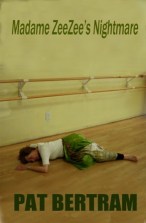
Madame ZeeZee's NightmareI have been enjoying being a character in my book, enjoying even more finding inspiration in the small matters of my life. For example, yesterday I wrote in a blog post:

I tend to believe my memory. Whenever I have gotten into a he said/she said or she said/she said argument, I can often find some sort of corroboration for my side, such as in a text or an email, which adds credence to my belief. Also, in dance class, I often remember steps when others don’t.However, there are a few steps from a dance we performed eighteen months ago that are completely gone from memory. Erased. I watched a video of that performance to see what the steps in question were, and even though I could see myself doing the steps, I have no memory of them.

It seemed such an interesting lapse, that I used the episode, which for some reason I found amusing, as a jumping off place for this rather chilling scene in the book:

I prided myself on having a good memory, and I believed everything it fed me. Whenever I’ve become party to a he said/she said or she said/she said argument about something that had happened, I could often find some sort of corroboration for my side, such as in a text or an email, which added credence to my belief. Also, in dance class, I often remember steps when others don’t.

Madame ZeeZee watched us practice a dance we should have known well because we had performed it a year previously in a concert at the local college.

We’d been working on new dances recently and hadn’t practiced that particular dance in several months, but we did okay without either Grace or Madame ZeeZee dancing in front of us. Until the final verse. In Hawaiian, each verse is repeated twice in exactly the same way, but in this particular dance—“Green Rose”—when the last verse repeated, we did different steps than we had the first time the verse played. Deb did something I knew was wrong for that last verse and the rest of us foundered. I stood there while the music died out, trying to recall the right steps, but I had absolutely no memory of that final sequence.

We danced “Green Rose” a second time, with Madame ZeeZee leading us. I did the dance perfectly, but only because I watched her. I didn’t remember ever having done those final steps before. It was as if the memory had been completely erased.

Walking home after class, I pondered the mystery of my missing memory. Could this be the beginning of Alzheimer’s? Or could I always have had blank spots in my memory? If so, how would I know? I only knew what I remembered.

I did remember telling Jackie once that I was an unreliable narrator, but I’d been talking about my lack of attention to details, not my memory. But now I wondered about Grace’s death.

Could I have done something besides play her mystery game that got her killed? Did Deb know what I had done, and that’s why she claimed the death was all my fault? I refused to believe the ghastly thought. Erasing a few steps of a dance was one thing, but losing the memory of a murder was something completely different.

Still, I hardly slept at all that night, and when I did, I dreamed of shadowy beings I should have remembered, but didn’t.

Ah, the beauty and amusement of writing!

***

(Pat Bertram is the author of the suspense novels Light Bringer, More Deaths Than One, A Spark of Heavenly Fire, and Daughter Am I. Bertram is also the author of Grief: The Great Yearning, “an exquisite book, wrenching to read, and at the same time full of profound truths.”)

Flawless Characters

Everyone who knows anything about writing or reading novels knows that you have to start with a flawed character. Well, everyone but me. I don’t believe in flawed characters, just characters that come alive.

Tell me honestly, except for a few physical attributes that you might not like about yourself, do you think you have flaws? No, of course you don’t. You think you have problems. You laugh about your quirks. You are beset with internal conflicts. You might even have a list of traits that you try to work on, such as trying to be kinder or more disciplined, but you don’t have flaws. You are who you are. All the parts, good and bad (and who is to say which is which) make up your character.

To me, the character flaw is like the Persian Flaw. The Persian rug makers purposely put a flaw into each of their rugs supposedly because of their belief that only God can make something perfect. That speaks to me of arrogance, to believe you are so absolutely perfect you have to create a flaw to make yourself less than perfect. It’s the same with the character flaw in writing. If you create a realistic character, there is no flaw, just a character wyahabibi5ith a mixture of admirable and not so admirable points. To add a flaw on purpose takes away from the realism of the character. At least to my way of thinking, and now I have proof of sorts.

I am writing a novel about a fictitious death in my dance class. I began using all my classmates as characters, but gradually I have been camouflaging them by changing names and creating omnibus characters — combining two or three classmates into a single character to avoid hurting anyone’s feelings. And I had to create a couple of wholly fictitious characters because a mystery is primarily about unraveling the back story to find out why the victim was killed and why the killer was so motivated. I didn’t want to create fictitious backgrounds for my classmates because when it comes to murder, there are no innocent folk, or at least not often. The victim — and the red herrings — usually has done something to set the whole thing in motion. And it’s those “something”s I worried about attributing to people I meet every day. Who needs that kind of pressure?

I started out with myself as the unreliable narrator, and when I blurred the edges of the others in my class, I kept the real me as a character. If I had known how easy this made writing a novel, I would have done it long ago! I don’t need to create a character. Don’t need to do psychological profiles. Don’t need character arcs or family trees. It’s all here, in my head. In me.

And especially, I don’t need to create flaws. I don’t particularly consider myself a flawed character, though I do have some character traits that are less than saintly. And I have a few other traits that come from lapses.

For example, I tend to believe my memory. Whenever I have gotten into a he said/she said or she said/she said argument, I can often find some sort of corroboration for my side, such as in a text or an email, which adds credence to my belief. Also, in dance class, I often remember steps when others don’t. However, there are a few steps from a dance we performed eighteen months ago that are completely gone from memory. Erased. I watched a video of that performance to see what the steps in question were, and even though I could see myself doing the steps, I have no memory of them. Is this memory lapse a flaw? Not particularly. It’s just a . . . lapse. Is the insistence on the accuracy of my memory a flaw? No. That’s also just a lapse.

The best part of using myself as a character is that I never have to worry about creating a conflicted character. Every page illuminates my internal conflicts about death, finding my place in the world, trying to do the right thing and failing, dancing to a different beat. (I think that’s why I like dancing so much — for once in my life, I get to do exactly what everyone else is doing without the conflict of having to choose between being out of step with the world or being out of step with myself.)

So there you have it — proof that you don’t need flaws to create a good character. You just need realistic traits.

Note: Please don’t leave comments telling me that there is no such thing as a perfect character, that they need flaws to be realistic. I’ve heard all the arguments. You believe what you want. I know the truth. Oops. Did I just show a character flaw?

***

(Pat Bertram is the author of the suspense novels Light Bringer, More Deaths Than One, A Spark of Heavenly Fire, and Daughter Am I. Bertram is also the author of Grief: The Great Yearning, “an exquisite book, wrenching to read, and at the same time full of profound truths.”)

Coming Home

I am creating another writer’s retreat for myself this weekend, but to tell the truth, right now my whole life feels like a writer’s retreat. I continue to feel conflict free, partly because I have put off worrying about the future and what is to become of me, and partly because I have temporarily found a safe place to land. (Hard to believe, but I’ve been here a whole month already!)  So far, my roommates are working out, with only minor irritations that I choose to let go and not obsess over. Surprisingly often, I have the house to myself, and best of all, even though I still don’t have a remote garage door opener, I do have use of the garage, which pleases both me and my aged vehicle.

I am living day to day (to the extent that it’s possible), making a point of noticing my moments, and being grateful for the good things in my life. With the questions and worries that usually plague me on hiatus, my stream of consciousness has nothing to do but let my work in progress steep, so I don’t often find myself tongue-tied (finger-tied? word-tied?) when I open the computer to work on my book.

I am going to dance classes four days a week and enjoying it as much as I did in the beginning, perhaps because when people irritate me, I can take them out of my head and put them in my story. Although I spend the remaining three days of the week working on my novel, I am sticking with the 250 words a day club, so I manage to write a bit every day. I am usually not one of those writers who live by word counts, but because of the club, I am keeping track of my words. I was thrilled when I realized that in the past two weeks, I have added 10,000 words to my novel. Wow! You might not be impressed, but I am.

I do continue to have a bit of a reality lapse when I go from my fictitious class to my real-life class, but trying to remain in the moment helps. And my teacher in life as well as in the book is always kind to me, which helps make for an even transition.

A real boon for my book has been my online life. For the most part, once I got online, I stopped writing fiction and went to blogging. I blogged everyday for about five years, but without conflict or adventure to fuel my posts, I don’t have much to say, so I have let fiction writing replace blogging. Now whenever I have a question, I Google it rather than spending months trying to find the information in the library, and if Google doesn’t have an answer for me, there is a whole slew of people all around the world to ask. Not only have I gotten medical information from a doctor friend, and help with the structure of a mystery story from a writer’s group, people have even offered me wonderful suggestions for motivation. (Not being a murderous type myself, ingenious motivations for committing such a crime are hard for me to come up with. I’d be more of a slam-bam-goodbye-ma’am sort of killer rather than a revenge-is-a-dish-best-served-cold murderer.)

The most wonderful thing about being back in writer’s mode is that I feel as if I’ve come home. So much of my internal conflict since Jeff died and more recently my dad, is that I have nowhere to call home. And now I do — inside my head, playing with words.

Not a bad place to be.

***

(Pat Bertram is the author of the suspense novels Light Bringer, More Deaths Than One, A Spark of Heavenly Fire, and Daughter Am I. Bertram is also the author of Grief: The Great Yearning, “an exquisite book, wrenching to read, and at the same time full of profound truths.”)

If You Want To Help Me, Buy My Books!

People often say that helping others makes you feel better, and it’s true, you do feel better. I used to try to help people, but then a rebellious thought hit me. Wasn’t it a bit arrogant to assume we know what other people needed? Has anyone asked the ones who are helped how they feel about receiving such help? Sure, in dire situations like the Louisiana floods, people rally around, as they should. But in everyday matters? Shouldn’t we wait to be asked before we decide someone needs to be helped? I’ve seen situations where the elderly are “helped” into being dependent, and the quality of their lives diminishes dramatically. Sometimes people no matter what their age rebel at a being given a helping hand, preferring to do for themselves. Which is at it should be.

I was perusing blog posts this morning, when I came across a post that mentioned me. The blogger referred to an open letter to blog readers I’d written where I said “So what if I still have a hard time being around coupled people? That’s my problem, not yours. So what if I still feel lonely and sorrowful after six years? That too is my problem, not yours. The truth is, missing one’s mate is something that lasts a lifetime. Think of all the good things (and bad) you have experienced during the past six years of your couplehood. Well, guess what? I haven’t had any of those experiences. I have done a lot of interesting things, but no matter what I do, what I experience, how I grow or stagnate, I do alone because my mate is gone. And if that still affects me, what difference does it make to you?”

I didn’t think I sounhandsded needy in that post, and I certainly didn’t feel needy. (Exasperated, maybe, but not needy.) Apparently, though, the blogger was upset that some of my friends still expected me to get over Jeff’s death and move on. Which was fine — I didn’t mind her being upset even though I wasn’t particularly bothered by what my friends said, especially since that wasn’t the gist of my article. (The gist was that I am a writer. Everything anyone does to me or around me belongs to me and provides ink for my pen.) What upset me was the conclusion to her post where she wrote that she and a couple of partners were starting a business and how they “wanted our business to help people like Pat.”

I’ve been online friends with this woman ever since we fell into the grief maelstrom about the same time, so I understand her desire to help others, but her assumption that I needed help made me uneasy. Diminished me. As if I she thought I couldn’t handle my life.

Her post reminded me of the beginning of my grief cycle, where people would write and say they wished they could take my pain away, or that they bled for me. I hated that. My grief is my own. I didn’t want anyone to take it away from me. I don’t need help, not that kind.

Right after Jeff died, a lot of people offered to help, but they wanted to help by giving advice. The one person who really did help found out I was defeated by the thought of cleaning that big house by myself before I moved out, so she showed up with a friend and carload of cleaning supplies and spent an entire day cleaning. Now, that’s help! But other kinds of help? No. I’m not interested, thank you. Unless you want to buy my books, of course.

Truly, if you want to offer me a helping hand, buy my books! Write reviews of my books. Do something to promote my books. What I need is a living, and since I am a writer, I would prefer to make a living from my books.

The rest of my life, for now anyway, I’m handling just fine on my own.

***

(Pat Bertram is the author of the suspense novels Light Bringer, More Deaths Than One, A Spark of Heavenly Fire, and Daughter Am I. Bertram is also the author of Grief: The Great Yearning, “an exquisite book, wrenching to read, and at the same time full of profound truths.”)
My Writer’s Retreat

I’ve been wondering if I should do some sort of writer’s retreat to get me back into writing fiction, and as it turns out, all unknowingly, I created my own retreat. Last weekend, beginning Thursday afternoon when my last dance class was over until Monday when the first class of the week began, I did nothing but indulge myself. I started the days with my old workout, the stretching routine and weight training that fell by the wayside when I started taking dance classes. And I worked on my book. Not the whole weekend, of course, because I am not one of those who can sit down and write for the entire day — I need to do a lot of thinking about where to go next — but I did a couple of sessions each day. Even better, I ate only the food I had in the house — good food, no junk. — so I never had to leave my retreat. Best of all, my next room housemate was gone, so I had nothing but quiet (and a bathroom to myself) the entire time. Ah, joy!

A couple of weeks ago, I had experienced a day where I felt blessed, and that feeling has been with me all this time. I have been magnifying the mood by paying attention to the moment because the power of our lives is in the moment. And I’ve been cultivating gratitude, though that particular discipline is not hard to do — tballoon2here is so much in my life to be grateful for in any given moment.

During these blessed weeks, my internal conflict about where to go and what to do has faded because I have made commitments to continue with dance classes at least until the end of the year, to build up my strength, to refrain from worrying. (I worry more than I should about what is to become of me and how I will support myself in my soon-to-be old age.) And so I let the air out of all my conflicts (which is why I haven’t had much to blog about).

I joined an online writing group where the only requirement is to write 250 words a day. It’s a month-long commitment, but every month, I can recommit, which is what I plan to do at least until the end of the year. Even a writer who plods as slowly as I do can manage 250 words in a couple of hours. I usually spend the first hour reading the previous chapter to get in the spirit, to take into consideration past story actions, and to plan the next move. And I still have time to grab 250 words from the vortex of my mind, and sometimes a lot more!

I’ve never been one to write by word counts, so the count in itself is unimportant, but the commitment is. (Oh, who am I kidding. Having written 5,000 words in a week feels great!)

This weekend’s writing retreat will be different than last week’s because I will be performing with my class at a luau on Saturday, but that is still in the realm of creativity.

Dancing, writing, living. Ah, life is good in the moment.

***

(Pat Bertram is the author of the suspense novels Light Bringer, More Deaths Than One, A Spark of Heavenly Fire, and Daughter Am I. Bertram is also the author of Grief: The Great Yearning, “an exquisite book, wrenching to read, and at the same time full of profound truths.”)

Getting Back to the Fundamentals

It’s always seemed odd to me that when it comes to the fundamentals of education, people talk about the three R’s — reading, ‘riting, and ‘rithmetic. Or is it reading, writing, and arithmetic? Either way, out of a possible three, there are two errors, which is not a very good score, especially when it comes to learning.

In my case, I am more interested in three W’s. Writing, wisdom, and wit. Or maybe walking, wondering, and whim. Or as I mentioned when I came to this hiatus in my travels: writing, walking, and weights. These three W’s were my foundation during a time of great upheaval (the first unacknowledged sense that Jeff was pulling away from life and me, along with a growing numbness to the coming death of “us”), and they seemed a good place to start rebuilding my life.

I’ve been more or less stationary for almost two months — more because I have remained in the same town, less because I have lived five different places in those months — so now I am following through and investing in a couple of my W’s. Not walking, surprisingly, considering how much I have walked in the past few years since coming to the desert. Between the endless 100º+ days and the smoke from nearby brush and forest fires, walking hasn’t been a pleasant activity, so I have been taking a break. When the weather cools down, I will walk the mile and a half to the dance studio (and back again) at least a couple of days a week (not the day I have three classes. Eeek. My poor feet!), and go for longer roams on weekends.

Meantime, I have been using my dumbbells. Maybe someday I will even feel up to digging out my bars and heavier weights, but for now, multiple repetitions will be the name of the game.

And, I’ve been wotortoiserking on my book. Until recently (well, okay, if you must know the truth — until just today), I haven’t done much writing. I’ve been trying to get the book and the characters into my head, trying to straighten out a very crooked timeline, trying to make the leap from not writing to writing. Mostly, though, I’ve been turning on my computer, opening the manuscript, looking at a few words, checking my email, scrolling through my Facebook feed, playing a game or twenty of solitaire, then turning off the computer, feeling as if I’ve done my stint.

But, through it all, I have established a bit of connection to my book, and more importantly, to myself.

Now, I just have to focus. As my publisher told me, “You must concentrate, Grasshopper. This is literature, the soul’s highest calling. Plus, you need to write a bestseller.”

Okay. One bestseller coming up.

***

(Pat Bertram is the author of the suspense novels Light Bringer, More Deaths Than One, A Spark of Heavenly Fire, and Daughter Am I. Bertram is also the author of Grief: The Great Yearning, “an exquisite book, wrenching to read, and at the same time full of profound truths.”)

Open Letter to Blog Readers

To Whom it May Concern:

This is my blog, and I am allowed to say whatever I wish. When I first began blogging, the posts were impersonal — comments about the books I was reading, the books I was writing, and writing hints I garnered along the way.

mailboxThen, after the death of my life mate/soul mate, I got personal, very personal, explaining everything I was going through. Some people took offense at this, and I endured well-meaning suggestions to “get over it” because I knew my posts were helping people.

Now that my sorrow and loneliness treat me much gentler, I still write about how I am feeling and what I am doing about those feelings. The problem is that people I have met offline read my blog occasionally, which was not the case in the beginning, so I have been censoring some of my posts to make sure I don’t hurt anyone’s feelings. Well, apparently, I have gotten some backs up anyway, so no more censoring.

If you are upset by anything I say, remember, this is not necessarily about your truth. It’s about my truth. If I feel slighted, why shouldn’t I mention the slight especially if I don’t use your name? The only time I ever use anyone’s name is if the person is well known or an author who could use a bit of publicity, and so far, none of them feel hurt by anything I have said. If you don’t like what I write, if you take it personally, don’t read this blog. If you know me at all, you know I never knowingly hurt people. But I cannot sort out my truth if I don’t mention the things that trigger a spate of emotionalism or a feeling of unbelonging.

And there are a whole lot of triggers.

So what if I still have a hard time being around coupled people? That’s my problem, not yours. So what if I still feel lonely and sorrowful after six years? That too is my problem, not yours. The truth is, missing one’s mate is something that lasts a lifetime. Think of all the good things (and bad) you have experienced during the past six years of your couplehood. Well, guess what? I haven’t had any of those experiences. I have done a lot of interesting things, but no matter what I do, what I experience, how I grow or stagnate, I do alone because my mate is gone. And if that still affects me, what difference does it make to you?

I’m not asking you to feel sorry for me. I’m not asking you to make allowances. I’m not even asking you to notice what I am going through. But here’s a hint: if you don’t want me to write about what affects me, then don’t do things that affect me adversely.

I am a writer. Everything anyone does to me or around me belongs to me and provides ink for my pen.

***

(Pat Bertram is the author of the suspense novels Light Bringer, More Deaths Than One, A Spark of Heavenly Fire, and Daughter Am I. Bertram is also the author of Grief: The Great Yearning, “an exquisite book, wrenching to read, and at the same time full of profound truths.”)

Getting older? Here’s an App.

mickeyhoffman's avatarMickeyhoffman's Blog

These days I feel like my body has become a foreign entity which does whatever it wants. I’ve almost given up trying to keep control. Bits and pieces, parts and systems go awry without advance notice and seemingly without cause. So I have decided to relinquish my futile attempts at managing these processes. But if I’m no longer going to pretend to be in charge, something has to take over. Hence, the new app. This app is called, “Today’s Body Part.”

After download and installation on your mobile device, the app will run itself beautifully.  Each morning a cheerful message will appear on screen to inform you which of your body parts or systems is going to go wrong.

For example, “Good Morning. This is your lumbar spine and I’m excited to tell you I’m going to be your Body Part of the Day! For more details just watch your…

View original post 87 more words

Best Selling Author Makes Me Sick to My Stomach

Periodically I read the entire oeuvre of a bestselling author to try to see what it is that so many people finding interesting, and so far, I haven’t a clue what makes hordes people buy the books they do. Even if I did figure it out, I don’t think it would help me any. Unlike advertising folk, like James Patterson once was, and other faux authors, I can’t study people’s reading habits, then put my knowledge to use. I can only write (or not write, as the current situation seems to be) what I can write.

I can sort of understand the appeal of people of like Danielle Steele, whose characters are passionate about everything. I can even understand the appeal of Sue Grafton and Janet Evanovich, at least in the beginning of the series. The characters were quirky enough to be appealing, and after a while, even when the characters cease to be appealing, readers keep the habit.

But James Patterson’s Alex Cross is basically a one note guy. I know it is okay for writers to cross gender and even race lines, but for a white guy to presume to know how it is for a black guy, seems almost like a black-face minstrel show. But let’s forget that and talk about the character himself. This supposed hero dotes on his family and his sidekick, which is supposed to make him seem human (in the same way that the families of the villains are supposed to make them seem as if they could be like us), but without that supporting cast, he is . . . grayed out. A sock puppet who is supposed to look like a young Muhammad Ali. Even that’s okay. A lot of fictional characters are mostly plot devices, a way of presenting the plot.

The basic plots in the books are okay, but they are pretty much cookie cutters stories, each one more or less like the one before. (Easy to see if you read one immediately after the other.) Even that isn’t a problem — sometimes predictable is comforting.

But . . .

I despise books where each is written to be more grotesque than the last, where the villains are so incredibly evil they are cartoonish. And this series is the worst of the lot. Each loathsome act is lovingly drawn with a whole pallet of colors, though the predominant color is red. Blood red. Lots of gore. Lots of sexual perversion. Is this really what people want? Why? (I have gotten to the point where I skip the violence and perversion. I don’t need those images in my head. And yet presumably that is why people buy the books. There is nothing else in them that is different from any other book.)

villainInterestingly, in most of the books, the poor dupe Alex Cross doesn’t finger the villain the first or second and sometimes not even the third time. Sometimes he is so far off, it is the villain himself who reveals the truth to us. And yet we are told over and over how smart Alex Cross is, how attuned he is to the monsters. Also, in every book, he meets a staggeringly beautiful and awesomely smart women who he manages to get killed or kidnapped or otherwise destroyed. Ah, such a loving man.

And these are the books that have spawned an entire literary industry. James Patterson is not merely an author, he is a whole industry unto himself. (That tells me more about people than it tells me about him.)

His books have left me with a sour taste in my mouth and an unsettled feeling in my belly. Even writing this post, makes me queasy. (If I had to write such disgusting scenes to become even an adequately selling author, I’d rather work at McDonald’s.)

Luckily, there are books out there I do enjoy reading. And if not, I’ll write my own.

***

(Pat Bertram is the author of the suspense novels Light Bringer, More Deaths Than One, A Spark of Heavenly Fire, and Daughter Am I. Bertram is also the author of Grief: The Great Yearning, “an exquisite book, wrenching to read, and at the same time full of profound truths.”)




