Puzzled About Puzzles

Now that I’m not going to the library and am only reading or rereading the books in my house, I’ve mostly exchanged my reading time for pencil puzzle-solving time. I have a foot high stack of puzzles that I bought years ago when I moved here, but then I got caught up in visiting the library because it felt like such a treat.

Well, library visits aren’t a treat anymore, and the puzzles are.

When you are working a puzzle, such as a crossword puzzle, and you come to the end of what you can do on your own, do you consider it cheating to look at the solution for hints so you can finish the puzzle? Or do you see checking the answer as part of the fun of doing puzzles? Or do you abandon the puzzle unfinished to keep from cheating? If you do consider it cheating to check the solution for an answer you have no way of figuring out, do you also consider it cheating to ask someone, to use a crossword puzzle dictionary, or to look online for the answer to the clue? Do you find yourself shying away from difficult puzzles because you can’t do them without periodically checking the answer?

Years ago, I might have considered it cheating to look at the answers, but I don’t now and haven’t for a long time. It’s all part of the game for me, a way to keep the puzzle going if I hit a wall, a way to up the challenge. If I only do puzzles that are easy enough to “win” all the time, what’s the point? And anyway, if I complete the puzzle, I don’t consider it a win as much as a chance to start a different puzzle.

I’m just curious what people think. Doing the puzzles again reminded me of a discussion I had with someone years ago. I didn’t know her, she was just responding to a blog post where I pretty much asked the same questions as I am doing here, but it shocked me when she berated me on my behavior. She was appalled that I would cheat, because even if you “cheat” when it’s just a game you’re playing against yourself, then it’s still cheating

So, I know one person’s answer!

And I know mine. To me, cheating connotes an intention to deceive, and since I’m not deceiving anyone, not even myself, doing the puzzles, however they are solved, is all just a way of passing the time. Maybe it’s even a way of exercising my mind. And perhaps I’m even learning something along the way. Besides, tossing out a puzzle just because I couldn’t finish it without a quick look to see where to go next, is a waste of money. Admittedly, I bought past-date puzzle books in bulk, so each puzzle probably cost less than a penny, but even at a penny, an unfinished puzzle is a waste.

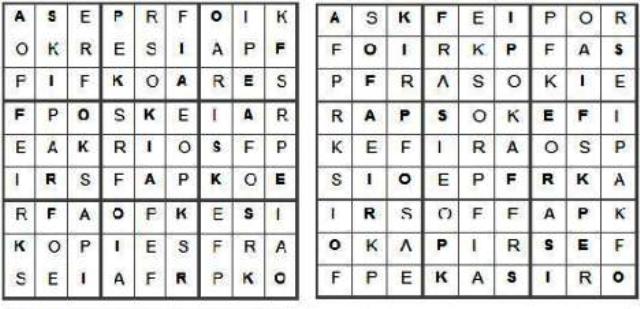
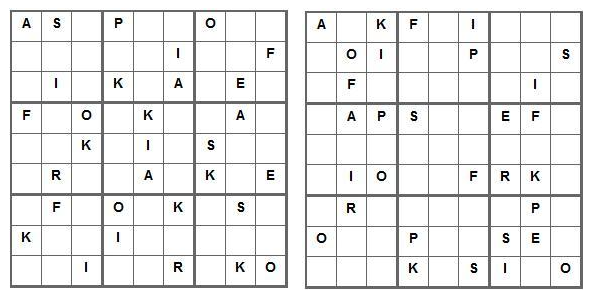
Speaking of puzzles, I created the following puzzles in 2009 for a promotion when A Spark of Heavenly Fire was published. Instead of numbers, these Sudoku puzzles use the letters from the title of the book: A, S, P, R, K, O, F, I, E.

Have fun solving! And if you get stuck, click here to find the solution: Spark of Heavenly Fire Sudoku solution.
***

Pat Bertram is the author of Grief: The Inside Story – A Guide to Surviving the Loss of a Loved One
Lady Bountiful

I normally stay away from lotteries and sweepstakes and slot machines and every other kind of gambling, but this year I’ve been filling in the ridiculous Publisher’s Clearinghouse Sweepstakes forms. I’ve been feeling lucky — or rather, I had been feeling lucky — having a house (a home!), a nice town to live in, as well as friends is luck indeed, and on the off chance that this lucky streak continued, I went ahead and played their silly game.

And it is a game. They hide the necessary stickers among copious ads for things no one needs in the hope that those foolish enough to enter will think they have a better chance of winning if they buy something. I have a hunch, if I read all the small print, I would discover that I had entered various drawings. The winner the first few times was supposed to win $7,000 a week for life, and the last form said the winner would receive $5,000 a week for life. So . . . games.

Mostly, I was playing a game with myself, thinking of what I would do with all that money. I don’t need it all (a couple weeks worth each year would be riches for me) and would have no way of spending it. I did think it would be fun to turn each week’s check over to a local organization and let them deal with spending it for the good of the community. It certainly would have brought much needed cash to this rather impoverished area.

I don’t really feel that lucky any more — not that I am unlucky, because I’m not. All the things that made me feel lucky are still in place, but that moment when I felt it possible for the universe to open up a crack to shower me with enough riches to play Lady Bountiful seems to have closed. And anyway, the more I think about it, the more dreadful it seems — every week, for the rest of my life having to figure out where the money would do the most good, and then having to make the effort to get it to the proper organization (as well as trying to keep my name out of the public’s eye so as not to be inundated with people’s outstretched hands).

If that had a become a problem, there would still be other ways of using the money for good, such as buying up one of the derelict houses around here and flipping it or tearing it down (it’s costly to tear down some of these houses because of the asbestos issue) and creating a green space. But even that seems like too much work.

Besides, my own property still needs work, and for now, that’s enough riches and enough of a responsibility to keep “Lady Bountiful” occupied.

***

Pat Bertram is the author of Grief: The Inside Story – A Guide to Surviving the Loss of a Loved One. “Grief: The Inside Story is perfect and that is not hyperbole! It is exactly what folk who are grieving need to read.” –Leesa Healy, RN, GDAS GDAT, Emotional/Mental Health Therapist & Educator.


An Unscheduled Life

A long-time friend wrote to tell me she’s been enjoying my posts about my new house, and spoke with awe about the success of my new life. Then she said she was going to make attendance at community events in her area more of a priority. I had to laugh at this, because I am doing the opposite — making community events less of a priority.

When I moved here, I made a concerted effort to be . . . not me. At least, not my usual semi-hermit self. I knew I had to do something to keep my concern about stagnating from becoming a reality. To that end, I said yes to every invitation, took every opportunity to attend community events, joined every group that expressed an interest in me, even played games — a couple of times at the library, most often at the senior center. (If you knew how little I like games, except perhaps the solitaire kind that keeps my mind occupied while I think, you would understand how big a concession this was.)

In the last couple of months, things have changed. Or perhaps it is I who have changed, reverting to my stay-away-from-crowds inclination. (I do best one on one. Being with two or three is acceptable, especially if the others are congenial, but more than that tends to overwhelm me.)

Although I did set out to get involved, I never actually set out to get uninvolved. It just happened. Any time someone ignored me, asked for one thing more than I was willing to give, said something that hit me the wrong way (or even the right way), it stopped me cold, breaking whatever momentum of sociability I’d built up. None of these things were important. None of these things hurt beyond the moment. None of them were things I couldn’t have easily shrugged off. But all of them, in that stopped moment, made me wonder, “What the heck am I doing?”

And so, the life I had built for myself slowly disintegrated. Well, not my life — that’s still intact, along with all the friends I’ve made — but my scheduled life is disappearing. I’ll keep up with a few things — Art Guild, the strategic planning sessions, and maybe an occasional potluck or other activity, but everything else that’s been a regularly scheduled event seems to have been wiped from my calendar.

I’m not sure what I’ll do with this newly unscheduled life. Exercise more, eat better, and try to lose the weight I gained by going to all those community events, of course. Visits and excursions with friends, I hope. But beyond that, I don’t know. (I suppose it’s possible — vaguely possible — that I’ll start writing a new book.)

It seems fitting, in a way, that this change is taking place now. The first anniversary of when I bought my house is two weeks away. A lot has happened in the past year. I’m sure a lot more will happen in the coming months, though I don’t know — can’t know — what. More hermitting? More socializing? More scheduling? Walking back to functions I’ve walked away from?

Since I can’t even guess who or what I will be, how I will change, or how I will feel, I’ll just have to wait to see how the future unfolds and trust that it will be good for me.

***

Pat Bertram is the author of Grief: The Inside Story – A Guide to Surviving the Loss of a Loved One. “Grief: The Inside Story is perfect and that is not hyperbole! It is exactly what folk who are grieving need to read.” –Leesa Healy, RN, GDAS GDAT, Emotional/Mental Health Therapist & Educator