That “R” Thing Again

Daily writing prompt
If you could permanently ban a word from general usage, which one would it be? Why?

There are many terms that really get on my nerves, words and phrases I don’t use and would like expunged from the English/American language: “110%” (a physical impossibility); “intestinal fortitude” (just have the guts to say “guts”); “veggies” (the very sound of that mawkish word gags me), and “climate change” (the term is redundant. Climate is change. Climate is always changing).

Recently I have expunged another word from my vocabulary, and though I would like it banned from general use, simply the idea of suggesting banning it would seem to prove the very thing I would like banned.

It’s that “R” thing I wrote about yesterday. The word is so dangerous, so powerful and pejorative that just being called that “R” thing will bring down collective wrath on your head. It’s the one thing that is outside the normal rule of “innocent until proven guilty.” If you’re called that “R” thing, whether or not you did anything to earn that slur, that’s what you are. End of story. Except it’s not the end. Just being called that “R” thing can get you banned from social sites online and community groups offline, can get you ostracized from family or friends, and can sometimes get you fired from your job. It also subverts the law — too many district attorneys refuse to charge criminals for minor crimes and even great crimes, and they ignore fraudsters for stealing billions because they don’t want to be tarnished with the brush of that “R” thing.

I’m not saying the “R” thing doesn’t exist, but that the word itself has become something separate from the behavior it describes. It’s become such a triggering word that the true definition has all but been lost — there seems to be a disconnect between how easily the word is thrown out there and what it actually means.

People have become hyper-vigilant toward cultural nuance or slight and what can be perceived as aggression (even if it’s not directed at them), and they are quick to point it out. At the same time, we have become hypersensitive to and fearful of being called that “R” thing. In a world where words are considered an instance of violence, this could be the most violent. It’s also a weapon, a sure-fire way to silence opposition, to shut down any discussion, and with it any hope of true understanding because it’s an attack on the speaker, not on what is spoken.

Nowadays, it seems as if everything is viewed through that “R” lens, even when unnecessary, even if what you say is true or is not in any way divisive or derogatory.

Yesterday, I posted a blog about the conservative black commentators I have been following. As far as I can see, there was nothing discriminatory about what I wrote, and yet I hesitated to post it because of that “R” thing. I’d already been slandered on Facebook for simply sharing a post from a black commentator, and I didn’t want to continue being slandered. On the other hand, why should I not be able to write what I think just because others might see that “R” thing in my words?

Anyway, whatever anyone else does, in my little world (basically just me and this blog), I am getting rid of that word. There are plenty of other words to use to describe that particular attitude, words that aren’t as incendiary, words such as prejudiced, biased, intolerant, discriminatory, xenophobic, ethnocentric. Too bad I can’t also get rid of the emotional connotations attached to being called the “R” thing, but I’m afraid it’s now embedded the world today, and even in my own psyche. Still, there’s hope . . . well, probably not. I’ve always been sensitive to any sort of slight, and I don’t see that changing any time soon.

***

Pat Bertram is the author of Grief: The Inside Story – A Guide to Surviving the Loss of a Loved One.

A World of Opinions

Sometimes if I check online to see what other people think a cryptic passage in the Wheel of Time means (because Robert Jordan seemed to love being enigmatic and making readers work), I end up falling down the rabbit hole of old online discussions. That everyone would have a different opinion makes sense when it comes to these cryptic passages (especially those that prophesy the characters’ journeys), but this difference holds true even when Jordan is very clear about what is happening.

For a hypothetical example, say that a character went to a tavern to eat, and someone in a forum asked what Jordan meant. By the end of the discussion, you would think that the character was motivated by a desire to foment rebellion rather than a simple desire to assuage hunger. Admittedly, it’s not necessarily a cut-and-dried sentence since, as I said, Jordan delighted in being enigmatic, but still . . . The character went to a tavern to eat. Simple. No discussion required. And yet there are dozens of different points of view even though everyone read the exact same sentence. Or maybe they didn’t read the same sentence; maybe everyone’s eyes saw different words and hence the confusion.

There is also a difference in the way readers look at the saga as a whole. Everyone seems to admit that Jordan got caught up in his vision, and lost the forward momentum of the story about three-fourths of the way through. Some people see this as a vindication of their belief that he is a terrible writer. Others, like me, overlook those parts (that might have made sense if Jordan had been able to finish his epic) and see the brilliance that he did display elsewhere.

So, yes. We do see things differently even when we see the same thing.

A few years back there were all sort of photos going around the internet, like a pair of shoes or a dress. Oddly, though everyone saw the same photo, people saw different colors. I think the shoe was supposed to be pink and white, but I saw grey and turquoise. The dress was supposed to be blue and black, which is what I saw, but some people saw white and gold. Even when people would look at the same screen, such as on one person’s phone, they still saw different colors. Supposedly, there is an explanation, but explanations differed, so who knows the truth of it. The point is the vast difference in perception.

[It reminds me, though, of something I always wondered — do two people actually see the same color in the same way? If I were to show a blue flower, for example, everyone who is not color blind would agree that it was blue, but are we actually seeing the same color or do we just give the name “blue” to whatever color it is we see when shown that color?]

In cases like those I mentioned above, where opinions vary widely, where even what one sees varies, the difference is rather meaningless, since it doesn’t affect anything.

But this divergence holds true even when it does mean something, when it’s not a simple difference of opinion, when the disagreement can affect our very lives. Like the direction the country is going. Some people want open borders, equity more than equality (equality is giving everyone the same opportunity; equity is making sure everyone ends up in the same place), free trade, and a continued move toward globalism. Others want a sovereign nation with closed borders, putting legal citizens first, fair trade, less reliance on inimical countries, and a return to nationalism.

Those who want globalism also, paradoxically, believe in democracy. They believe that they are able to choose their own destiny, and so they can’t see that the policies they support are being pushed on them by outside global influences. The nationalists often do see that globalism hides in certain policies, such as open borders and punitive tariffs placed on American goods, and so they want to retract from world-wide policies that seem to go against sovereignty. For years, these nationalists were hushed by taunts of “conspiracy theorist,” but labels don’t affect the truth that these are two disparate visions of the United States.

It makes me wonder if both sides are seeing the same thing but interpreting it differently, as in the example of the hypothetical sentence in the Wheel of Time mentioned above, or if we are seeing completely different things as with the example of the shoes and dress.

I used to not pay much attention to current doings (it’s easier to study the past because it’s not ever changing as is the present). But now I worry about what could happen when the difference is so great, when whatever opinion you have is subsumed into one of those two vastly different visions. I also worry that the country I die in will be unimaginably different from the one I was born in.

Oh, well. That’s my fault for blogging every day. When I wasn’t blogging, if I had ideas such as these, I’d just let them pass, but now I think about them so I can write a cogent essay. A good reason to stop blogging, but so far, I don’t have an opinion about whether or not to continue.


***

Pat Bertram is the author of Grief: The Inside Story – A Guide to Surviving the Loss of a Loved One.

My Every Day

Daily writing prompt
Describe your most ideal day from beginning to end.

My most ideal day? Well, that’s simple enough to describe — it’s pretty much my every day so far this year:

Get up. Do stretching exercises. Make the bed. Have a cup of tea. Play a bit of a hidden object game. Write a blog post. Read. Have breakfast. Read. Have lunch. Read. Take a short walk. Read. Rest a bit. Read. Have a quick snack. Read. Check online to see what if anything is going on with my blog. Read. Read some more until it’s time to go to bed, then read until lights out.

Well, that’s my every day except for the walk. I keep trying to get back into walking every day, but I can’t seem to always find the energy. Of course, in an ideal day, I’d have plenty of energy, no sinus issues, and the get up and go to just get up and go. Sometimes, of course, my ideal day involves a visit with a friend or neighbor or whoever else I might encounter during the walk, but apparently not today.

I used to play the hidden object game a lot more until much of that online time got supplanted by blogging. Odd how that happened. I never actually decided to start posting every day as I used to. I just . . . did.

I must admit, blogging does help make my day an ideal one. It feels like coming home, in a way, a comfortable way to spend time, a pleasant way to communicate without having people cut me off while I am speaking if they disagree. (You might cut me off and stop reading, but since I’d never know, it’s not hurtful.) It also gives me something to think about other than the state of the world and the lack of common sense (though why something that’s in such short supply is called “common,” I don’t know, and neither does anyone else, apparently, since this is a sentiment I encounter so often that it’s embarrassingly trite). Best of all, blogging allows me to play with words, like above when I wrote “the get up and go to just get up and go.” I tend to be too serious, so word play lets me indulge my fantasy that I’m witty and charming and lighthearted. (And no, that fantasy is not part of my ideal day since ideally, I need to be what I am, whatever that might be.)

Well, this part of my ideal day has been fulfilled. Now on the next part: Reading!!

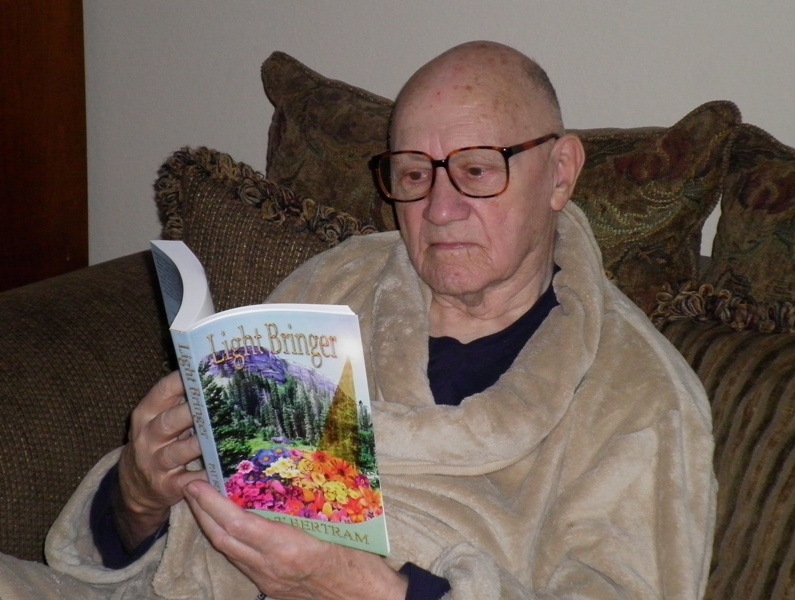
(I couldn’t find a photo of myself reading, so here is the next best thing: my 97-year-old father reading one of my books during his last days.)

***

Pat Bertram is the author of Grief: The Inside Story – A Guide to Surviving the Loss of a Loved One.

When Online Friends Disappear

For almost twenty years now, I’ve been a quiet presence on the internet. Nothing I’ve posted has ever gone viral, though a few posts have accumulated thousands of views over the years. Most of those, I think, were posts about grief that apparently resonated with people, but for whatever reason, people have found me. Many of the people I met through this blog, as well as through various networking sites, became online friends. Some even became offline friends.

Once I stopped blogging about grief, stopped blogging every day about anything, and stopped participating in places like Facebook (Facebook banned all links to this blog, so I had no real reason to participate since all I had to say, I said here), I didn’t “see” those friends as often, but I did catch a glimpse of them online now and again, so I knew they were well.

Facebook has recently lifted their 7-year ban of this blog, so I have no real reason to continue my boycott, except that the ban pretty much put the kibosh on book sales since most of my buyers came from there, and that’s hard to forgive. I did log in to check on a friend, one who I admired and with whom I had a wonderful visit on my cross-country trip, but he was gone from the site. No record of his ever having been there. It turns out, it wasn’t his choice. Facebook just arbitrarily deleted his account. No reason. No recourse.

I’ve seen a lot of really horrible things posted online over the years, but this author, who I’ve followed almost from the beginning, has never posted anything the least bit controversial. He’d mention books, the ones he wrote and the ones he read. He’d share a joke. He’d write about his research. Oh, any number of interesting, totally benign subjects, and then . . . nothing.

He was understandably angry and mentioned his troubles a couple of times in a blog post, but then he even stopped posting anything on his blog. I emailed him, and when I got no answer, I checked obituaries. (But he wasn’t there, either. Whew!)

Obviously, we weren’t close or otherwise we would have kept in contact more frequently after our visit, but to tell the truth, I lost contact with a lot of people. I settled down, eventually began to live more offline than on, stopped writing. Most of my online friends were people I met through various author groups, some groups of which are now defunct (that’s why so many of us reluctantly migrated to Facebook). When I lost interest in writing novels, I also lost interest in talking about writing, so there went most of my online activity.

If I hadn’t met him in person, I would begin to think this disappeared friend was a figment of the internet, perhaps an avatar of some artificial intelligence, but I know for a fact he existed and that his intelligence was anything but artificial.

I may never know what happened to him, though I hope he is doing well.

Other people I have lost track of occasionally check in here with me, just to say they’re still around, which I appreciate. But then, I suppose that’s the way of the ever-turning wheel of the internet. It spins us together and then whirls us apart.

Though come to think of it, that “apart” part might just be life. Or aging. Many of the friends I’ve made since moving into my house I seldom see. Even a friend who lives a mere two blocks away!

So, for all of you I’ve lost track of, know I am thinking of you and hoping you are well and at peace.

***

Pat Bertram is the author of Grief: The Inside Story – A Guide to Surviving the Loss of a Loved One.

My First Contact with Computers

Daily writing prompt
Write about your first computer.

My first computer wasn’t really a computer. It was a Smith Corona Wordsmith 250 electric typewriter with a few computer-like features, such as a 50,000-word dictionary, a small memory where you could type what you wanted before it printed on the page, and being able to change to italics or bold with a shortcut.

By the time I got my first taste of a real computer, a 10-year-old hand-me-down IBM Thinkpad, I had some inkling of what was possible. Still, I was a bit nervous having to learn an entirely new way of writing, especially since I’d heard horror stories of the early days about how hard it was to boot up a computer and getting it all set up. Then I remembered that a vast majority of people who were adept at computer usage were children, or at least children compared to me, and that gave me courage to forge ahead. But there was no problem. I turned on the computer and immediately started typing. (I cheated, though. When I found out I was going to be getting a computer, I got some general usage books from the library and read them.) By that time, so much of the fiddling with setting up a computer was gone and the computer did most of the work, and I took to it immediately. Never had a problem figuring things out. Once I knew the basics of Word, the rest seemed intuitive. I’d also read that there was almost nothing done on a computer that couldn’t be undone, so I was fearless in trying whatever came to mind.

That computer didn’t last long, just long enough to scan my typed manuscripts, edit them, format them according to publishing standards, and start sending them out.

As the Thinkpad started having problems, I asked around to see if any relative had a computer they wanted to get rid of, and one said that he’d see what he could do.

A couple weeks later, UPS delivered a package. I opened that box and completely lost my breath, stunned by what I saw — a brand-new Dell Inspiron. No one had ever given me such a fabulous (and expensive!) gift. The date of receipt is one of those dates I will never forget, it was that important to me.

I wish I could say that Dell computer jumpstarted my career as a published author and made me an instant success, but that wouldn’t be true. What it did start me on was a lifelong relationship with computers and the internet. And with friends all over the world. (I was lucky enough to meet many of them on my various travels, which truly was a thrill!)

One of the first things I did once I was set up with the internet at home was to start this blog. And here I am, eighteen and a half years later. All because of that Inspiron.

And yes, I thanked him — many times, actually, probably to the point of embarrassing him.

I still have that computer, though it is defunct. The battery is worn out, and even if I could get a new battery, I doubt there’s enough power in the machine to run today’s programs. What I have now is another Inspiron, one I gifted to myself, and though it’s developed a couple of idiosyncrasies during its seven years of life, it still does everything I need it to. (The major problem is that doesn’t like being put to sleep — it needs to be rebooted when it’s awakened — and hibernation isn’t a power option, so I have to shut it down every time or just walk away and let it do what it wants.)

And oh, in case you’re wondering, the photo is of the computer I was gifted way back when.

***

Pat Bertram is the author of Grief: The Inside Story – A Guide to Surviving the Loss of a Loved One.
A Sort of Apology

I feel as if I should apologize for all these Wheel of Time posts, and yet, here I still am.

In an effort to find an alternative to posting here, I looked for book discussions, thinking it would be fun to talk about the story, characters, and implications of the various events with other students of the work, but the discussions fell into a few distinct categories:

Discussions during the long years while fans waited for a new book to be published, most centering on where they thought the story was going, and which are now defunct because the series of books is finished and the ending, or at least an ending, is known.

Discussions centered on who loved what character, and how foolish were those who didn’t like said character. That sort of non-discussion gets old, especially if you hold a minority opinion and don’t want to be lambasted.

Discussions about the end of the book, and how wonderful the ending was, or if not how wonderful the ending was, how wonderful the substitute writer was for writing it (ignoring the fact that he got paid, and even more importantly, that the project catapulted him into fantasy superstardom).

None of those discussions fit with anything I wanted to discuss, and anyway, most were many years old. Any newer discussions revolved around the now cancelled television series, and how terrible/wonderful the show was. (Terrible because it turned the story into something completely different from the books, wonderful because . . .  well, because it was the Wheel of Time.)

I tried starting my own discussion, but only got the usual fan-type comments such as “I liked character A, I hated character B.”

I considered resurrecting one of my dormant blogs and doing a chapter-by-chapter discussion, but that didn’t appeal to me. I like the puzzle the books present, and I like that in some ways it is (was?) a cultural phenomenon, with many more millions of words written about the books than were actually in the books (the first book was published right around the time the internet, discussion boards, and social sites were just beginning, and the story happened to be geared to the age group that first embraced the online world). To be honest, I didn’t want to spend that much effort on what is really just a way for me to pass mental time. (Physical time, too, but I like having something to occupy my mind, more than the issues of the day or . . . whatever.) Besides, however much I determine that upon this rereading, for sure, I will read every word, I never do. I find myself skimming or even skipping the characters I find annoying and the parts that include too much torture, both mental and physical.

I make sure, however, that I never skim or skip some of the most lyrical of Jordan’s writing. At one point, a character got lost in thoughts of the past, remembering that “They danced beneath the great crystal dome at the court of Shaemal, when all the world envied Coremanda’s splendor and might.” That’s pretty much all we ever find out about the lost nation of Coremanda, but that one sentence is haunting, conjuring in just a few words a long-forgotten time.

And then there’s a song that the same character remembers from long ago, a song that seems to be a theme of the books (NB: the Aes Sedai are the women power wielders):

Give me your trust, said the Aes Sedai.
On my shoulders I support the sky.
Trust me to know and to do what is best,
And I will take care of the rest.
But trust is the color of a dark seed growing.
Trust is the color of a heart’s blood flowing.
Trust is the color of a soul’s last breath.
Trust is the color of death.

Anyway, that lyricism is beside the point . . . actually, no — it’s not beside the point, it is the point of my rereading the books. It’s just not the point of this blog post and my feeling I should apologize for dumping my thoughts on the books here.

So, if you want an apology, you got it, but it’s not truly an apology because a sincere apology connotes a promise of not repeating the offense, and perhaps unfortunately for you, I will continue posting my thoughts until I’ve finished this reread or until I’ve given up blogging again.

***

Pat Bertram is the author of Grief: The Inside Story – A Guide to Surviving the Loss of a Loved One.

Comfortable Clutter

Daily writing prompt
Where can you reduce clutter in your life?

The easiest place for me to reduce clutter in my life right now is to clear up my desk and worktable. Except for my office, where I spend most of my time, I keep surfaces free from clutter. I was always sort of messy, never really having the energy to do a lot of cleaning, but ever since I moved into my own house, I’ve kept everything neat and clutter-free. I like the clean lines — no photos or pictures on the walls, nothing but lamps on the side tables, books in their proper place, kitchen counters bare. I also like that people can drop by without my getting embarrassed by my lack of housekeeping skills.

My cupboards are full of kitchenware and other necessities, but I make sure that whenever I get new items, instead of further cluttering those cabinets, I get rid of an equal number of older items.

I have a lot of boxes of things stored in my garage, but they’re not exactly clutter, at least not according to the definition of clutter as being a disorganized mess — my garage is neatly organized. Still, there are many things, maybe even most things, that I will get rid of, but not yet. Too often in my life, I’ve disposed of various items, particularly materials and tools for a special project, and then later had to buy those items again. There’s a good chance I won’t use most of what I have since my project days seem to be over, but I don’t know for sure, so there the boxes sit. And anyway, the would-be clutter is out of the house so I don’t have to think about or stumble on boxes of stuff. It does help that I got rid of about half of what we owned when Jeff died and I moved in with my father, and another significant portion when my father died and once again, I had to move on. I am clearing the rest out gradually, but at the rate I’m going, I’ll be one hundred and ten by the time everything is gone, but oh, please! Don’t make me live that long!

Mental clutter is pretty much the same, with any possible issues either left in the past, neatly stored away for easy retrieval, or dumped here on this blog.

So am I going to clear up the clutter on my desk? Probably not. Everything I need is right at hand, and if there is too much clutter, well, it’s comfortable clutter, not an embarrassing mess.

***

Pat Bertram is the author of Grief: The Inside Story – A Guide to Surviving the Loss of a Loved One.

Intentions and Unintentions

So far most of my New Year’s resolutions are on track, both the intentional ones and the unintentional ones. My plan of taking a walk every day was pretty much buried in the snow a few days ago. Although the snow is melting, there is too much slush to for me to want to be out there; also I’m fighting some sort of allergy or early cold symptom, which gives me even more of an excuse to remain inside. I am doing well staying away from the news, though occasionally the news comes calling with an email or an inadvertent glimpse when I let my attention wander. I’m also staying with the no sugar/no wheat thing, though I am looking forward to some sort of treat when the month is over. (This resolution was only for a month, though the intention of sticking with real food is an ongoing one.)

My unintentional resolution of blogging every day is still on track. Fifteen days and counting! I never really planned to blog every day . . . I just started, and now here I am. It feels good to be back blogging. An additional benefit is that it’s getting me away from playing games on the computer, which is just as well. The hidden object game I play is getting tiresome, though I still log in and play a bit every day just to keep my hand in, but any sense of wanting to work toward game goals has dissipated.

One unvoiced intention this year was to reread The Wheel of Time series by Robert Jordan and try to pick out clues to the real ending, not the ending we ended up with, which I am trying to do. Jordan, the one who created his world out of a mosaic of our history, culture, myths, and legends, died before he could finish, and the author chosen to finish the series did an execrable job. Not only was he at best a serviceable writer, he dumped characters that played a role through Jordan’s writings, ignored many characters’ development and regressed them to the beginning, traded established subplots for new subplots of his own that added nothing to the story, destroyed his own timeline so that things happened in no order (even seemingly having one character in two places at a time and two characters meeting where their timelines couldn’t have intersected).

[What astonishes me about those ersatz books is how protective everyone is of that substitute author. There are no one- and two-star ratings of his offerings, though there are plenty of low ratings when it comes to Jordan’s books. (Admittedly, some of those are deserved. Although much of Jordan’s story is brilliant and shows the ten years he spent researching, and his writing seems epic at times, it could do with a serious editing, including slashing huge sections of a couple of books.) I did find one review that was an honest critique of the last three books, yet the overwhelming response to the thoughtful piece was that the review was “overwrought drivel” written by an angry fan. (Even though the reviewer admitted he wasn’t a fan.)]

I read this series multiple times because after volume 6, I could no long remember what had happened in volume one. Most of the brilliance in the series comes from foreshadowing, and it’s hard to tell when a foreshadowed event occurs when you can’t remember the foreshadowing. So now I am able to remember the story going both ways — what I’ve read and what I’m going to read. Unfortunately, now I can’t forget those last three mishmash books by the substitute author in order to come up with my own ending as foreshadowed by Jordan’s writings.

I am not a fan of these books so much as a student, which is why I want to puzzle out the real ending. (Something to occupy my mind, if nothing else.) Perhaps as I find more of the clues to the ending Jordan intended, I’ll be able to override in my mind the bad ending with one of my own concoction.

Meantime, the year progresses. Already halfway through January! And my intentions (and unintentions) are still holding strong.

***

Pat Bertram is the author of Grief: The Inside Story – A Guide to Surviving the Loss of a Loved One.

Aged Thoughts

So far this year, I’ve kept up with my resolutions and intentions, as well as inadvertent plans. “Inadvertent plans” meaning those things I’ve been doing without ever actually planning to do them, such as daily blogging.

Of course, this is only the fifth day of the new year, but still — to be keeping up with all I want to do is pretty impressive. At least, it is to me.

What’s funny is how much time everything takes. I knew things took a lot of time, which is why I got lackadaisical about doing them. Blogging, by the time I write, rewrite, edit, add images, figure out tags and actually post the thing takes a couple of hours. Exercise — both the stretching (which includes therapy for my knees) and walking — takes another hour. And cooking, eating, and cleaning up after myself as well as other household chores and personal maintenance takes another hour or two or even three.

Lately it seems as if once I’ve done what I’ve planned, there isn’t a whole lot of time left of the day. Admittedly, I am trying to do more, and the day ends early. Despite the end of the creeping darkness and the gradual returning of the light, sunset comes quickly: today the sun will set at 4:47 pm.

Even taking all that into consideration, the day seems to disappear, which makes me wonder if I am moving slower. Is it possible that one can move slowly without knowing it? It doesn’t seem as if I take a longer time to do the things I’ve often done, and yet, the hours evaporate.

A lot of things change around a person without their being aware of it, such as age. Even in late middle age and early old age, we still feel the same as we always did, and despite occasional twinges and a few wrinkles (well, perhaps more than a few!) we tend to think we still look the same. People used to tell me how young I looked, and yet, I was often given a senior discount without requesting it, which told me that I might look good for my age, but when it comes to comparison with young workers, I must look ancient.

Even if our minds slow, we don’t really notice because we are always at home in our own minds. So perhaps it’s the same with movement. We seem to move with the same level of effort, but the effects of that effort, obviously, change with the years, but when does that change come, and will we know it?

None of this really matters, of course. I do what I can when I can, move at a comfortable pace, and as long as there are enough hours to accomplish what I want to accomplish each day, it’s no one’s business (maybe not even my own) about how much of the day is left to read and relax.

Still, I do wonder how much slower I am moving, and how it will affect me during the coming years. Luckily, I don’t often give in to such aged thoughts, which helps me forget the number of years heaped on my head.

***

Pat Bertram is the author of Grief: The Inside Story – A Guide to Surviving the Loss of a Loved One.