Grateful

Daily writing prompt
How do significant life events or the passage of time influence your perspective on life?

I’ve experienced many significant life events and life-changing experiences that influenced my perspective on life, but I don’t have any interest in rehashing any those past traumas. Nor do I have any present traumas to talk about since, luckily, I’m going through a rather static time right now. No major life experiences. I am still enamored with the experience of owning my own home and landscaping the yard, but that’s become simply my life.

What does affect me, and does more every day, is the passage of time. I’ve reached the age of no return — my body no longer heals itself quickly, and so small infirmities will begin to add up leading inevitably to a frailer old age than I might have envisioned. If I’m careful, I might not become as frail as I fear, so that’s the big way that time influences my perspective on life now —carefulness. Mindfulness.

Mindfulness is not some sort of esoteric practice, but a very practical way of approaching the end of the road — being careful. I used to move quickly, but now I move deliberately, mindful of where I place my feet. Too many older people have lost their independence because of a fall, and I’ve already destroyed enough of my body by falling (fake elbow, multiple pins in my wrist and forearm). I tend to think I’m still too young to have to worry about losing my independence, but things can happen in an instance, and I am not taking a chance. At least I’m trying not to.

I take care of myself as best as I can, though I admit, it’s not as good a job as I did when I was younger. I might also be coddling myself more than I should, using any small malady as an excuse not to exercise, but maybe coddling is a necessary a part of taking care of oneself.

I also do things like find chores in the kitchen while I’m cooking so that I don’t get distracted and walk away from a potential hazard. And I pay attention to the sort of accidents that happen when people get older so that I can protect myself, if at all possible, from that happening to me. (Not that we can protect ourselves from everything, but being careful means at least trying.)

Mostly, I’m grateful. Grateful for everything I can do. Grateful for every day I wake up. Grateful for every pain-free moment. Grateful I can still read and understand what I’m reading. Grateful I can still eat what I like. Grateful for the friends I have and the companionship they give me.

Just . . . grateful.
***

Pat Bertram is the author of Grief: The Inside Story – A Guide to Surviving the Loss of a Loved One.

A Big To-Do About What To Do

Daily writing prompt
Something on your “to-do list” that never gets done.

Nothing on my to-do list ever gets done for the simple reason that I don’t have a to-do list. If I did have a to-do list, the first thing on the list would be to make a to-do list, which I would not do, so again, the answer would be that nothing on my to-do list ever gets done.

I’m of the firm belief that what doesn’t need to be done today should be put off until tomorrow. And if there is something that needs to be done today? I do it. Simple. If I know ahead of time I will need to do something today (because each day I kept putting it off until tomorrow, and tomorrow finally came), I put a reminder on my calendar. For example, this was the last day to pay my car insurance, which I know because it’s on my calendar, so I did it. But I remembered anyway, so the reminder was simply insurance insurance. (If that doesn’t make sense, no problem; I often try to be clever and only end up being too clever for my own good.) I occasionally leave myself a sticky note to remind me of something I need to remember to do, such as letting a faucet drip during our below freezing nights. I suppose each of those sticky notes could be construed as a list, but a list with a single reminder isn’t much of a list.

I come by leaving myself occasional notes honestly. My father always did it, though my mother never did. In fact, she was a bit bemused by his reminders. She often told the story of coming across a note he wrote before they were married reminding him to marry her. “Would you really have forgotten to marry me?” she supposedly asked. And his answer, “No, but I didn’t want to take a chance.”

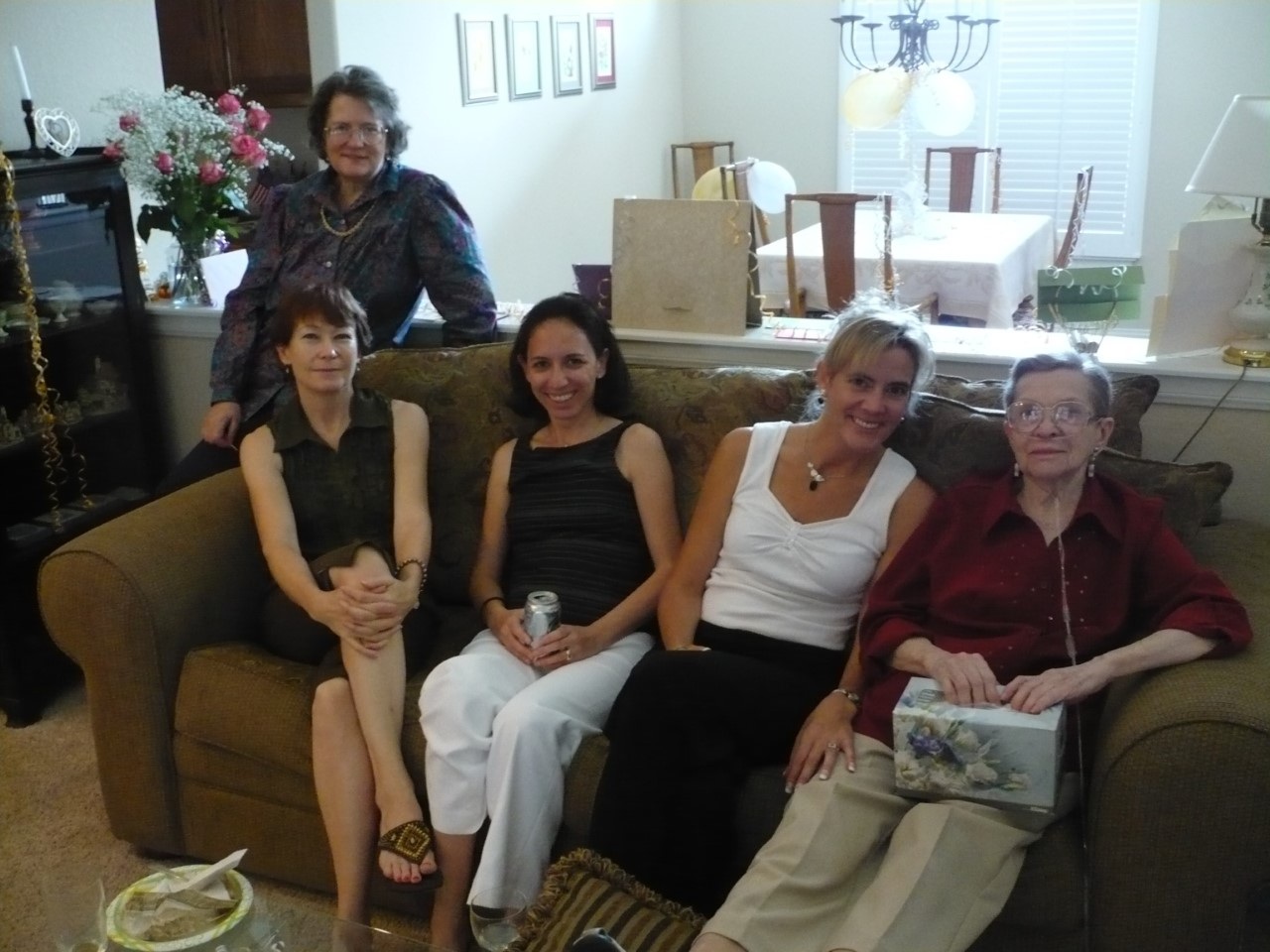
The note apparently worked because they did get married. They celebrated their sixtieth anniversary a couple of months before my mother died. The January before their September anniversary, doctors diagnosed my mother with cancer and told her she had three to six months to live. She told them that wasn’t good enough. She needed nine months. The anniversary was that important to her, and she did make it. (The photo accompanying this article is one taken of all us women at the get-together.)

I think I’m getting off the track here. But really, what is there to say about a to-do list that doesn’t list anything to do?

***

Pat Bertram is the author of Grief: The Inside Story – A Guide to Surviving the Loss of a Loved One.

My First Contact with Computers

Daily writing prompt
Write about your first computer.

My first computer wasn’t really a computer. It was a Smith Corona Wordsmith 250 electric typewriter with a few computer-like features, such as a 50,000-word dictionary, a small memory where you could type what you wanted before it printed on the page, and being able to change to italics or bold with a shortcut.

By the time I got my first taste of a real computer, a 10-year-old hand-me-down IBM Thinkpad, I had some inkling of what was possible. Still, I was a bit nervous having to learn an entirely new way of writing, especially since I’d heard horror stories of the early days about how hard it was to boot up a computer and getting it all set up. Then I remembered that a vast majority of people who were adept at computer usage were children, or at least children compared to me, and that gave me courage to forge ahead. But there was no problem. I turned on the computer and immediately started typing. (I cheated, though. When I found out I was going to be getting a computer, I got some general usage books from the library and read them.) By that time, so much of the fiddling with setting up a computer was gone and the computer did most of the work, and I took to it immediately. Never had a problem figuring things out. Once I knew the basics of Word, the rest seemed intuitive. I’d also read that there was almost nothing done on a computer that couldn’t be undone, so I was fearless in trying whatever came to mind.

That computer didn’t last long, just long enough to scan my typed manuscripts, edit them, format them according to publishing standards, and start sending them out.

As the Thinkpad started having problems, I asked around to see if any relative had a computer they wanted to get rid of, and one said that he’d see what he could do.

A couple weeks later, UPS delivered a package. I opened that box and completely lost my breath, stunned by what I saw — a brand-new Dell Inspiron. No one had ever given me such a fabulous (and expensive!) gift. The date of receipt is one of those dates I will never forget, it was that important to me.

I wish I could say that Dell computer jumpstarted my career as a published author and made me an instant success, but that wouldn’t be true. What it did start me on was a lifelong relationship with computers and the internet. And with friends all over the world. (I was lucky enough to meet many of them on my various travels, which truly was a thrill!)

One of the first things I did once I was set up with the internet at home was to start this blog. And here I am, eighteen and a half years later. All because of that Inspiron.

And yes, I thanked him — many times, actually, probably to the point of embarrassing him.

I still have that computer, though it is defunct. The battery is worn out, and even if I could get a new battery, I doubt there’s enough power in the machine to run today’s programs. What I have now is another Inspiron, one I gifted to myself, and though it’s developed a couple of idiosyncrasies during its seven years of life, it still does everything I need it to. (The major problem is that doesn’t like being put to sleep — it needs to be rebooted when it’s awakened — and hibernation isn’t a power option, so I have to shut it down every time or just walk away and let it do what it wants.)

And oh, in case you’re wondering, the photo is of the computer I was gifted way back when.

***

Pat Bertram is the author of Grief: The Inside Story – A Guide to Surviving the Loss of a Loved One.

How Fast Time Flies

Daily writing prompt
What do you complain about the most?

I wasn’t going to answer this particular blog prompt because I don’t think I complain all that much. I suppose it’s possible I do complain at times to other people, and it might seem to them that I complain a lot, but since I spend most of my time alone, to me, those complaints seem few and far between. I do, however, tend to mention how fast time is passing, which could be construed a complaint.

January especially seems to skim by me with barely a nod to the passing days. By the middle of the month, I’m usually bemoaning the speed which the year is passing, and by the end of the month, I figure the year is all but done.

But not this year. This January seems interminably long. It feels as if the month should be over, and yet there’s still most of a week remaining. I don’t suppose it matters how fast the month seems to be passing except that it screws up with my internal clock. Also, I am trying to do a “dry January,” and having to be extra cognizant of what I eat is wearing on me.

[I learned of Dry January (a program started in the UK in 2013) from my sister who follows this program, and since I don’t drink, I decided to show my solidarity by eschewing sugar and wheat, with of course, the goal of trying to reset my metabolism and eating habits. (I always try to eat as healthy as I can, but I find as the year progresses, I slip more and more from my goal, and I wanted to give myself a good start to the new year.)]

I suppose my starting Dry January early (the day after Christmas) could be making the month seem longer, but the Christmas treats were gone, and so was the tree. (I wrapped the fully decorated fake tree in cushioning packing materials, stuck in in a heavy trash bag and took it down into the basement, ready to pull out for next year. It makes it so much easier to put up a tree when it’s already decorated!) So there was no reason to wait to start that particular resolution. But even given that I started the “dry” month early, there’s no reason for January to seem so long.

Oh, well. It will eventually be over, February will fly by, and I will soon be complaining again about fast time is passing.

***

Pat Bertram is the author of Grief: The Inside Story – A Guide to Surviving the Loss of a Loved One.
Fun? Me?

Daily writing prompt
List five things you do for fun.

Five things I do for fun:

1.

2.

3.

4.

5.

Yep, that’s right — I don’t do anything for fun, don’t even know how to have fun. Even as a kid, I didn’t know how to play let alone have fun. I used to like paper dolls, but after I did the work to cut out the clothes and tried them on the dolls, that was it. I never knew what to do with them afterward. I remember once I spent hours building a small town out of paper, complete with houses and streets, but since I didn’t know what to do with it, I let my younger siblings play with my creation while I sat and watched.

(Apparently, I was born with that trait. My mother often told the tale of baby me and how my eleven-month older brother would play with my toys, and as long as he stayed by my playpen so I could watch, I was content.)

To be honest, I don’t even know what fun is, so I had to look it up. According to the Oxford English Dictionary, fun is “light-hearted pleasure, enjoyment, or amusement; boisterous joviality or merrymaking; entertainment”.

Boisterous joviality and merrymaking are not part of my makeup. I am quiet, the one sitting back and letting other people get rowdy or drink too much or “party” (whatever that is). On my twenty-first birthday, I went to a bar in Central City with a friend for my first drink, but she dragged a friend of hers along. I sat and watched the two of them get raucously drunk. Finally, I went up to the bar and started talking to the owner. Even though he didn’t know it was my birthday, he seemed to feel sorry for me, especially as all I did was order a soft drink. At one point he asked me if I wanted to see his new icemaking machine and I said yes. I know what you think: “Hey, want to come up and see my etchings?” But no. He was thrilled with his new machine, and wanted to show it off. So typical of me! (Typical, too, that I had to drive those two drunks home, stopping periodically so they wouldn’t mess up by new car with their retching.)

I read a lot, but for me, reading is not a “light-hearted pleasure or enjoyment.” I’m not sure it’s even enjoyment. It’s more of a thing I do the in the same way I breathe — as a necessity, a mechanical act that keeps me alive, something that supports calm, and keeps me centered. It’s just what I do. Sometimes, if the book is not particularly stimulating, I let my conscious mind follow the story while my subconscious deals with whatever problems I might have, or even deconstructs the story to see what the author did.

I also like to learn, but that fits in with the whole “reading” thing.

As for entertainment: the last time I had a television (until I moved here to my permanent home, I rented a room in a house that came with a television), I decided to watch Hallmark movies. I figured I’d never spring for television programming, so it would be the last time I had a chance to watch those movies. So I did. But for me, it wasn’t entertaining so much as a study in how to put together a Hallmark movie. So much time for an introduction. So much time until the meeting. So much time for the characters to get to know each other. At exactly what time the big breakup/misunderstanding occurs. And finally how long for the happily ever after ending.

Despite being a rather quiet and serious person who spends most of her time alone, I still do like to laugh and chat with friends, but sometimes days pass without my seeing anyone, especially in winter. (Sometimes it takes more mental energy than I have to make the effort. Luckily, my friends make the effort for me.) In the summer, when I am out working in my yard (again, not really fun for me, though I do like seeing the results of my work) I often visit with neighbors across the fence, in the alley, or in the middle of the street depending on where those neighbors live.

A friend posted on her blog that instead of making New Year’s resolutions or intentions, she’d heard of a different way to start the year: pick a word to be a theme for that year. Sounds nice. Maybe I should choose “fun”?

But no, if resolutions tend to set us up for failure, then trying to live up to a word that is not in my nature would set me up for even more failure.

I suppose not being “fun-loving” is something I should worry about, but I’ve lived this long without being able to list five things I do for fun, so I suppose I can live my remaining years the same way. And anyway, I’m contented, which should count for something.

***

Pat Bertram is the author of Grief: The Inside Story – A Guide to Surviving the Loss of a Loved One.

Books I Want to Read

Daily writing prompt
What books do you want to read?

The books I want to read are novels with a new story (which is hard to find since it seems so many novels repeat the same old stories with minor variations) or a truly different twist on an old story. The characters in these new — or old — stories are loyal and kind, nice until it’s time not to be nice, have integrity, do their best and when they don’t succeed, try to do a better best in some way. Often these characters have a talent or skill, but the story challenges them in ways that those abilities don’t help, and in fact force them try to find ways to use their lesser abilities. (For a simplistic example, a person with great eyesight would be at a disadvantage in a lightless cave and would need to rely on their perhaps diminished hearing.)

These books are also all written with clarity and grace using words and phrases that are sometimes lyrical or out of the ordinary, but always clear and understandable.

The books are of various genres, but at their core they are all great stories with relatability and depth, a sense of wonder and perhaps a touch of strange. No category romance! And not much science fiction or fantasy, either. (A lot of fantasy starts out very confusing and quite frankly, I have enough trouble sorting out the confusion in the real world. I don’t need to bring more confusion into my life.) Some speculative fiction would be on the list of books I want to read, especially if the stories are rooted in an everyday world and only after the story is established does it branch off into extrapolated plausibility (or implausibility).

The books also keep me absorbed without nail-biting tension. Curiosity about what is happening is better for me since tension, like confusion, is something best left to the real world. In fact, if a book makes me too tense, I read the ending, and if the ending fulfills the author’s contract with the reader, giving a satisfying and fulfilling resolution (another thing that’s in all the books I want to read), I’ll go back and finish reading the book with a deeper understanding of the situation.

I’m sure there are other characteristics I’m looking for in the books I want to read, but for now, this will do.

Oh, you want the titles? If I knew the titles of such paragons of the written word, I’d have already read the books!

The truth is, although the books I want to read have all the elements I’ve just described, I read just about anything as long as it engages my attention enough to get through the first chapter. Besides, somewhere in all the sludge are gems just waiting to be found.

***

Pat Bertram is the author of Grief: The Inside Story – A Guide to Surviving the Loss of a Loved One.

Pat In the Hat

Daily writing prompt
Write about your first name: its meaning, significance, etymology, etc.

A patrician during the Roman Empire was a person of noble birth, an aristocrat who had high social standing and owned a significant portion of wealth and land.

A plebian was everyone else — the ninety-five percent who did the work: farmers, merchants, laborers, crafts people, who had no rights and could not own land.

Eventually, the plebians managed to attain equal rights through protests and walkouts because a city could not survive, nor could a non-working aristocratic class survive when there were no workers to do the necessary tasks of keeping the armies marching, the cities clean, and the citizenry fed.

Still, throughout the centuries, those two words have held some sort of power. Although I was named after the patricians, I never felt “patrician.” I always considered myself to be plebian and my name ironic, though I am glad of the name “Pat.” I would not like being called “Plebe.”

Actually, I never really liked the name “Pat,” though I took that version of my name as an author name since it seemed to have a nice strong sound and connotation. I also used the name to introduce myself to new acquaintances, partly to help them find me online but mostly because I didn’t like giving my real name to strangers. (It felt as if I were giving too much of myself to people I didn’t know and perhaps would never see again.) When I was mostly nomadic, this pseudo-name didn’t matter. It only became a problem when strangers became friends, or when online connections became offline friends, and by then it was too late to change names.

My writing career, such as it was, has all but disappeared, so what I call myself doesn’t really matter, but it was the name I’d used for so long, that it seems convenient to keep it. The truth is, I no longer know what my real name is. Or if I have one. I spend so much time by myself, that there’s no need of a name. I just . . . am. (I once wanted to learn the names of birds; then it dawned on me that the names of birds were names we gave them, not the names they gave themselves, so it seemed rather a silly project. If you can’t learn the truth from the inside out, then looking from the outside in didn’t seem to gain much.)

A week or so ago, when I had just loaded groceries in my car, I heard someone call out, “Pat!” Since I didn’t associate the name with myself, it took me a moment to realize that a good friend was calling me from across the parking lot. (I recognized her voice before I realized who she was talking to.)

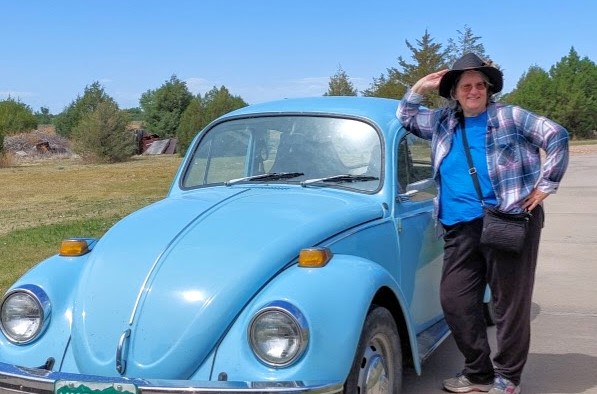
So, until I discover my real name, “Pat” is fine. Besides, to distinguish me from all the other Pats in this town — at least a half dozen of us — people identify me as “Pat in the Hat,” which is kind of cute. And accurate.

***

Pat Bertram is the author of Grief: The Inside Story – A Guide to Surviving the Loss of a Loved One.

Uninventing

Daily writing prompt
If you could un-invent something, what would it be?

I spent a lot of time thinking about this question because it seems as if there should be things in our lives that need uninventing, but I can’t think of any. There are a lot of things that have far reaching ramifications that I don’t like, such as generative artificial intelligence, but since it’s a direct result of computers and the internet, if it was un-invented, it would simply be reinvented.

There are things I don’t like, of course, but I try to stay away from them. It’s easy enough to do, most of the time. Keep the computer off, put the phone on airplane mode (as I do at night since no one is depending on me, and even if there were, there is nothing I could do about it that late anyway), don’t read books published after 2022 unless I’m familiar with the author.

Even though in some form, artificial intelligence has been around since the 1960s, models for the public like ChatGPT weren’t released until late 2022, and it seems as if the writing world has gobbled up the technology. People like that they can write a book in a day! Yay! Well, yay for them, not for me. I read to connect with the author’s view of the world, to find perhaps more depth to my own world. Connecting with artificial intelligence would not be the same thing at all. I’m sure, with time, generative AI will master even the complexity of human thought and emotions, developing novels that have layers to them, but I’m not interested.

Actually, I’m not interested in most authors who were first published in the past ten or fifteen years. There seems to be an underlying nastiness to so many of them, with unreliable characters lying in their own POV about what they did and about other characters, so the reader doesn’t know and can’t guess how appalling the unreliable character is until the end when you find out they were the bad guy all along. Eek. I don’t know if this is the sort of story new writers prefer or if it’s what editors are looking for, but either way, I don’t like being left with a feeling of squalor, as if there’s a thin film of filth on my soul.

But I am getting away from the point of what I would uninvent — nothing. On the other hand, if I could get rid of some policies, that I would gladly do.

***

Pat Bertram is the author of Grief: The Inside Story – A Guide to Surviving the Loss of a Loved One.

Comfortable Clutter

Daily writing prompt
Where can you reduce clutter in your life?

The easiest place for me to reduce clutter in my life right now is to clear up my desk and worktable. Except for my office, where I spend most of my time, I keep surfaces free from clutter. I was always sort of messy, never really having the energy to do a lot of cleaning, but ever since I moved into my own house, I’ve kept everything neat and clutter-free. I like the clean lines — no photos or pictures on the walls, nothing but lamps on the side tables, books in their proper place, kitchen counters bare. I also like that people can drop by without my getting embarrassed by my lack of housekeeping skills.

My cupboards are full of kitchenware and other necessities, but I make sure that whenever I get new items, instead of further cluttering those cabinets, I get rid of an equal number of older items.

I have a lot of boxes of things stored in my garage, but they’re not exactly clutter, at least not according to the definition of clutter as being a disorganized mess — my garage is neatly organized. Still, there are many things, maybe even most things, that I will get rid of, but not yet. Too often in my life, I’ve disposed of various items, particularly materials and tools for a special project, and then later had to buy those items again. There’s a good chance I won’t use most of what I have since my project days seem to be over, but I don’t know for sure, so there the boxes sit. And anyway, the would-be clutter is out of the house so I don’t have to think about or stumble on boxes of stuff. It does help that I got rid of about half of what we owned when Jeff died and I moved in with my father, and another significant portion when my father died and once again, I had to move on. I am clearing the rest out gradually, but at the rate I’m going, I’ll be one hundred and ten by the time everything is gone, but oh, please! Don’t make me live that long!

Mental clutter is pretty much the same, with any possible issues either left in the past, neatly stored away for easy retrieval, or dumped here on this blog.

So am I going to clear up the clutter on my desk? Probably not. Everything I need is right at hand, and if there is too much clutter, well, it’s comfortable clutter, not an embarrassing mess.

***

Pat Bertram is the author of Grief: The Inside Story – A Guide to Surviving the Loss of a Loved One.